An ancient town with a history of settlement that goes back to the Romans, St Albans is these days known not only for its Roman ruins but as the home of Britain’s longest cathedral (and one of the country’s oldest pubs!)
 Settled by the Romans and known then as Verulamium, St Albans was Britain’s second largest Roman settlement after London. Destroyed in the Boadicean rebellion, of 60-61 AD, it was rebuilt but declined after the Romans withdrew in 410 before gradually regaining prominence in the later Saxon and then early medieval ages.
The town, which had been known by the Saxon name Verlamchester after the Romans left, was subsequently named St Albans after the Christian martyr Alban who was believed to be executed by the Romans sometime in the 3rd century for his faith and whose shrine was attracting increasing interest from pilgrims.
The town, which continued to attract pilgrims through the medieval period, subsequently played an important role during the Wars of the Roses – with two battle fought there – but wasn’t directly affected by the later English Civil War. These days, given its location only some 22 miles north of London, it’s easy to reach by car or rail.
As might be expected given it’s prominence during the Roman era, St Albans today boasts a plethora of Roman ruins including the excavated remains of a former theatre on the town’s outskirts (it suggested this could have had seating for as many as 7,000 spectators, most of the town’s then population) as well as what’s left of the Roman wall and an exposed hypocaust and mosaic floor now located in a purpose-built building in the middle of Verulamium Park. On the edge of the park, which covers much of what was the Roman town, there’s also a terrific museum (the Verulamium Museum) with artefacts from the period as well as reconstructed rooms.
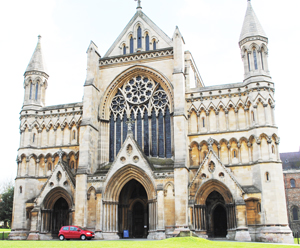
Towering over the town is another reminder of the city’s past – the Cathedral and Abbey Church of St Alban (pictured). Completed in about 1115, it has the longest nave of any cathedral in England and also hosts St Alban’s Shrine – a rare survivor dating from 1308, it still contains some of the martyr’s remains.
The only other piece of the abbey which survives from medieval times is the Great Gatehouse which dates from the 1360s and has served, among other things, as the town gaol. The grounds around the cathedral are these days pleasant parklands -among the graves is that of the former Archbishop of Canterbury (and former Bishop of St Albans), Robert Runcie.
Other medieval survivors in the town are the Clock Tower – built between 1403-1412, it’s one of only two “curfew towers” left in the country (you can now climb it for a great view of the surrounding area), and Ye Olde Fighting Cocks, believed by some to be England’s oldest surviving pub. Not far from here is Sopwell Nunnery, actually the remains of a Tudor mansion built in around 1560 by Sir Richard Lee on the site of what was a nunnery.
The town’s history is also on show in the Museum of St Albans which stands in Hatfield Road opposite the Marlborough Almshouses, built as a gift from Sarah, the 1st Duchess of Marlborough.
The tourist information centre, housed in the Georgian-era Town Hall, has a mini visitor guide which provides a walk through the town, taking in many of its historic sites – perfect if you’ve only got a day to spend there!
 Exploring London