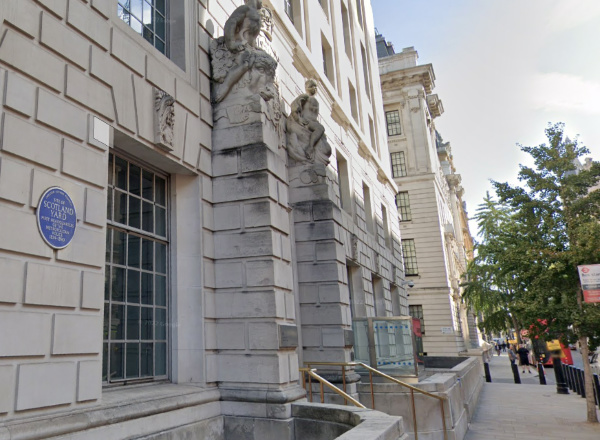
OK, so there’s not much left to see here – at least not from Wren’s time. But it was in Scotland Yard that Wren spent much of his time after being appointed Surveyor-General of the King’s Works.
The yard, which was located just north of the kitchens serving the Palace of Whitehall and to the south of aristocratic mansions built along the Strand, was the location of the Office of Works. It served as a workplace for Wren and was also the location of his main residence between 1669 and 1718 when he lived in a house built by his predecessor in the office, John Denham.
According to a recent lecture by Professor Simon Thurley at Gresham College, newly identified plans of the house show the ground floor contained a hall, with a kitchen and scullery to the rear while on the first floor was a great dining room, a smaller private dining room, bedroom and dressing room. A floor above contains quarters for servants and possibly the nursery for his children. There were cellars below, two yards and a long narrow walled garden (he also had a stable nearby for his horses and carriage). Most importantly, a door connected the house directly with the Office of Works next door.
Said Thurley: “Although slightly further [from] the royal lodgings than some apartments, Wren’s house was amongst the largest and best appointed of all the houses allocated to senior courtiers.”
Wren lived here with his two wives – his first wife Faith Coghill died of smallpox here in 1675 and his second wife Jane Fitzwilliam died of tuberculosis in 1680 as well as their children – Christopher, William and Elizabeth. Both William and Elizabeth never left their father’s care and died before him.
The origins of the name of Scotland Yard – which has since become synonymous with the Metropolitan Police (now based at New Scotland Yard) – apparently come from the fact the site contained lodgings where the Kings of Scotland stayed when visiting London (the last Scottish royal to stay here did so before Wren’s time, apparently in the reign of King Henry VIII).
From the Stuart period onward, the site was used for government offices – as well as Wren, other famous residents included Inigo Jones, one of Wren’s predecessors as Surveyor of Works, and, during the Commonwealth, John Milton, while serving as Latin Secretary to Oliver Cromwell.
The location of Scotland Yard is these days commemorated in the name of Great Scotland Street and Scotland Place, just off Whitehall. There’s also an English Heritage Blue Plaque marking the site in Whitehall Place, although Wren doesn’t get a mention on that (it’s entirely devoted to the former police presence).
 Exploring London
2 thoughts on “10 London locations related to Sir Christopher Wren…3. Scotland Yard…”