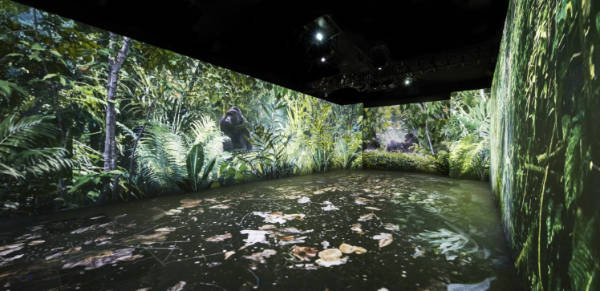
• Our Story with David Attenborough – the first ever immersive experience at the Natural History Museum – opens its doors today. Created by Open Planet Studios, the 50 minute experience in the Jerwood Gallery features animations, projections, real-world footage and full 360 degree immersion as Sir David draws on his life of exploration to tell the story of humanity and the planet on which we live. The experience is taking bookings until 18th January, 2026. Admission charge applies. For more, see www.nhm.ac.uk/visit/exhibitions/our-story-with-david-attenborough.
• The Royal Academy’s 257th Summer Exhibition opened this week. Co-ordinated by internationally acclaimed architect and Royal Academician Farshid Moussavi in conjunction with the Summer Exhibition Committee, this year’s display of art and architecture explores the theme of ‘Dialogues’. Among the works on show is a six metre high installation of ostrich feathers and steel chain by British artist Alice Channer, a 4.5 metre high and seven metre wide wall made from deconstructed matchboxes by Brazilian artist Antonio Tarsis, and installation of textile carcasses by Argentine-American artist Tamara Kostianovsky. Meanwhile, the Annenberg Courtyard hosts a large scale installation by Royal Academician Ryan Gander which features five three metre diameter inflatable balls inscribed with absurd questions developed with children in a representation of the “inquisitiveness of children who ask what grown-up minds often dismiss as nonsensical or illogical”. Runs until 17th August. Admission charge applies. For more, see royalacademy.org.uk.
• The London Transport Museum has launched an appeal for £30,000 to help complete the restoration of three 1930s Q stock Underground carriages. The funds will be used to re-upholster the seats of two of the Underground cars in moquette – the durable, woollen seating material used in upholstery on public transport all over the world. Q stock trains first entered service on the District line in November, 1938, and were retired from service in 1971. The restoration of the three carriages – which aims to restore them to operational condition – has mainly been carried out at the London Transport Museum Depot in Acton, west London. Donations can be made on London Transport Museum’s website: www.ltmuseum.co.uk/make-donation?campaign=qstock
Send all items for inclusion to exploringlondon@gmail.com.
 Exploring London