• More than 100 works of art showing the changing attitudes towards the military in the 19th century opens at the National Army Museum in Chelsea next Tuesday. Myth and Reality: Military Art in the Age of Queen Victoria – the first dedicated art exhibition at the museum in more than five years – centres on four themes – ‘The Female Perspective’, ‘The Great Campaigns’, ‘Patriotism and Portraiture’, and ‘Realism and Reportage’. Highlights include a collection of 25 works by Elizabeth Thompson, Lady Butler, who rocketed to fame in the 19th century for her depictions of Waterloo and Crimea. Other works in the show include Thomas Barker Jones’ The Capitulation of Kars, Crimean War, 28 November 1855, works by war artists such as Joseph Arthur Crowe – a journalist at The Times‘, consular official and art historian, and portraits of Victoria Cross winners. Runs until 1st November. Admission charge applies. For more, see www.nam.ac.uk.
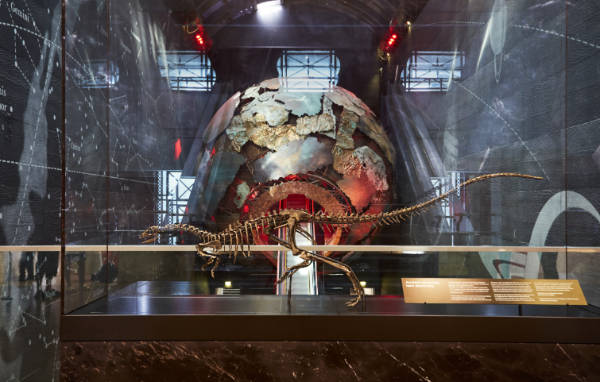
• A new species of dinosaur, Enigmacursor mollyborthwickae, a two-legged herbivore from the famous Morrison Formation in the US, goes on show at the Natural History Museum from today. Standing half a metre tall and a little over a metre long, the Enigmacursor mollyborthwickae, would have been found on the floodplains of the western United States in the Late Jurassic period (145-150 million years ago), darting around underneath giants like Diplodocus and Stegosaurus (like Sophie, who also resides in the Museum’s Earth Hall). Unearthed in 2021/2022 from a commercial quarry, Enigmacursor was acquired from the gallery David Aaron Ltd thanks to the support of David and Molly Lowell Borthwick. It was initially thought to be a Nanosaurus – a poorly-known species of small herbivorous dinosaur first named in the 1870s – but on closer inspection it was found to be a new genus and species. Enigmacursor mollyborthwickae is on permanent public display on the first-floor mezzanine in Earth Hall. For more see www.nhm.ac.uk.
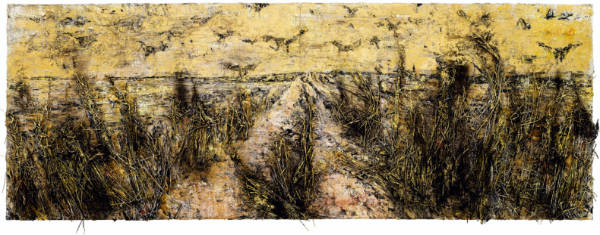
• The influence of Vincent van Gogh on the work of artist Anselm Kiefer is the subject of a new display at the Royal Academy of Arts. Kiefer/ Van Gogh, held in the The Gabrielle Jungels-Winkler Galleries, brings together works by both artists for the first time in the UK and features paintings and drawings by Van Gogh from the collection of the Van Gogh Museum, Amsterdam, as well as paintings, drawings and sculptures by Kiefer including some works that have never been shown before. Among highlights are a selection of Kiefer’s celebrated large-scale landscapes such as The Crows (Die Krähen) (2019) as well as Van Gogh’s Snow-Covered Field with a Harrow (after Millet) (1890) and Field of Irises near Arles (1888) and drawings Kiefer made as a youth inspired by van Gogh which are being shown alongside several of van Gogh’s own drawings, including La Crau Seen from Montmajour (1888). There’s also Kiefer’s 2014 work Walther von der Vogelweide: under der Linden an der Heide (Walther von der Vogelweide: under the Lime tree on the Heather) and a new sculpture created for the exhibition which depicts a tall sunflower emerging from a large pile of books, shedding golden seeds onto their lead pages (shown in dialogue with Van Gogh’s Piles of French Novels (1887). Opens on Saturday, 28th June, and runs until 26th October. Admission charge applies. For more, see royalacademy.org.uk.
Send all items for inclusion to exploringlondon@gmail.com.
 Exploring London