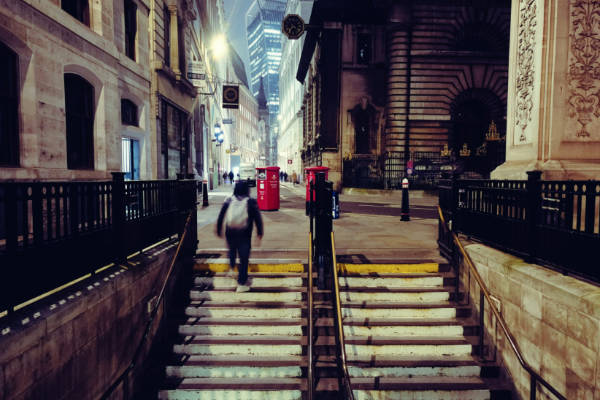
Outside St Paul’s Cathedral.

Outside St Paul’s Cathedral.
Known to many as the eastern end of the District Line, Upminster is located some 16.5 miles to the north-east of Charing Cross and is part of the London Borough of Havering.
Historically a rural village in the county of Essex, its name comes from Old English and means a large church or “minster” located on high ground.

The church is said to have dated at least as far back as the 7th century and to have been one of a number founded by St Cedd, a missionary monk of Lindisfarne, in the area. It was located on the site occupied by the current church of St Laurence (parts of which date back to the 1200).
The nearby bridge over the River Ingrebourne shares the name Upminister and is known to have been in existence since the early 14th century.
Once wooded, the area was taken over for farming (cultivation dates as far back as Roman times) and by the 19th century it came to be known for market gardens as well as for some industry including windmills and a brickworks.
Development was initially centred around the minister and nearby villages of Hacton and Corbets Tey. It received a boost in the 17th century when wealthy London merchants purchased estates in the area.
Improved transportation links also helped in later centuries including the arrival of the London, Tilbury and Southend Railway in 1885 – it was extended from Barking – and the underground in 1902 via the Whitechapel and Bow Railway.
Landmarks include the Church of St Laurence, the redbrick Clock House (dating from about 1775), the 16th century house Great Tomkyns, the Grade II*-listed Upminster Windmill, built in 1803 and considered one of England’s best surviving smock mills, and the 15th century tithe barn (once owned by the monks of Waltham Abbey and now a museum).

Upminster Hall, which dates back to the 15th and 16th century (and, once the hunting seat of the abbots of Waltham Abbey, was gifted by King Henry VIII to Thomas Cromwell after the Dissolution), is now the clubhouse of the Upminister Golf Club.
Hornchurch Stadium, the home ground of AFC Hornchurch, is located in the west of the area.
It was in Upminster that local rector Rev William Derham first accurately calculated the speed of sound, employing a telescope from the tower of the Church of St Laurence to observe the flash of a distant shotgun as it was fired and then measuring the time before he heard the gunshot using a half second pendulum.
Known through its many surviving copies, the Whitehall Mural was a dynastic portrait understood to have been created to decorate a privy chamber of King Henry VIII at the Palace of Whitehall.

The mural, which was the work of Hans Holbein the Younger, featured four figures standing around a central plinth. They include King Henry VIII and his wife Jane Seymour at the front with the King’s parents King Henry VII and Queen Elizabeth of York at the back.
It is believed the portrait, commissioned during the King’s brief marriage to Jane Seymour (between 30th May 1536 and 24th October 1537), may have been created to celebrate the birth of Prince Edward (later King Edward VI) in 1537 and may have been commissioned before or after the prince’s birth.
The iconic image of the bearded King Henry VIII – which was created for the purposes of propaganda – shows him as something of an idealised powerful monarch with feet firmly planted apart and his arms out with a dagger hanging at his waist.
The mural was lost when a fire consumed much of the palace on 4th January, 1698. But copies – both of the mural as a whole and of the individual figure of King Henry VIII – survive including one by Flemish artist Remigius van Leemput commissioned by King Charles II the year before the fire.
There’s also a full-sized cartoon (pictured) showing the left-hand section of the mural which was created by Holbein in preparing to create the mural. Depicting King Henry VIII – his head turned in a slightly different aspect to the final version – and King Henry VII, it would been used to mark out the mural on the wall where it stood.

• The disappearance of a jewelled Ottoman dagger which is believed to have once belonged to King Henry VIII has inspired a new exhibition at Strawberry Hill House, Horace Walpole’s former home in Twickenham in London’s west. Henry VIII’s Lost Dagger: From the Tudor Court to the Victorian Stage looks at the history of the 16th century dagger which, said to have been richly decorated with “a profusion of rubies and diamonds”, was once part of Horace Walpole’s collection. When the collection was sold in 1842, the dagger passed into ownership of the Shakespearean actor Charles John Kean who directed private theatricals for Queen Victoria at Windsor Castle. Kean (1811-1868) pioneered what critics dubbed “living museums” on the Victorian stage by using real artifacts, including the dagger, during performances. But after Kean’s death the dagger vanished without a trace. Dr Silvia Davoli, the principal curator at Strawberry Hill House, launched an investigation to find the dagger and instead found six almost identical daggers scattered around the globe. Two of these daggers – known as the Vienna and Welbeck Abbey examples – are featured in the exhibition alongside reproductions of 18th century materials which related to Walpole’s lost dagger from Yale University’s Lewis Walpole Library. The exhibition can be seen from Saturday until 16th February. Admission charge applies. For more, see www.strawberryhillhouse.org.uk.
• The role maps have played in preserving secrets for the benefit of their creators from the 14th century to the present day is the subject of a new exhibition at the British Library. Secret Maps features more than 100 items ranging from hand-drawn naval charts given to Henry VIII to maps of cable networks used to intercept messages between the world wars; and the satellite tracking technology used by apps today. Among highlights are a map from 1596 attributed to Sir Walter Raleigh on an expedition in search of the mythical city of El Dorado in what is now Guyana in South America; a map produced in 1946 of British India (modern-day India, Pakistan and Bangladesh) with a ‘top secret’ report investigating the potential economic and military impact of partition for the proposed state of Pakistan; one of only two known existing copies of a secret map produced by Ordnance Survey during the General Strike of 1926 amid fears of a public uprising; and a 1927 Cable Map of the world which reveals a global network of censorship stations and was used by the British government to intercept messages sent via submarine and overland cables. Runs until 18th January (and accompanied by a programme of events). Admission charge applies. For more, see https://events.bl.uk/exhibitions/secretmaps.
• Staffordshire-based artist Peter Walker’s large scale interactive artworks, Connection and Identity, can be seen in the Painted Hall at the Old Royal Naval College in Greenwich from Friday. Identity features eight columns suspended within the hall which shift in colour and light while Connection showcases “a dramatic and modern reinterpretation of Michelangelo’s Creation of Adam“. The installation, which is located in the hall sometimes described as “Britain’s Sistine Chapel”, is accompanied by music specially composed by David Harper. Runs until 25th January. Admission charge applies. For more, see https://ornc.org/whats-on/connection-and-identity/.
Send all items for inclusion to exploringlondon@gmail.com.
Before we move on to our next Wednesday series, here’s a recap…
London has several police forces so let’s explain.
The largest police force in London (and the UK as a whole) is the Metropolitan Police. They are responsible for policing the Greater London area and its 8.6 million residents (with some exceptions – more on that in a moment).
The Met, currently led by Commissioner Sir Mark Rowley, was founded by Sir Robert Peel in 1829 and across the almost 200 years since has grown to a service of more than 33,000 police officers, 11,000 staff, almost 1500 police community support officers and more than 1,100 special officers.
They are headquartered at New Scotland Yard on Victoria Embankment in Westminster.
The Met’s jurisdiction comprises some 620 square miles – the 32 boroughs of Greater London.
An exception within Greater London is within the Square Mile of the City of London, home to some 8,000 residents but host to an additional 500,000 workers, tourists and others each day. This falls under the jurisdiction of the much smaller City of London Police.
The London City Police officially formed in 1832 but became the City of London Police with the passing of the City of London Police Act 1839.
Led by Commissioner Peter O’Doherty, the 17th City of London police commissioner, the service consists of more than 1,000 officers and staff and as well as providing policing services locally, the City of London Police also leads policing efforts nationally on fraud and cyber-crime.
They are currently temporarily headquartered at Guildhall.
A number of other police services also operate in London. They include the British Transport Police, responsible for policing the railway network including track and stations as well as the London Underground and Docklands Light Railway.
The Ministry of Defence Police, meanwhile, are responsible for policing Ministry of Defence property in London including the ministry itself in Whitehall while the tiny Kew Constabulary is responsible for policing Kew Gardens (the former Royal Parks Constabulary merged with the Met in 2004 – the parks are now policed through a specialist unit in the Met).

• Artist JMW Turner’s only royal commission has returned to public display in Greenwich to mark the 250th anniversary of the artist’s birth. The more than three metre-wide painting (Turner’s largest completed work), The Battle of Trafalgar, went on display on Tuesday – 220 years to the day since the battle it depicts – at the Queen’s House. The 1824 painting, which was commissioned by King George IV, commemorates the victory of the British Royal Navy over a combined French and Spanish fleet off Cape Trafalgar on 21st October, 1805. First displayed at St James’s Palace, it was transferred to the Naval Gallery at Greenwich Hospital in 1829. It was removed from public display in March last year to protect it during a works project at the National Maritime Museum and has now found a new home at the Queen’s House. Admission is free. For more, see www.rmg.co.uk/queens-house.
• The ghosts of King Henry VIII and Oliver Cromwell are among those which can be encountered at Hampton Court Palace from Friday as it marks Halloween. Immersive Halloween-inspired installations with unearth the stories of some of the palace’s former residents while outside there’s a Haunted Garden complete with skeletal horse and carriage. Halloween season at the palace runs until 2nd November and is included in general admission. For more, see www.hrp.org.uk/hampton-court-palace/whats-on/halloween-at-hampton-court-palace/.
• Diwali, the annual Hindu celebration, comes to the National Maritime Museum in Greenwich this Saturday with the ‘Illuminate’ festival. The free festival, which runs from 11am to 5pm and is curated by Mehala Ford – founder of South Asian art collective COMMONGROUND&, includes performances, creative workshops including traditional Rangoli art and Henna art, storytelling sessions including a puppet show telling the epic story of Ramayana, and a lantern parade around Greenwich Park. There ares also talks and Diwali-inspired food. For more, see www.rmg.co.uk/whats-on/national-maritime-museum/diwali.
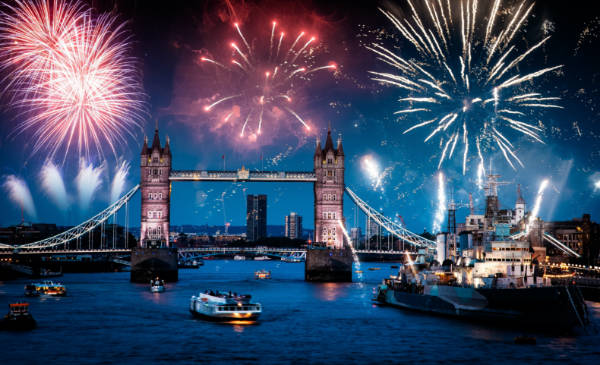
• Tickets to London’s New Year’s Eve celebrations have gone on sale. The 12 minute show celebrating the new year will kicks off with the familiar sounds of Big Ben’s chimes, before thousands of fireworks and hundreds of lights help to illuminate the night sky around the London Eye all set to a wide-ranging soundtrack. Around 100,000 Londoners and visitors are expected to attend. Ticket prices are between £20 and £35 for Londoners and £40 and £55 for visitors. For more, see www.london.gov.uk/nye.
Send all items for inclusion to exploringlondon@gmail.com
Hanwell Zoo in London’s west is, like Golder’s Hill Zoo, one of the city’s smaller zoos.

Described as an “immersive work honouring the reciprocal relationship between the Sámi people, the reindeer, and the land”, the Goavve-Geabbil is a monumental new sculptural installation by Sámi artist Máret Ánne Sara and has been made using materials which sustain her community in Sápmi, the territory of the Indigenous Sámi people which spans the countries of Norway, Sweden, Finland and Russia.
In this, Sara’s first major work in the UK, the artist draws on her experience as member of a reindeer herding family to highlight ecological issues impacting Sámi life and has combined hides and bones derived from traditional reindeer herding practices along with wood, industrial materials, sound and scent.
The Hyundai Commission: Máret Ánne Sara: Goavve-Geabbil can be seen in the Turbine Hall at the Bankside institution until 6th April. Admission is free. For more, see tate.org.uk/visit/tate-modern.


Terroni of Clerkenwell, which opened in 1878, is said to be London’s oldest Italian deli.
Located in the district known as Little Italy next to St Peter’s Italian Church, Terroni was opened by Luigi Terroni to supply Italians living in London with a taste of home.
The business at 138-140 Clerkenwell Road in Clerkenwell was sold to the Anessa family in 1983. It underwent renovation in the early Noughties which saw the deli double in size. A coffee bar was added in 2012.
For more, see https://terroni.co.uk/.

Located in the Hyde Park Rose Garden in the south-east corner of Hyde Park, the Huntress Fountain dates from 1906.
It is topped with a bronze statue depicting Diana, the Roman goddess of hunting (known as Artemis to the Greeks), naked and in the process of shooting an arrow.
The statue, which was once known as the Diana Fountain, is the work of Countess Feodora Gleichen. She was posthumously named one of the first female members of the Royal Society of Sculptors in 1922.
It is said to have been originally made for Sir Walter Palmer’s pile, Frognal, at Ascot in 1899 but was instead donated the park by Sir Walter and Lady Palmer.

• An exhibition of entries into the annual Wildlife Photographer of the Year competition opens tomorrow at the National History Museum in South Kensington. The exhibition features 100 images selected from a record-breaking 60,636 entries and follows from this week’s announcement of the winners at a ceremony held at the museum earlier this week. The display includes the winning image – ‘Ghost Town Visitor’ which, captured by South African wildlife photographer Wim van den Heever depicts a brown hyena near the ruins of a long-abandoned diamond mining town in Kolmanskop, Namibia – as well as the winner of the Young Wildlife Photographer of the Year 2025 – 17-year-old Italian Andrea Dominizi’s After the Destruction which spotlights a longhorn beetle in the Lepini Mountains of central Italy, an area once logged for old beech trees, with a background of abandoned machinery. Other images on show include the winner of the Impact Award – Brazilian photographer, Fernando Faciole’s Orphan of the Road depicting an orphaned giant anteater pup following its caregiver after an evening feed at a rehabilitation centre – as well as category winners. The exhibition can be seen until 12th July next year. Admission charge applies. For more, head here.
• Three 20th century conflicts which broke out in Malaya, Kenya and Cyprus after World War II are the subject of a new exhibition at the Imperial War Museum in Lambeth. Emergency Exits: The Fight for Independence in Malaya, Kenya and Cyprus looks at how these three conflicts, known as “emergencies” to the British Government, shaped and continues to shape Britain, its former territories and the wider world today. The display includes more than 70 objects such as propaganda posters, flags and artworks as well as oral histories and personal belongings which belonged to those impacted by them. As well as telling the stories of the three conflicts, Emergency Exits also explores Operation Legacy, the British Government’s attempt to prevent publication of sensitive documents related to the conflicts which included evidence of human rights abuses. The free exhibition, which opens on Friday, runs until 26th March. For more, see iwm.org.uk/events/emergency-exits-the-fight-for-independence-in-malaya-kenya-and-cyprus.
• The first major solo exhibition focusing on the work of pioneering Black British photographer Jennie Baptiste opens in the Terrace Rooms at Somerset House on Friday. Jennie Baptiste: Rhythm & Roots, which is a highlights of Somerset House’s 25th birthday programme, charts how Baptiste used her lens to capture youth culture, music, fashion, and urban life within the Black British diaspora in London in the past few decades. The exhibition can be entered under a “pay what you can” model. Runs until 4th January. For more, see www.somersethouse.org.uk/whats-on/jennie-baptiste-rhythm-and-roots.

• On Now: Nigerian Modernism. The Tate Modern is hosting the first UK exhibition to trace the development of modern art in Nigeria with more than 250 works by more than 50 artists on display. The exhibition, which spans the period from the 1940s to today, features works by globally celebrated artists of the 1940s, Ben Enwonwu and Ladi Kwali, as well as works by The Zaria Arts Society members Uche Okeke, Demas Nwoko, Yusuf Grillo, Bruce Onobrakpeya, and Jimo Akolo, Nsukka Art School members including Obiora Udechukwu, Tayo Adenaike and Ndidi Dike, and concludes with a spotlight on the work of Uzo Egonu. The display can be seen until 10th May. Admission charge applies. For more, see www.tate.org.uk/whats-on/tate-modern/nigerian-modernism.
Send all items for inclusion to exploringlondon@gmail.com.
This 211 hectare site in east London, managed by Thames Water, is one of the largest urban wetland in Europe.

Exploring London spoke to Dr Louise Devoy about her role at the observatory, her new book, Royal Observatory Greenwich: A History in Objects, and her “must-see” for those visiting the observatory…

How long have you worked as senior curator at the Royal Observatory Greenwich and what was your pathway into the job?
“I’ve been working here for 12 years now and it’s been quite a journey! I originally studied physics with astrophysics at the University of Leicester and intended to continue with scientific research but my ideas changed after an inspirational internship working at a museum in the US. I really enjoyed learning about the history of astronomy – how our ideas have changed over time and the incredible stories of the people who were involved – and I continued my studies in the history of science. I’ve since worked at the Science Museum and British Museum and came here in 2013.”
Have you always been interested in astronomy?
“Yes, I have vivid memories of building a space rocket in primary school from cereal packets and yogurt pots that quite literally fired my imagination! I’ve still got The Night Sky Ladybird book that I bought and later in my teens my parents kindly bought me a telescope so I could learn more about practical astronomy. I don’t have much time for stargazing these days but I’ve recently purchased a compact smart telescope that you can put in your hand luggage and I’m looking forward to taking it on my travels.”
What does your job at the Royal Observatory entail?
“My job consists of two main parts; one based on research and one focused on communication. As a curator, I’m responsible for doing research on our collections, identifying objects for display and collaborating with researchers from other museums and observatories. Once I’ve done the detective work, I like to share these ideas and stories with our visitors through displays, talks and writing books and articles.”
What’s your favourite part of the day at the Observatory?
“For me, I enjoy seeing the sunset as I’m leaving the office, especially as the lights start to come on across London and you get a great view of the city from our hilltop location. It also makes me smile that sunset means going home for me, whereas for Greenwich astronomers in the past, it would have been the start of their working ‘day’!”
What prompted the writing of the book?
“It’s difficult to say but I definitely remember working on this during lockdown in 2020 and being inspired by similar books such as Neil MacGregor’s A History of the World in 100 Objects. Most books about the history of the Royal Observatory focus on the story of longitude, John Harrison’s marine timekeepers and Greenwich Mean Time (GMT) but I wanted to show how the Observatory has a much broader, richer history that encompasses many more people, subjects, stories and objects.
How did you decide which objects to feature in the book?
“I knew that we would be celebrating our 350th anniversary in 2025 and so I decided to choose objects that spanned the full chronology from 1675. I also wanted to expand the scope beyond the well-known clocks and telescopes to include books, paintings, manuscripts, watercolours, and even items of clothing previously worn by the Astronomer Royal and his family. In addition, I selected a few mystery objects to give me a good excuse to dig into the archives and piece together their stories.”
Do you have a favourite among them?
“I really like the story of the hole punch from the 1840s because it’s indicative of the paperwork and number-crunching that is an important but often overlooked aspect of astronomy. Once astronomers have done their observations, they have to apply mathematical corrections (‘reductions’) to account for atmospheric effects that might affect the results. It’s very tedious, repetitive work that was traditionally done by teenage boys known as ‘computers’. The seventh Astronomer Royal, George Biddell Airy (1801–1892) tried to make the process more efficient and less prone to errors by creating a template known as a ‘skeleton form’. The system worked well but generated vast amounts of paper, leading Airy to design a hole punch to organise the work. He was so proud of his idea that he encouraged other observatories to do the same and that’s why you’ll find another example of this hole punch over 8,000 miles away at the South African Astronomical Observatory in Cape Town. Airy invented his hole punch several decades before the standard office hole punch was patented, making our gadget one of the oldest in the world!”
What did you learn during the process of writing the book that you didn’t already know about the history of the Royal Observatory?
“The story of the secret binocular testing during the First World War really surprised me. The Observatory had already been involved in testing chronometers – portable, accurate timekeepers for navigation at sea – since the 1820s but the binocular testing was a new task. For security reasons, it was not mentioned in the Observatory’s Annual Reports and remained an unknown story for decades. I was intrigued by a one-line mention to it in the archives and dug a little further to uncover the full facts.”
• The first exhibition to exclusively explore Cecil Beaton’s pioneering work in fashion photography opens today at the National Portrait Gallery. Cecil Beaton’s Fashionable World features portraits of some of the 20th century’s most iconic figures including celebrities, Marilyn Monroe, Audrey Hepburn, Elizabeth Taylor and Marlon Brando as well as royalty including Queen Elizabeth II and Princess Margaret and artists such as Lucian Freud, Francis Bacon and Salvador Dali. Curated by Vogue contributing editor Robin Muir, the display charts his meteoric rise and legacy and celebrates his signature artistic style which married “Edwardian stage glamour with the elegance of a new age”. As well as photographs, the 250 items displayed include letters, sketches, and costumes – the latter including the costumes and sets he created for the musical My Fair Lady, performed on stage, and then later on screen. The exhibition runs until 11th January. Admission charge applies. For more, see www.npg.org.uk/whatson/exhibitions/2025/cecil-beaton/.
• Diwali on the Square – London’s annual celebration of the Festival of Lights – takes place in Trafalgar Square this Sunday. The free, family event runs from 2pm to 8pm and will feature 200 dancers from Hindu, Sikh and Jain communities performing a mix of modern and classical dance. There will also be diya lighting, a retelling of the Diwali story by Aaya Anand Chaaya Anand, Bollywood Bhangra, and activities such as turban tying, yoga and meditation, henna decorations, puppet shows and dance workshops. Vegan and vegetarian food will be available at market stalls serving traditional and fusion cuisine. For more, head to www.london.gov.uk/events/diwali-square-2025.
• Piano legend and TV personality Winifred Atwell has been honoured with an English Heritage Blue Plaque at her former Mayfair home. Atwell, the first black artist to achieve a UK number one single, with the medley Let’s Have Another Party in 1954, lived at the home at 18 Bourdon Street with her husband and manager Lew Levisohn during the 1950s and the 1960s. It was in this property that she kept her famous Steinway concert grand piano and a deliberately out-of-tune upright piano that become a signature in her honky-tonk performances. For more, see www.english-heritage.org.uk/visit/blue-plaques/

• The works of artists such as Edvard Munch and Mamma Andersson are at the centre of a new exhibition at the British Museum showcasing Nordic works of art on paper. Nordic noir: works on paper from Edvard Munch to Mamma Andersson is the culmination of a five year programme to build the museum’s collection of post-war Nordic art and among the highlights on show are two of Munch’s woodcut prints. Other artists featured in the exhibition include Olafur Eliasson, John Savio, Vanessa Baird, Yuichiro Sato, Fatima Moallim, and John Kørner. Key themes explored in the exhibition include nature and the need to preserve the natural world, the worlds of Norse myth, inner struggles with mental health, post-war angst, the threat of the Cold War, feminism and the rights of the Indigenous Sami people. Runs until 22nd March. Admission to display in Room 90 is free. For more, see www.britishmuseum.org/exhibitions/nordic-noir-works-paper-edvard-munch-mamma-andersson.
Send all items to exploringlondon@gmail.com.
This 6,000 acre woodland and pasture habitat, located on the north-eastern outskirts of London, is famous for its ancient and veteran trees – numbering almost 55,000 – but is also home to a range of wildlife.

This Borough pub’s name comes from 19th century Field Marshall Colin Campbell Clyde (Lord Clyde).

Clyde (1792-1863) was a Scottish carpenter’s son who joined the military at age 16 and fought in many campaigns during the first half of the 19th century including the Peninsular War of 1808-1814, the War of 1812 in the United States, the First Opium War in China in 1842, and in India during the Second Anglo-Sikh War in 1848-49.
During the Crimean War, Clyde led the Highland Brigade at the Battle of the Alma and repulsed the Russian attack on Balaclava. He become Commander-in-Chief, India, during the Indian Mutiny in 1857 and relieved the siege of Lucknow in India the same year.
Clyde was raised to the peerage in 1858. Her died in Chatham on 14th August, 1863, and was buried in Westminster Abbey.
A pub was first erected on the site at 27 Clennam Street (on the corner with Ayers Street) at the time of his death in 1863 by brewers in East London (originally known as the Black Eagle Brewery, the name Truman, Hanbury, Buxton & Co – which appears on the pub’s exterior – was being used for the brewery by 1889).
It was rebuilt in 1913 – the present frontage dates from that period – and is now Grade II-listed thanks to its architecture, which exemplifies the development of the ‘house style’ in pub architecture of the early 20th century.
The signage on the pub depicts Lord Clyde wearing the insignia of the Knight Commander of the Bath, an honour he was awarded in 1849 for his services in the Sikh War. There is a statue of him in Waterloo Place in London.
For more, head to https://www.facebook.com/lordclydeborough/.