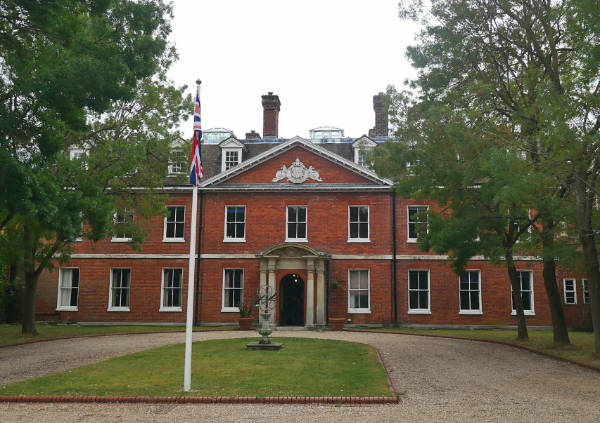
This building, which dates from 1775, is the former palace of the Bishops of Rochester and the latest incarnation of the palace which the bishops used for centuries.
The land, which came to be known as the Manor of Bromley, was initially granted to the bishops of Rochester by Saxon kings of Kent over a couple of centuries. Following the Norman Conquest, an attempt by Odo, the Earl of Kent, to claim it failed thanks to the efforts of Bishop Gundulf (1075-1108) and the Archbishop of Canterbury, Lanfranc.
Subscribe for just £3 a month to access all of Exploring London’s articles…
Located in Bromley Palace Park – once the home of the Bishops of Rochester and now the grounds of the Bromley Civic Centre – is what appears to be the remains of a medieval church or building.
But the “ruins” actually only date from the Victorian era and were created as a folly for the first private owner of the house.
The ruins, which are Grade II-listed, consists of a brick turret which features a rounded arched window in the Norman style with some raised zig-zag decoration above it and an arched arrow squint. The arch rests upon what is believed to actually be early medieval capitals with a late 12th century column on the left.
The folly, located at the south-western corner of the bishop’s palace grounds, was created in about 1865 on the orders of merchant Coles Child, who bought the house in 1845, and may have been created, along with other garden features, by the company of James Pulham.
Tradition says it was constructed from medieval remnants found in the moat of the bishop’s palace.
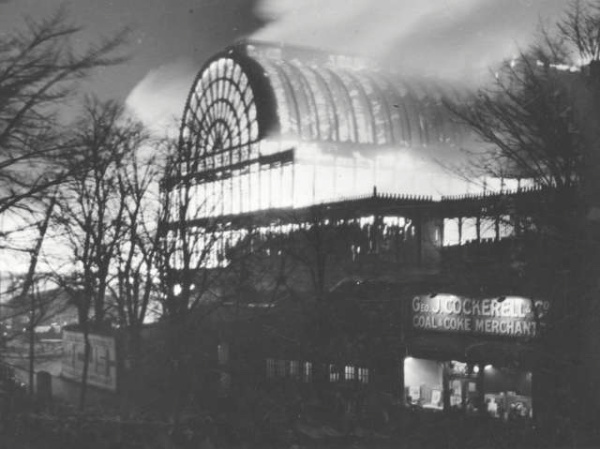
The Crystal Palace fire in 1936. PICTURE: Unknown author (via Wikipedia)
This month marks 85 years since the Crystal Palace in London’s south was destroyed in a fire.
The Joseph Paxton-designed building had originally been located in what is now Hyde Park for the Great Exhibition of 1851 and, following the end of the exhibition, had been dismantled and relocated to Sydenham.
When the fire in broke out on the night of 30th November, 1936, two night watchmen tried to put it out. Sir Henry Buckland, the building’s general manager, was out walking his dog with his daughter Crystal (named, apparently after the building) when he spotted the flames and called the fire brigade.
They arrived at about 8pm but the fire, fanned by a wind, was soon out of control and so further aid as summoned with hundreds of firefighters and some 88 engines attending the scene. It has been said the blaze could be seen across eight counties.
A crowd of spectators – said to number as high as 100,000 – arrived to watch what was apparently a rather spectacular sight (special trains were apparently put on to transport people from towns in Kent and private airplanes were spotted overhead). Police, some on horseback, did their best to keep the crowds away but had limited success given the numbers who turned out (Winston Churchill, among those watching the building burn, is said to have remarked: “This is the end of an age” while Sir Henry told reporters later that the palace would “live in the memories not only of Englishmen, but the whole world”).
By morning, the building was reduced to bits of twisted metal and ash but thankfully no lives were lost in the conflagration. The cause, however, remained a mystery – there was speculation it had been started by a stray cigarette butt or had been deliberately lit by a disgruntled worker. Television pioneer John Logie Baird, who had a workshop in the building, believed it could have been started by a leaking gas cylinder in his workshop.
Two water towers, located at either end of the building, survived the blaze but were later demolished. Among the few remains of the building which did survive the blaze is the subway located under Crystal Palace Parade. The park which surrounded the building remains home to the famous ‘Crystal Palace dinosaurs’.

 Exploring London