Around London – Chiswick House furnishings; Miniature German Bibles; free buses to Isabella Plantation; and, marking the 50th anniversary of the Profumo Affair…

A collection of furniture originally belonging to the 5th Duke of Devonshire and his wife, Georgiana, the Duchess of Devonshire, has been returned to the Palladian masterpiece, Chiswick House, in west London. The furniture – which includes four French fauteuils (open arm chairs) by the leading Parisian chair maker Jean-Baptiste Tilliard, four neo-classical chairs with caned backs and seats and a ladies’ roll-top writing desk – was purchased by English Heritage at an auction in 2010 with the assistance of Art Fund. It had been removed from the house to the family estate in the late 1800s. Extensive conservation work on the furnishings was carried out thanks to the support of The Art Fund, Chiswick House Friends and The Pilgrim Trust prior to their being restored to the house. They are now displayed in the bedchamber while a mahogany pole-screen – designed in about 1730 by William Kent, protégé and collaborator of the house’s first owner and architect, Richard Boyle, 3rd Earl of Burlington – has also been acquired and will be displayed in Lord Burlington’s Blue Velvet Room. Admission charge applies. For more information, see  www.english-heritage.org.uk/daysout/properties/chiswick-house/ or www.chgt.org.uk.

German miniature picture Bibles are the subject of a new exhibition at The Courtauld Gallery. The third display in the gallery’s Illuminating Objects programme, the display centres on Bibles created by two sisters who belonged to a family of printmakers, Johanna Christina (Or Christiana) and Maria Magdalena Kusel, in Augsburg in the late 17th century. While many of the 17th century ‘thumb’ Bibles were created for children, the Kusel sisters most likely made theirs for private devotion. It is believed this is the first time the two Bibles have gone on public display. Visitors to the Courtauld website are also able to turn the Bible’s pages. Runs until 22nd July. For more, see www.courtauld.ac.uk/gallery/exhibitions/2013/illuminating/bible.

Royal Parks are offering free travel to the newly improved Isabella Plantation – a 40 acre ornamental woodland garden in Richmond Park – this Sunday. The minibus service, which will travel from the traffic lights on Ham Common to the plantation, will be running between 10am and 4pm. The plantation, which features azaleas, rhododendrons, camellias, magnolias, daffodils and bluebells, has recently been the subject of a £1.5 million improvement project funded by the Heritage Lottery Fund and BIG Lottery Fund. Improvements have included enhancements to ponds and streams and upgrades to the existing path network. For more, see www.royalparks.org.uk/parks/richmond-park.

A display commemorating the 50th anniversary of the Profumo Affair has opened at the National Portrait Gallery. Scandal ’63: The Fiftieth Anniversary of the Profumo Affair looks in depth at the scandal in which Secretary of State for War John Profumo was found to have had a brief affair with nightclub hostess and model Christine Keeler who happened to also romantically involved with Yevgeny Ivanov, a senior Russian naval attache (rather controversial during the Cold War). The display features a vintage print of one of Lewis Morley’s seated nude portraits of Keeler as well as press images of other key protagonists in the matter including her friends Mandy Rice-Davies and Paula Hamilton-Marshall. Also featured is on-set photographs of Keeler taken to publicise The Keeler Affair, a film which was banned in Britain (and later remade in 1989), images of a now lost work of pop art by Pauline Boty featuring four of the key players (it was titled Scandal ’63), and a pastel of Keeler by Stephen Ward (pictured). Admission is free. Runs until 15th September. For more, see www.npg.org.uk.
10 Historic Sporting Events in London – 9. A dead heat in the Oxford-Cambridge Boat Race…

Now officially known as the BNY Mellon Boat Race, the annual rowing event between Oxford and Cambridge universities was first held at Henley on Thames in 1829, moving to London for the second event in 1836 and becoming an annual event (with the exception of the two world wars) in 1856.

One of the most controversial races ever held – and next year’s will be the 159th – was in 1877 when the race, run over a four mile, 374 yard course which starts in Putney in west London and taking in a great bend of The Thames as it goes past Chiswick and Hammersmith, finishes at Mortlake, ended in a “dead heat”.

The drama began as the boats passed Barnes Bridge, about three-and-a-half miles through the course, when one of the blades of the Oxford team’s oars broke after striking rough water. Oxford (wearing dark blue) had been leading the race and the incident is believed to have helped Cambridge (wearing light blue) to draw level – so much so that both crews are recorded as having passed the finish line in 24 minutes and eight seconds.

It’s the only time the race has ever finished in a draw and there was, as might be expected, significant controversy over the result. With no finishing posts then in place, the judge, a waterman from Fulham named ‘Honest John’ Phelps, had to decide the result from his place in a small skiff on the water (and, according to the official Boat Race website, it is believed he was in a position to do so and not dozing under a bush as others have suggested).

His skiff, it is believed, may have drifted off the finish line. In addition, it was not the only craft on the water and it’s believed that the other craft filled with people eager to see the result, may have partially obscured his view. Even if they hadn’t, his was a tough task.

As was recorded in The Times (with thanks to Wikipedia):  “Cheers for one crew were succeeded by counter-cheers for the other, and it was impossible to tell what the result was until the Press boat backed down to the Judge and inquired the issue. John Phelps, the waterman, who officiated, replied that the noses of the boats passed the post strictly level, and that the result was a dead heat.”

Oxford, however, thought they had won by a matter of several feet and it’s believed that as a result Honest John announced the result as “dead heat to Oxford by five feet”. The result was later confirmed as simply a “dead heat”.

The controversy did lead to some changes – including the introduction of finishing posts – a stone on the south bank and a post on the north – and the passing of the role of judge to members of the two universities instead of a professional waterman.

Following this year’s race (also rather controversial – see our earlier article here) Cambridge has 81 wins and Oxford 76. For more on the history of the Boat Race see our earlier entry here or visit www.theboatrace.org.

LondonLife – Gold, gold, gold…

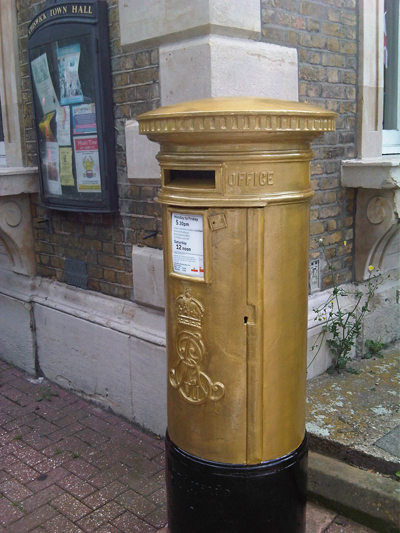
The Olympics might be over but there are still plenty of reminders of the Games around town. Not the least of which are the gold postboxes, painted that color in celebration of London’s gold medallists (the postboxes are located in the home towns of the gold medallists where possible). Pictured is the gold postbox in Heathfield Terrace, Chiswick, west London, painted gold in honor of the victory of Pete Reed in the men’s four rowing. It’s one of a number of gold postboxes in London – others include one in with others in Carshalton Road, Sutton, for Joanna Rowsell’s gold medal win in the women’s team pursuit; one in Church Road in Wimbledon for Andy Murray’s gold medal in the men’s tennis singles, and one in Broad Street, Teddington for Mo Farah’s gold medal in the men’s 5000 metres. Royal Mail has a website where you can see the location of all the gold postboxes in London and elsewhere around the nation – www.goldpostboxes.com. Not sure how long the gold is going to last – Royal Mail has said they will repaint them red – the color they have been, with a few exceptions, since 1874 –  in “due course” but there is a push for them to remain gold as a reminder of the Games.

PICTURE: Courtesy of Royal Mail.

Around London – Chiswick House’s Camellia Festival; Picasso at the Tate; and, Mondrian at the Courtauld…

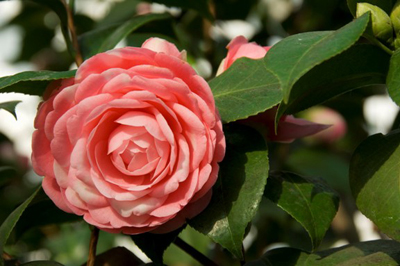
The second annual Camellia Festival kicks off in  gardens surrounding the neo-Palladian property, Chiswick House,  in west London this weekend. The month long festival, run by the Chiswick House & Gardens Trust, was kicked off in 2011 with the aim of showcasing Chiswick’s world renowned Camellia Collection, believed to be the largest in the Western world. Following the success of last year’s festival following a £12.1 million garden restoration project, the flowers will once again be on display in the Conservatory (designed by Samuel Ware in 1813). Complementing the display of camellias will be a showcase of early spring flowers planted in the newly restored Italian Garden (originally created for the 6th Duke of Devonshire in 1814, it was, at the time, at the forefront of horticultural fashion). The Camellia Collection, meanwhile, includes rare and historically significant plants featuring pink, red, white and striped blooms, many of which are descended from the original planting in 1828. Among them is the Middlemist’s Red which was originally brought to Britain from China in 1804 by John Middlemist, a nurseryman from Shepherds Bush. It is one of only two in the world known to exist (the other is in Waitangi in New Zealand). The festival runs from the 18th February to the 18th March.  Admission charge applies. For more information, see www.chgt.org.uk. PICTURE:  The Middlemist’s Red Camellia at Chiswick House © Clare Kendall.

• On Now: Picasso and Modern British Art. This exhibition at Tate Britain explores the influence of Spanish artist Pablo Picasso on British art and the role this played in the acceptance of modern art in Britain as well as celebrating the connections Picasso made with Britain following his first London visit in 1919. It features more than 150 works including 60 by Picasso, among them Weeping Woman and The Three Dancers, as well as works by the likes of Duncan Grant, Wyndham Lewis, Ben Nicholson, Henry Moore, Francis Bacon, Graham Sutherland and David Hockney. Runs until 15th July. Admission charge applies. For more information, see www.tate.org.uk

On Now: Mondrian || Nicholson in Parallel. This show at the Courtauld Gallery tells the story of the extraordinary relationship between celebrated 20th century painter Piet Mondrian and Ben Nicholson, one of the UK’s greatest modern artists. The exhibition will follow the parallel artistic paths taken by the two artists in the 1930s and their subsequent creative relationship. Each of the works selected for the exhibition have a particular historical significance and the presentation also includes archival material such as photographs and letters. Admission charge applies. For more information, see www.courtauld.ac.uk.