There’s a number of contenders for this controversial title and a number of different ways of looking at the question. So, rather than take sides, we’ll just canvas a few of them.
Our initial contenders are:
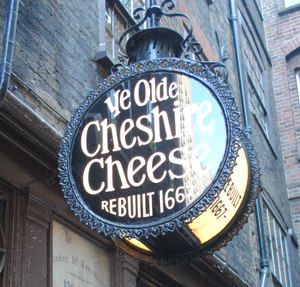 • Ye Olde Cheshire Cheese (145 Fleet Street, the City). Built in 1667 after the Great Fire of London, the current building replaced one previously on the site. The cellar is apparently 13th century and forms part of the remains of an old monastery on the site. Dr Samuel Johnson, who lived just around the corner while creating his famous dictionary, was a regular here and the pub is also said to have been frequented by writers Mark Twain, Alfred, Lord Tennyson, and Sir Arthur Conan Doyle, creator of Sherlock Holmes.
• The Spaniards Inn (Spaniard’s Road, Hampstead). Located on the edge of Hampstead Heath, the Spaniard’s Inn dates from around 1585. The story goes that it was named after the Spanish ambassador to the court of James I who lived here for a time (another version says it was two Spanish brothers who first converted the building into a pub in the 1700s). Other historical figures associated with the inn include the highwayman Dick Turpin (some say he was born here while others say he used to wait here while watching for vulnerable coaches to pass by), the poets Byron and Keats and the painter Sir Joshua Reynolds – who apparently visited, and Charles Dickens who mentioned the inn in the Pickwick Papers (it also gets a mention in Bram Stoker’s Dracula).
• The Lamb and Flag (33 Rose Street, Covent Garden). The building has been occupied since Tudor times but it’s only been a licensed premises since 1623. The pub, certainly the oldest still standing in Covent Garden, was previously associated with prize fighting and was apparently once called the Bucket of Blood. The poet John Dryden is said to have been involved in a fight here.
• The George Inn (77 Borough High Street, Borough). Located on the south side of London Bridge, the George Inn is a rare surviving galleried coaching inn. Now owned and leased by the National Trust, the current building dates from 1676 after the previous inn was destroyed by fire. The inn is mentioned in Dickens’ Little Dorrit and the author himself was apparently a regular visitor.
UPDATE: It seems we left one of the list which is certainly worth mentioning – The Prospect of Whitby in Wapping (57 Wapping Wall). There’s been a tavern on this site on the bank of the Thames since 1520 and during its early days it became known the ‘Devil’s Tavern’ due to its rather dodgy clientele, alleged to have included smugglers, prostitutes and thieves as well as more famous people such as diarist Samuel Pepys, the notorious Judge Jeffreys, known as the ‘Hanging Judge’, and much later, Charles Dickens. Later destroyed by fire, it was rebuilt and given the new name, The Prospect of Whitby, after a ship that moored nearby. The building now incorporates a ship’s mast.
 Founded in 1798 by Thomas Rule, the restaurant has only been owned by three families – the Rules, the Bell family and that of the current owner, John Mayhew, who purchased the restaurant in 1984.

