Once a significant estate on the northern outskirts of London, the palace of the Bishops of Ely was used for some 500 years as their London residence.
Areas of London
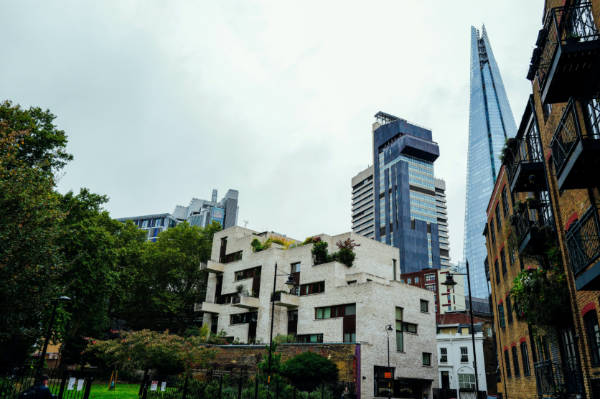
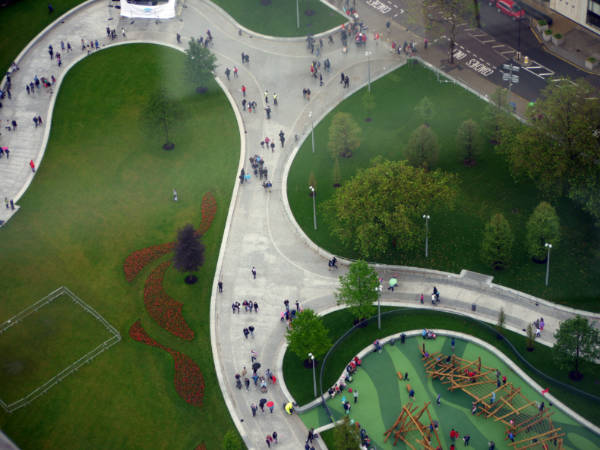
LondonLife – Geometry under the Shard…
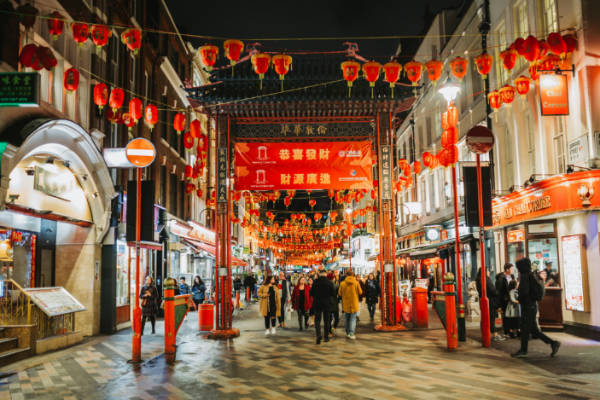
London Explained – Chinatown…
As London prepares to celebrate the Lunar New Year, all eyes naturally turn to London’s Chinatown, centred on Gerrard Street in Soho.
While the street dates back to the 17th century, by the first half of the 20th century it had become known for its nightlife, initially for nightclubs and then for a seedier side as striptease clubs opened.
The city’s first Chinatown had been established in Limehouse in the 18th century as Chinese immigrants and sailors frequented the area.
But after World War II, the damage in the Limehouse area and the comparatively cheap leases available around Gerrard Street, saw Chinese moved in during the 1950s and began opening restaurants and grocery shops.
Growing numbers of Chinese arrived from Hong Kong and by 1970, Gerrard Street has become a hub for the Chinese community in London. The London Chinese Chinatown Association formed in 1978.
It was in the late 1980s that Chinese gateways, a pagoda and street furniture were added. Gerrard Street and parts of Newport Place and Macclesfield Street became pedestrianised.
The first organised Chinese New Year celebrations took place in Gerrard Street in 1985.
This year’s Chinese New Year Parade – celebrating the Year of the Horse – will take place on Sunday, 22nd February. For more, see www.london.gov.uk/events/lunar-new-year-festival-spring-2026.
10 London bishop’s palaces, past and present – 7. Archbishop’s House, Westminster…
Archbishop’s House, located next to the Roman Catholic Cathedral of Westminster, is the official residence of the Catholic Archbishop of Westminster.
Subscribe for just £3 a month to see all of Exploring London’s content.
What’s in a name?…Rood Lane…
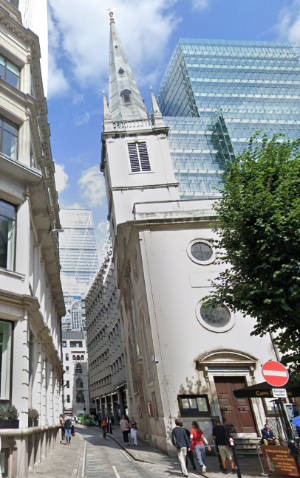
This name of this short City of London laneway which runs between Eastcheap and Fenchurch Street in the City of London has nothing to do with rudeness or lewdness (as you have no doubt guessed).
Rather it’s an ancient term for a crucifix, known in days past as a ‘rood’ or ‘rood cross’.
The laneway was originally known as St Margaret Pattens Lane, a church which, dating back as far as the 12th century, still stands on the corner of the laneway and Eastcheap.
It’s a crucifix which once stood in the churchyard gave the laneway its new name.
Historian John Stow wrote that on 23rd May, 1538, the crucifix was found smashed into pieces “by people unknown”.
This Week in London – Love letters at the National Archives; photographs of the Pantanal; and, the Foundling Hospital Boys’ Band…
PICTURE: Aaron Burden/Unsplash
• Love letters from some of the most famous – and infamous – love affairs have gone on show at the National Archives in Kew in the lead-up to Valentine’s Day. Love Letters features a note sent by Henry VIII’s fifth wife Catherine Howard to courtier Thomas Culpeper in 1541 – later used to prove they were having a treasonous affair, a never-before-seen love letter from the Cambridge Five spy ring’s “fifth man” John Cairncross to his 27-year-old girlfriend Gloria Barraclough, and, a letter Oscar Wilde’s lover Lord Alfred Douglas wrote to Queen Victoria on 25th June, 1895, begging her to exercise her “power of pardon” as Wilde began a two year sentence for gross indecency. Also included is a letter from Charles Kray in 1956, written to the courts on behalf of his son Ronnie, one of the notorious Kray twins, who was facing sentence for assault. The free display can be seen until 12th April. For more, see www.nationalarchives.gov.uk.
• More than 60 striking images showcasing the biodiversity of the Pantanal, a South American wetland, have gone on show at the Science Museum. Water Pantanal Fire features images by two of Brazil’s leading documentary photographers – Lala de Almeida and Luciano Candisani – which were taken between 2007 and 2024 and reveal a stark distinction between the teeming life seen in the region before fires and droughts ravaged the area, leaving a transformed barren landscape. The exhibition, which runs until the 31st May, is free to see. For more, see www.sciencemuseum.org.
• On Now: The Foundling Hospital Boys’ Band. This small display at The Foundling Museum in Bloomsbury looks at the history of the band from its founding in 1847 and explores how it shaped the boys’ lives with many of them graduating into professional military bands (in fact, by World War I, more than 80 per cent of the boys leaving the home went into military music. Admission charge applies. For more, see https://foundlingmuseum.org.uk/event/the-foundling-hospital-boys-band/.
Send all items for inclusion to exploringlondon@gmail.com.
10 London bishop’s palaces, past and present – 6. Fulham Palace…
The former residence of the Bishops of London for more than 1,300 years, Fulham Palace is today a museum surrounded by 13 acres of gardens on the north bank of the Thames.
Get access to all of Exploring London’s articles for just £3 a month…
LondonLife – Garden view…
A Moment in London’s History – John Logie Baird demonstrates television…
It was 100 years ago last month that on a wet Tuesday evening in Soho, Scottish engineer and inventor John Logie Baird demonstrated an experimental prototype that provided live moving pictures – the precursor to what we now know as television.
The successful, albeit rather low key, demonstration took place before some 40 members of the Royal Institution, all reportedly attired in evening dress, in an upper room which served as his laboratory at 22 Frith Street on 26th January, 1926.
According to a report in The Times on 28th January, the “transmitting machine” consisted of a “large wooden revolving disc containing lenses, behind which was a revolving shutter and a light sensitive cell”.
The first image to be transmitted was that of the head of a ventriloquist’s dummy but the image of a human face was transmitted later, “first on a receiver in the same room as the transmitter and then on a portable receiver in another room”.
“The image as transmitted was faint and often blurred, but substantiated a claim that through the ‘Televisor’, as Mr Baird has named his apparatus, it is possible to transmit and reproduce instantly the details of movement, and such things as the play of expression on the face,” The Times reported.
Present at the demonstration was William Edward Taynton, a 20-year-old office boy whose face Baird had transmitted in an experiment at the property the previous October.
Baird continued to refine his invention in the following months with the picture becoming clearer and was recognised in the years following for being the first to show television in colour,
In 1928 he completed a demonstration in which live images sent by radio from London were received in New York and the same year he demonstrated colour television. In 1929, the first television programmes were officially transmitted by the BBC using Baird’s system.
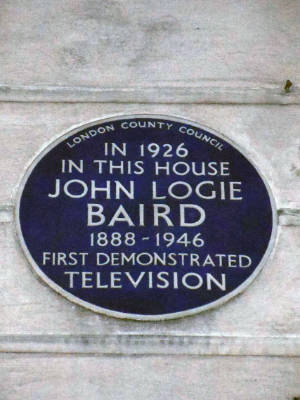
An English Heritage Blue Plaque todays marks the property where the demonstration took place (there’s also one at Baird’s former home at 3 Crescent Wood Road in Sydenham, where he lived from 1933 until 1945).
This Week in London – ‘Samurai’ at the British Museum; V&A East’s first exhibition; and, Jane Austen and the Royal Navy…
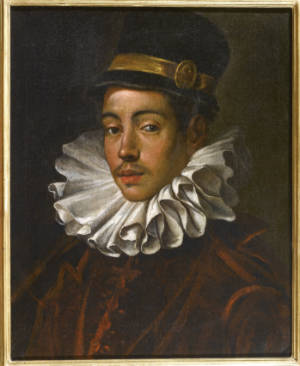
• The evolution of the samurai over the past 1,000 years is the subject of a new exhibition at The British Museum. Samurai brings together around 280 objects and digital media as it explores the role of samurai as warrior as well as the later roles they fulfilled, during a prolonged peace after 1615, as government officials, scholars and patrons of the arts with women making up half of the samurai class. On display will be a suit of samurai armour, complete with helmet and golden standard, which was recently acquired by the museum as well as a vermillion red woman’s firefighting jacket, a rare portrait of Itō Mancio, a 13-year-old samurai who led an embassy to the Vatican in 1582, by Domenico Tintoretto (pictured), and a portrait of Henry, Count of Bourbon, which portrays him as a samurai warrior and which was commissioned by him while visiting Japan in 1889. The exhibition, which opens on 3rd February, runs until 4th May in The Sainsbury Exhibitions Gallery. Admission charge applies. For more, see www.britishmuseum.org/exhibitions/samurai.
• Tickets are now on sale for the V&E East Museum’s first exhibition, The Music is Black: A British Story. The multi-sensory exhibition features more than 200 objects ranging from musical instruments to soundtracks,
artworks, fashion, and personal belongings of world-famed artists including Winifred Atwell’s piano, the Nintendo Jme used for early music experiments, fashion worn by Little Simz, Seal, Dame Shirley Bassey and Skin and newly acquired photographs of Kemistry and Storm, Mis-Teeq, and Skepta. The exhibition opens on 18th April. Admission charge applies. For more, see www.vam.ac.uk/exhibitions/the-music-is-black-a-british-story
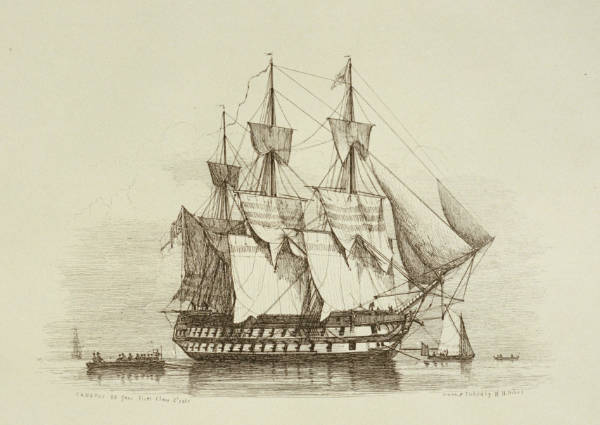
• On Now: Jane Austen and the Royal Navy. This display at the National Maritime Museum marks the 250th anniversary of Jane Austen’s birth and features manuscripts relating to her youngest brothers Francis and Charles Austen, both of whom had naval careers, and explores Jane’s connections to the Royal Navy and the influence her brothers had in her works. Francis – known as Frank (born in 1774) – entered the Royal Navy at the age of 12 and rose through the ranks to eventually captain the HMS Canopus during the Napoleonic Wars while Charles (born in 1779) also entered the Navy at age 12, was on board the Endymion when it captured the French ship Le Scipio, was captain of the Phoenix when it was wrecked at sea and ended his career as commander-in-chief of the East Indies and China Station. The display in the Caird Library can be seen until March. Admission is free. For more, see www.rmg.co.uk/national-maritime-museum.
Send all items to exploringlondon@gmail.com.
10 London bishop’s palaces, past and present – 5. Durham House…
Now long gone, this central London property was once the residence of the, you guessed it, bishops of Durham.
Subscribe for just £3 a month to access all of Exploring London’s articles…
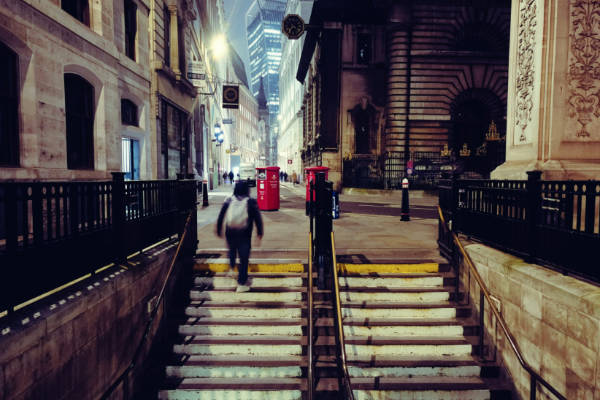
LondonLife – City of London stairway…
10 London bishop’s palaces, past and present – 4. Bromley Palace…
This building, which dates from 1775, is the former palace of the Bishops of Rochester and the latest incarnation of the palace which the bishops used for centuries.
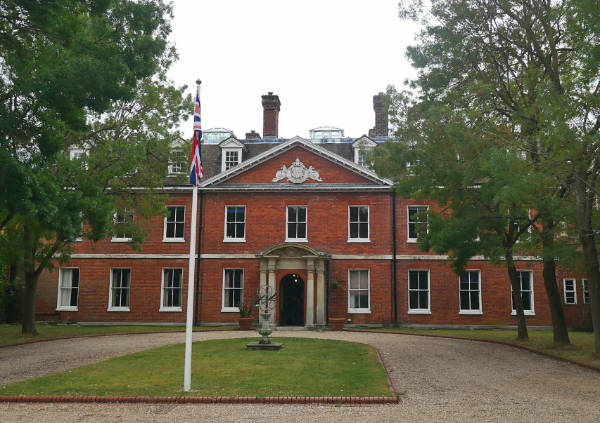
The land, which came to be known as the Manor of Bromley, was initially granted to the bishops of Rochester by Saxon kings of Kent over a couple of centuries. Following the Norman Conquest, an attempt by Odo, the Earl of Kent, to claim it failed thanks to the efforts of Bishop Gundulf (1075-1108) and the Archbishop of Canterbury, Lanfranc.
Subscribe for just £3 a month to access all of Exploring London’s articles…
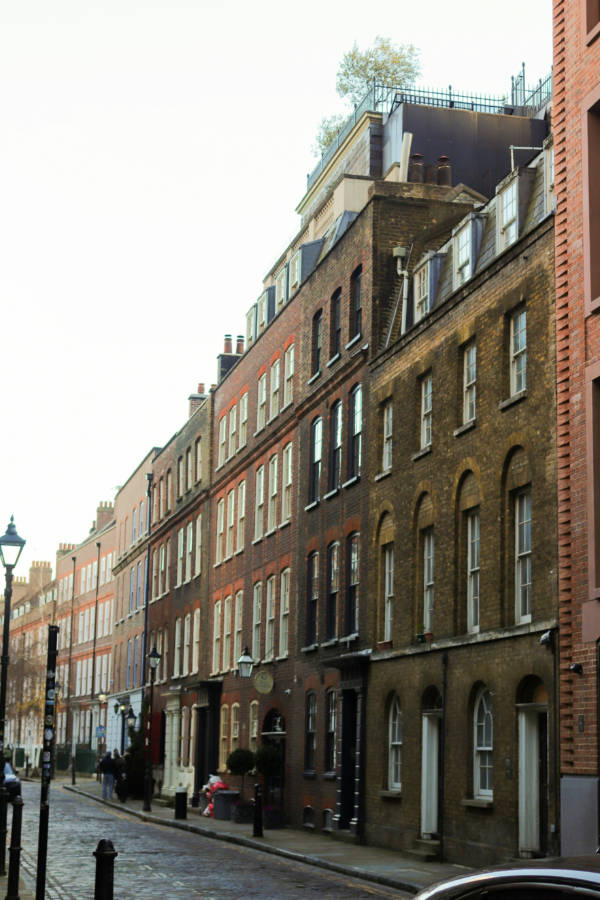
LondonLife – Folgate Street…
Where’s London’s oldest…carpet?
Said to be the oldest dated carpet in the world, it can be found in the Victoria & Albert Museum.
The Ardabil Carpet was made in the town of Ardabil in what is now north-west Iran, in 1539-40. The dating can be so exact thanks to a poetic inscription along one edge which, as well as referencing a date in the Muslim calendar, also reveals it to be the work of a court craftsman, Maqsud Kashani.
The carpet, which is one of an identical pair (the other is at the Los Angeles County Museum of Art (LACMA)), is believed to have been commissioned by the court of the Safavid Dynasty (1501-1722) – the ruler at the time was Shah Tahmasp I – for a renovation of the shrine of Shaykh Safi al-Din Ardabili.
The entire carpet, which may have been made in Tabriz and is said to be the finest carpet that could have been created at the time, is covered by a single integrated design with a large yellow medallion at the centre which is surrounded by a series of oval shapes with a lamp hanging at each end.
The wool pile is very dense with about 5,300 knots per ten centimetres square allowing a great deal of detail. According to the V&A, up to 10 weavers may have been working on it at the same time.
The carpet was seen by British visitors at the Shrine of Shaykh Safi al-Din in 1843 but following an earthquake about 30 years later, it was sold to a Manchester carpet firm. They sold it to the V&A for £2,000 in March, 1893, following a recommendation from William Morris that they do so.
It now sits under a special case at the centre of the Jameel Gallery and is only lit for 10 minutes every half hour to help preserve its colours.
WHERE: The Jameel Gallery at the V&A South Kensington, Cromwell Road (nearest Tube station is South Kensington); WHEN: 10am to 5:45pm daily (late opening Friday – but check website for possible gallery closures); COST: Free; WEBSITE: www.vam.ac.uk/
Lost London – Church of St Peter le Poer…
This parish church once stood on the west side of Broad Street in the City of London and dated back to the Norman era.
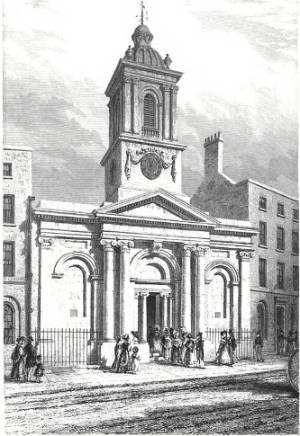
The church, which originally dated from before 1181 (when it was first mentioned) and was also referred to as St Peter le Poor, may have been so-named because of the poor parish in which it was located or for its connections to the monastery of St Augustine at Austin Friars, whose monks took vows of poverty.
Whatever the reason for its name (and it has been suggested the ‘le Poer’ wasn’t added to it until the 16th century), the church was rebuilt in 1540 and then enlarged in 1615 with a new steeple and west gallery added in the following decade or so.
The church survived the Great Fire of London in 1666 but just over a 100 years later has fallen into such a state of disrepair that parishioners obtained an Act of Parliament to demolish and rebuild it.
The new church, which was designed by Jesse Gibson and moved back off Broad Street further into the churchyard, was consecrated on 19th November, 1792. Its design featured a circular nave topped by a lantern (the curved design was not visible from the street) and placed the altar directly opposite the doorway on the north-west side of the church.
The church had acquired a new organ in 1884 but the declining population in the surrounding area led to its been deemed surplus to requirements. It was demolished in 1907 and the parish united with that of St Michael Cornhill.
Proceeds of the sale were used to build a new church, St Peter Le Poer in Friern Barnet. The new church, which was consecrated on 28th June, 1910, by the Bishop of London, the Rt Rev Arthur Foley Winnington-Ingram, also received the demolished church’s font, pulpit and panelling.
This Week in London – Hawai’i’s history and culture; Green Plaque commemorates FA; and, Turner and Constable at the Tate…

• The history and artistry of Hawaii along with its relationship with Britain is the subject of a new exhibition at the British Museum. Hawaii: a kingdom crossing oceans commemorates 200 years since a series of events including the visit of Hawaiian King Liholiho (Kamehameha II) and Queen Kamāmalu to London with a royal delegation to seek alliance and protection from the Crown. Building from the visit of the Hawaiian party to the British Museum, the exhibition features around 150 objects and artworks, many of which have never seen seen before, with highlights including an ‘ahu ‘ula (feathered cloak) which was sent in 1810 by the first king of united Hawai’i, Kamehameha I, to King George III, a nine foot ki’i image of the god Kū, and the Anglo-Franco proclamation of 1843, on loan from The National Archives, which highlights the UK and France’s formal recognition of Hawai’i’s independence and emphasises diplomatic bonds between these nations. Opening today, the exhibition can be seen until 25th May in The Joseph Hotung Exhibition Gallery (Room 35). Admission charge applies. For more, see britishmuseum.org/hawaii.
• The former headquarters of the Football Association (FA) has been commemorated with a City of Westminster Green Plaque at 22 Lancaster Gate, an address synonymous with the FA from the early 20th century until the 1990s. In a statement, the City of Westminster said the plaque, which was unveiled late last year, “celebrates the cultural and historical significance of the FA’s presence in the area and its role in English football history”.
• On Now: Turner & Constable. An exhibition at the Tate Britain focuses on two of Britain’s greatest painters, JMW Turner and John Constable, who were also great rivals. The display, which marks 250 years since their births – Turner in 1775 and Constable in 1776, features more than 170 paintings and works on paper as it explores their intertwined lives and legacies. Highlights include Turner’s momentous The Burning of the Houses of Lords and Commons (1835), not seen in Britain for more than 100 years, and Constable’s The White Horse (1819). Admission charge applies. Runs until 12th April. For more, see www.tate.org.uk/whats-on/tate-britain/turner-and-constable/exhibition-guide.
Send all items to exploringlondon@gmail.com.
Three places to remember Agatha Christie…
Before we get back to our current Wednesday series on bishop’s palaces, we pause to remember the death of celebrated crime writer Agatha Christie, 50 years ago this week (she died on 12th January, 1976).
• First up, we head to 58 Sheffield Terrace in Holland Park where Christie lived with her second husband, archaeologist Max Mallowan, between 1934 and 1941 (one of several homes she lived in in the area), and where she wrote books including Murder on the Orient Express (1934) and Death on the Nile (1937). The house is marked with an English Heritage Blue Plaque.
• Then it’s over to University College Hospital in Bloomsbury where Christie worked during World War II as a volunteer dispenser (and where she added to her expertise on poisons). Christie had in 1917 sat three exams to become a qualified pharmaceutical assistant at the Apothecaries Hall in London.
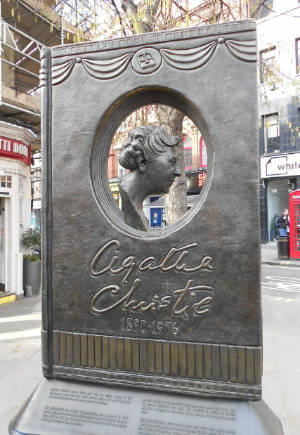
• Finally, we head to the West End and St Martin’s Theatre where Christie’s play, The Mousetrap, continues to be performed nightly, notching up more than 30,000 performances. Outside is the Agatha Christie Memorial (pictured) depicting a book with a bust of Christie set into the centre.
We’ll be taking a more detailed look at Agatha Christie’s London in a series soon…
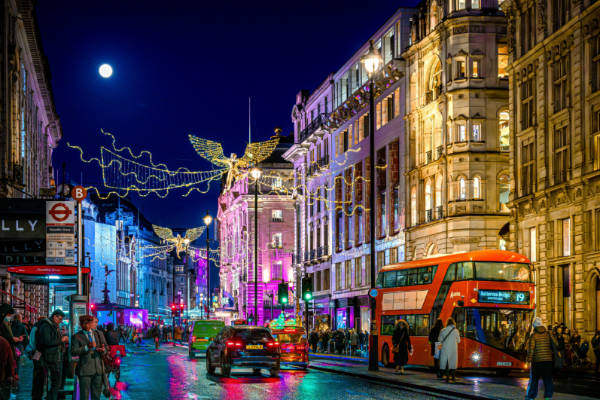
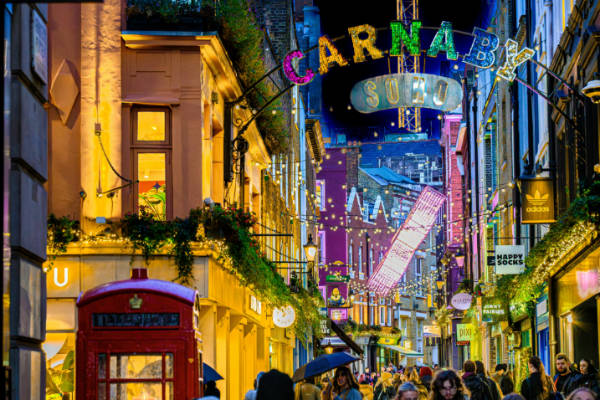
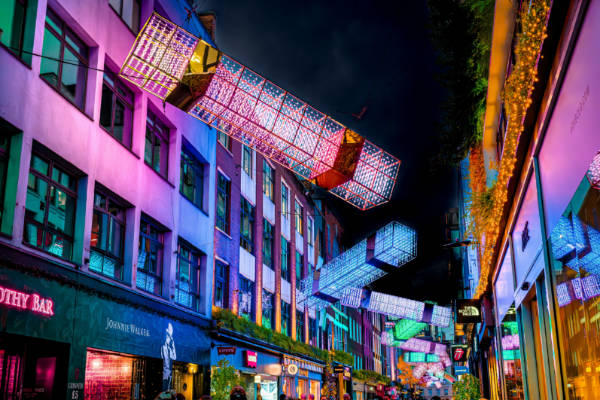
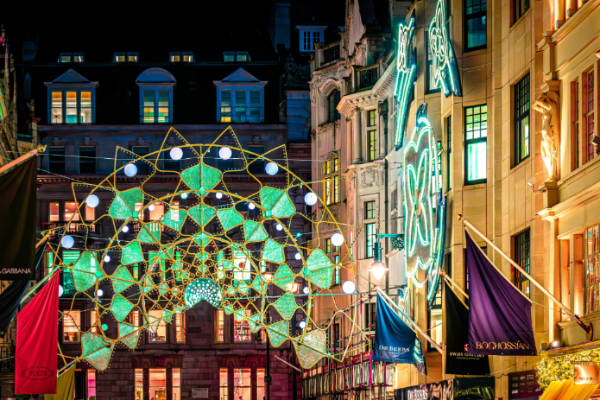
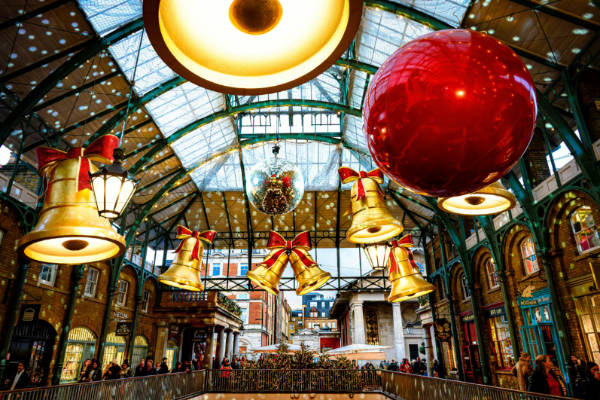
LondonLife – Streets aglow for Christmas…
London pub signs – The Phene…
This Chelsea pub has a rather unusual name and it, like that of the street in which it can be found, comes John Samuel Phene, the architect who built it.
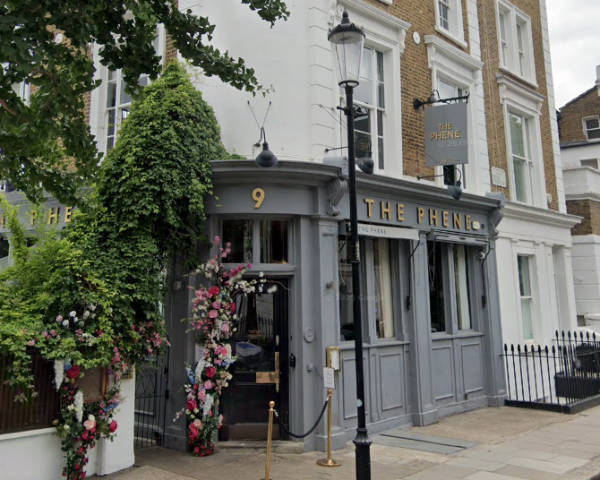
The pub dates from 1850 – Phene, who in 1903 constructed a now demolished five-storey house at in nearby Upper Cheyne Row which became known as “Gingerbread Castle” due to its elaborate decorations – had it constructed as a venue for servants and tenants to drink at.
It became known as a favourite of the likes of Northern Irish footballer George Best and the poet Dylan Thomas.
It was saved from being redeveloped in 2013 after a campaign by local residents backed by high profile celebrities such as Hugh Grant.
The pub at 9 Phene Street, which these days sports a rather plain sign, is now run by the City Pub Company.
For more, see www.thephene.com/
 Exploring London

.jpg)