Another of the many statues in Belgrave Square and surrounds, this statue depicts a giant of South American history.
Don José de San Martín was an Argentine general who was instrumental in the continent struggle for independence from the Spanish Empire and is regarded as a hero in Argentina, Chile and Peru.
The bronze statue, the work of Juan Carlos Ferraro, was cast in Buenos Aires in 1993 and unveiled in the northern corner of the square’s gardens by the Duke of Edinburgh in 1994 in the presence of dignitaries including Senator Eduardo Menem of Argentina, Lord Mayor of Westminster Angela Hooper, UK Foreign Secretary Douglas Hurd and Argentine Ambassador Mario Campora. It was erected by the Argentine-British community in Argentina and is dedicated to the people of London.
San Martín is depicted standing in military uniform on top of a heavy plinth. It’s inscribed on the front with the words “General Don José de San Martín, 1778-1850, founder of the Argentine independence, he also gave freedom to Chile and Peru.” There are also some further inscriptions referring to its creation and one on the right side of the plinth saying “His name represents democracy justice and liberty”.
A plaque was added on the ground in front of the statue to mark the 150th anniversary of San Martin’s death – 17th August, 2000.
It’s not the only memorial to San Martín in London – there’s also a Blue Plaque, erected by the London County Council in 1953, at 23 Park Road in Marylebone (San Martín stayed here for a few months in 1824).
• A celebration of skateboarding and its impact on communities and culture of the past 45 years is underway at Somerset House.No Comply: Skate Culture and Community is a free exhibition featuring imagery from some of the world’s foremost photographers capturing skateboarding scenes from across the UK as well as early editions of skateboarding titles like Alpine Sports, Read and Destroy (R.A.D) and Skateboard!, and original film commissions including a new short film from London-based director Dan Emmerson and a new short by skate videographer Sirus f Gahan. The display also explores the influence of skateboarding on mainstream culture – everything from fashion brands to video games – and uses archival objects, photographs and personal anecdotes to share stories from skate communities in the UK and beyond as well as those of skateboarding-related non-profit initiatives including Free Movement Skateboarding and SkatePal. Runs until 19th September; pre-booking required. For more, see www.somersethouse.org.uk.
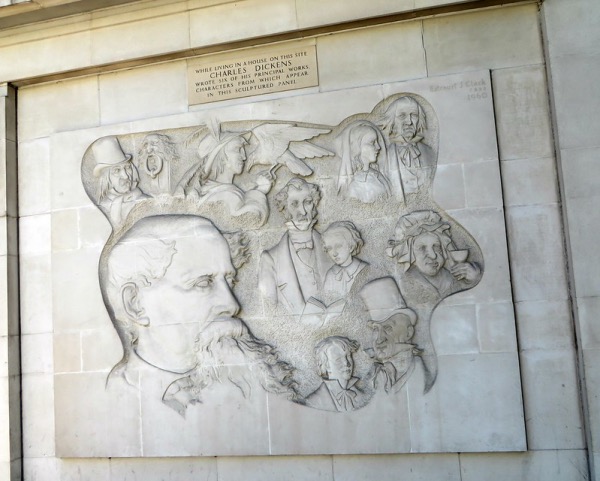
• On Now: More! Oliver Twist, Dickens and Stories of the City. This exhibition at the Charles Dickens Museum in Doughty Street, Bloomsbury, showcases a selection of letters, illustrations, postcards and photos – including a provocative artwork by artist Cold War Steve – as it explores the story of Oliver Twist and the inspiration behind it. Can be seen until 17th October; admission charge applies. For more, see https://dickensmuseum.com.
Send all items for inclusion to exploringlondon@gmail.com.
There’s a couple of statues commemorating Mahatma Gandhi in London with the most recent one was unveiled in Parliament Square in 2015.
But this week we head Bloomsbury where we find an older one in the centre of the gardens in Tavistock Square.
The work of Fredda Brilliant, it was unveiled by then Prime Minister Harold Wilson in May, 1968. Also present was the first High Commissioner of India to the UK after independence, VK Krishna Menon, and the then-current High Commissioner of India to the United Kingdom, Shanti Swaroop Dhavan.
Menon apparently chose the location for the statue – Gandhi had studied at the nearby University College London between 1888 and 1891.
Gandhi, who was assassinated in 1948 after having playing an instrumental role in the push for India’s independence, is depicted sitting in a cross-legged in the lotus position wearing a loincloth with a shawl over his right shoulder. The statue sits atop a rounded Portland stone plinth.
The memorial was erected by the Mahatma Gandhi Memorial Committee, with the support of the India League. It was Grade II-listed in 1974.
A further plaque was added beneath the statue in 1996 commemorating the 125th anniversary of the birth of Gandhi.
One of the 27 life-sized lion sculptures placed in central London to raise awareness and funds to support community conservation and livelihoods across Africa impacted by COVID-19. Each of the lions has been decorated by decorated by famous artists, musicians and comedians (this one by rock star Ronnie Wood and named ‘Not Lying Lion’). The Lion Trail, which is also part of the City of Westminster’s ‘Inside Out festival’, is delivered by wildlife conservation charity Tusk and supported by Art of London. The lions can be see until 26th September. For more, see www.tuskliontrail.com/london-pride/
This small chamber off The Long Gallery at Ham House – which was designed as an up-close and personal gallery to display both cabinet pictures and miniatures – is a rare survivor from the reign of King Charles I.
It retains many of its original contents and features carved woodwork and painted ceilings installed by Franz Cleyn during a 1637-39 refurbishment of the chamber carried out on the orders of the home’s then owner, William Murray.
The room, which would have been used for private meetings, was hung with green silk damask in 1655 (the present hangings are copies) and architecturally the room has remained unchanged since 1672 when a door into the North Dining Room was opened.
Of the many pictures hanging in the chamber, 22 were here in 1683 and another 10 of those now hanging here were hanging elsewhere in the house at the time.
The more than 80 works on show include a miniature of Queen Elizabeth I by Nicholas Hilliard created around 1590, a couple of David Paton – one of King Charles II (dated 1668) and one depicting John Maitland, the Duke of Lauderdale (dated 1669), one of the owners of Ham House.
The larger works include Gerard Dou’s Bust of an Old Man (1635), a rare posthumous portrait of Edward Seymour, the 1st Duke of Somerset (18th century) and the convivial scene, Boors smoking and drinking, by Adriaen Brouwer which, regarded as an original work in 1683, was then one of the most highly valued works at the house.
WHERE: Ham House, Ham Street, Ham, Richmond (nearest Tube station is Richmond). WHEN: Selected dates – check the website; ADMISSION CHARGE: Yes (National Trust members free); WEBSITE: www.nationaltrust.org.uk/ham-house-and-garden.
Inside Out Festival launch at The National Gallery. PICTURE: Nyla Sammons
• Reproductions of some of The National Gallery’s most famous works have appeared on Trafalgar Square’s North Terrace as part of the City of Westminster’s ‘Inside Out’ festival. The life-sized replicas include Van Gogh’s Sunflowers (1888), Turner’s The Fighting Temeraire (1839), Botticelli’s Venus and Mars (1485), Titian’s Bacchus and Ariadne (1520-3) and John Constable’s The Hay Wain (1821). The display is being accompanied by ‘Sketch in the Square’, a programme of free, daily alfresco art activities with a strong emphasis on mindfulness and wellbeing. Other events in the Inside Out festival include the ‘Tusk Lion Trail’ in which 22 life-sized lion sculptures take visitors on a journey to trail some of the West End’s most iconic landmarks, a immersive light installation by artist Chila Burman at Covent Garden’s historic Market Building, and ‘Art of London’, in which five Royal Academy artists have brought their art to Piccadilly Circus and its surrounding streets. The ‘Inside Out’ festival is part of the ‘Westminster Reveals’ campaign which aims to encourage visitors to return to the city’s streets and enjoy the city’s cultural scene. For more on ‘Inside Out’ – which runs until 31st October, see www.westminster.gov.uk/insideout.
Trellick Tower (courtesy of Open House London).
• Usually held over a weekend, Open House London is this year a nine day celebration of London’s architecture and urban landscapes. Highlights this year include the chance to see inside 10 Downing Street, Ernő Goldfinger’s brutalist landmark Trellick Tower (pictured), a street of self-build timber houses in Lewisham and a former Victorian workhouse which has been transformed into a homeless shelter in Camden. There’s also the first chance to see a new design district in Greenwich, a yet to be opened community centre in Holborn and a special focus on the capital’s pubs and breweries. The full programme for the festival – which runs from 4th to 12th September and features hundreds of events – is now available online. For full listings, see www.openhouselondon.org.uk/2021.
• Historic sites and objects related to the landmark 1951 Festival of Britain have been officially recognised to mark the event’s 70th anniversary. The London sites include Calvary Charismatic Baptist Church in Tower Hamlets, built as part of the ‘live’ architectural exhibition of the Festival of Britain, which has seen its heritage listing upgraded from Grade II to Grade II*. Among the sites which have had their listings updated are: Royal Festival Hall which was designed by the London County Council Architect’s Department as part of their contribution to the Festival of Britain; the Church of St John located just off the Waterloo roundabout which, struck by a bomb during World War II, remained damaged until 1950 when the interior was remodelled in a neo-Georgian style for the festival; and, the Newbury Park Bus Station Canopy, which was designed with a high arched, open structure in what has been described as the modernist ‘Festival style’. The Festival of Britain, which ran from May to September, 1951, was a national exhibition and fair aimed at promoting British design, science, technology, architecture, industry, and the arts. Held in the aftermath of World War II, one of its key aims was to help foster a national sense of recovery.
Send all items for inclusion to exploringlondon@gmail.com.
Unveiled on 29th August, 2007, this larger-than-life statue is the work of English sculpture Ian Walters (he completed a clay sculpture of the Parliament Square statue before his death in 2006 but sadly didn’t live to see it cast in bronze in London.)
The statue was proposed by South African journalist and anti-apartheid activist Donald Woods but after his death in 2001, the fundraising effort, officially launched in 2003, was led by his wife Wendy and Sir Richard Attenborough.
It depicts Mandela standing on a low plinth with his arms outstretched as though making a speech. He is shown wearing a flowery shirt.
It was originally proposed the statue be located outside of the South African High Commission in Trafalgar Square but after planning approval was refused, the alternative site of Parliament Square was eventually decided upon.
The unveiling in the south-west corner of the square was attended by Mandela himself along with his wife Graça Machel and then Mayor of London Ken Livingstone while then PM Gordon Brown did the official duties.
Interestingly it’s not the only work of Walters depicting Mandela – he was also the sculptor behind the bust of Mandela which stands outside Royal Festival Hall in South Bank.
It’s also not the only South African who has a statue in Parliament Square – there’s also one of Jan Smuts, twice Prime Minister of the Union of South Africa in the early 20th century (in fact Mandela recalled at the unveiling that he and his friend Oliver Tambo, who went on to become president of the ANC, had once joked about seeing the statue of a Black man one day erected in the square – Tambo never lived to see it, but Mandela, at age 89, did).
Julietta and her artwork which is among those in the exhibition..
Works by young Londoners depicting their COVID-19 experiences as well as their feelings in support of the Black Lives Matter movement have gone on show in an exhibition at the Saatchi Gallery and online. A Westminster City Council project, called Creative Collective, asked young people to produce works in any medium – audio clips, short films, poems, paintings, drawings, statements or digital works – responding to themes including lockdown, resilience and hope, community and Black Lives Matter. The results, which have previously been on display at libraries across Westminster, can now be viewed until 31st August at in the Learning Gallery at the Saatchi Gallery as part of the JR Chronicles Exhibition. The display is also available to see online here. The project is the work of the council’s cultural youth engagement programme – City Lions – in partnership with children’s services, local schools, professional artists, libraries and archives.
While there’s said to have been a pub on this site since the 16th century, The Compton Arms is most famous for its association with George Orwell, being one of three Canonbury pubs the writer is said to have patronised.
The Compton Arms sign.
In fact, Orwell was so enamoured of the pub that it’s said to be one of the places he had in mind when writing a famous 1946 essay, The Moon Under Water, in which he describes his perfect pub.
Orwell is memorialised in the pub’s coat-of-arms which features an image of a moon over water.
The coat-of-arms also features references to local sporting legend Denis Compton after whom it’s named. Pictured are cannons representing football club Arsenal and swords from the Middlesex County Cricket Club crest – both clubs for whom Compton played.
The last item on the coat-of-arms are juniper berries – apparently a reference to the US hip-hop artist Snoop Dogg’s song, Gin and Juice (juniper berries being a key ingredient of gin). Snoop Dogg’s life story was featured in the 2015 film Straight Outta Compton.
• A 19-year-old graphic design student from Nottinghamshire has won a competition to find an emblem for the Queen’s Platinum Jubilee. Edward Roberts, who is studying at Leeds, said that for his design, “I wanted to give a modern twist to the iconic elements of St Edward’s Crown, and so I created a continuous line, which I felt was a fitting representation of The Queen’s reign”. Paul Thompson, vice-chancellor of the Royal College of Art and a member of the judging panel which selected the winning design said it takes people “on a simple line journey to create the crown and the number 70, beautifully capturing the continuous thread of Her Majesty The Queen’s 70-year reign”. “Drawn on a computer, the ingenious emblem works across all scales and the flow of the line gives us a sense of a human touch behind the digital design process.” The competition, which was was open to young people aged between 13 and 25 from all over the United Kingdom, was judged by a panel of graphic designers, visual artists and design professionals, experts from the V&A, the Royal College of Art, the Design Museum, and a representative from the Royal Household. It was chaired by V&A Director Tristram Hunt. As the winner, Edward will be invited to next year’s Jubilee celebrations including the ‘Platinum Party at the Palace’, and his winning design, along with the other nine shortlisted emblem design entries which will be revealed next year, will be displayed at the V&A in June. Edward will also receive a prize of £1,500 and a year’s free membership of the V&A.
• The £8 entrance fee to the Marble Arch Mound has been dropped for visitors during August after it closed only two days after opening following sustained criticism from visitors. In a statement Stuart Love, chief executive of the City of Westminster, apologised that the Marble Arch Mound wasn’t ready for visitors when it opened. “London’s businesses and residents have suffered through the pandemic and we built the Mound as part of our bigger plan to get people back into the City and into the shops, restaurants, theatres and to see the amazing sights the West End has to offer,” he said. “We wanted to open the Mound in time for the summer holidays and we did not want to disappoint people who had already booked tickets. We made a mistake and we apologise to everyone who hasn’t had a great experience on their visit.” The 25 metre high temporary attraction will reopen on Monday. For more, head here.
• Explore the stories of real-life pets and their owners in a new feature at the Museum of The Home in Shoreditch. Pet Life – which features animations, projections, hands on activities and stories written by author and storyteller Bernadette Russell – aims to show “the joy, companionship and challenges our pets bring to the home”. Runs until 31st October. Admission charge applies. For more, see www.museumofthehome.org.uk/whats-on/exhibitions-and-installations/pet-life/.
Send items for inclusion to exploringlondon@gmail.com.
We go back to Belgrave Square this week to its westernmost corner where there is a bronze statue of 15th century Portuguese aristocrat and explorer, Prince Henry the Navigator.
Prince Henry (1394-1460) was the son of King John I of Portugal and Philippa, the daughter of English nobleman John of Gaunt and sister of King Henry IV.
As well as being appointed the Governor of the Algarve in 1419, Henry became famous for his scientific and exploratory endeavours – he was instrumental in opening the navigational route to India (although his nickname “The Navigator” apparently was applied to him until centuries later5)
The statue, which has the prince wearing robes seated on a rocky outcrop with a rolled map in his hand, is attributed to Simoes de Almeida (who died in 1950) and it’s been claimed it was made as far back as 1915. There is a duplicate of the statue located in the US – at Fall River, Massachusetts – but this is credited to the sculptor, Aristide Berto Cianfarani.
While it’s origins remain somewhat unclear, we do know the statue was unveiled by the President of Portugal in February, 2002, with the Duke of Westminster present.
There are some verses from Portuguese poet Fernando Pessoa on the side of the plinth.
A lost ‘garden snug’ has been recreated at 19th century designer William Morris’ Arts & Crafts home, Red House, in Bexleyheath. Inspired by the original notes of architect Philip Webb, the design draws on an ordnance survey map from when Morris and his family were residents at the house between 1860-1865 which shows outdoor spaces separated into different ‘rooms’. Photos of the garden from the 1890s were also used to guide the project. The 100 square metre garden is enclosed with traditional hazel and hawthorn and the planting inside its bounds references some iconic Morris & Co designs like ‘Trellis’, ‘Daisy’ and ‘Fruit’. At the centre is a Tibetan cherry (Prunus serrula) and the garden also features traditional cottage plants like Shasta daisies, columbines, honeysuckle, irises, peonies, jasmine and mock orange. Around the central tree are specially commissioned wooden seats from Scottish craftsman Angus Ross with distinctive two-metre high arches designed to echo the house’s medieval-inspired architecture. For more, see www.nationaltrust.org.uk/red-house.
• More than 150 of the finest portraits of royal families over five dynasties are on show at the National Maritime Museum in Greenwich.Tudors to Windsors: British Royal Portraits, which is being run in conjunction with the National Portrait Gallery, features famous paintings, miniatures, sculpture, photographs, medals and stamps from the Tudor, Stuart, Georgian, Victorian and Windsor dynasties. Highlights include the earliest known portrait of Henry VII (also the oldest artwork in the exhibition) which was painted in 1505 by an unknown artist, Flemish artist Marcus Gheeraerts the Younger’s famous ‘Ditchley Portrait’ of Elizabeth I, portraits of Charles II and his mistresses, early 19th century domestic photographs of Queen Victoria and her family, and a selection of paintings and photographs of Queen Elizabeth II by Cecil Beaton and Annie Leibovitz. Runs until 31st October. Admission charge applies. For more, see www.rmg.co.uk/TudorsWindsors.
• Westminster Abbey has announced a new memorial to Sir Roger Bannister, the first man to run under a mile in four minutes. The abbey said the memorial ledger stone to Bannister, who later became a neurologist, will be placed in what is known as ‘Scientists’ Corner’ in the building’s nave, close to the graves of scientists Sir Isaac Newton and Charles Darwin as well as the ashes of Stephen Hawking. “Throughout his life Sir Roger Bannister reached out for that which lay beyond,” said the Dean of Westminster, the Very Reverend Dr David Hoyle, in a statement. “As a sportsman, pushing himself towards a prize some considered beyond human reach, as a scientist ever eager for deeper understanding of neurology. We are delighted that his memory and his achievement will be set in stone in the Abbey. He ran the race set before us all.” Bannister is famous for having run a mile in three minutes, 59.4 second at Oxford on 6th May, 1954 – a record which stood for almost nine years.
• Be among those transforming the Tate Modern’s Turbine Hall into an “ever changing work of art”. Visitors are invited to join in covering the hall’s floor with their own jottings using coloured drawing materials as part of artist Ei Arakawa’s interactive installation, Mega Please Draw Freely. The installation, which can be contributed to until 29th August, kicks off UNIQLO Tate Play – a new free programme of playful art-inspired activities for families, being in partnership with UNIQLO, at the Tate Modern. The project, which has seen the Turbine Hall floor covered with a temporary surface allowing it to be drawn upon, is inspired by the Gutai group, radical Japanese artists who wanted to change the world through painting, performance and children’s play and, in particular, the group’s ‘Outdoor Gutai Art Exhibition of 1956’ in which Yoshihara Jirō created the groundbreaking work Please Draw Freely, a large board on which people were free to draw and paint. Visitors can access Mega Please Draw Freely by booking a free collection display ticket online at www.tate.org.uk.
• Send all items for inclusion to exploringlondon@gmail.com.
Unveiled in the early 1990s, this statue of the French leader Charles de Gaulle (1890-1970) is located in St James’s, close to the headquarters where de Gaulle headed the government-in-exile following the fall of France in 1940.
The life-sized statue is the work of sculptor Angela Conner and architect Bernard Wiehahn and was erected in Carlton Gardens following a campaign by Lady Soames, daughter of Winston Churchill. De Gaulle is depicted standing in the uniform of a General de Brigade.
The was unveiled by Queen Elizabeth, The Queen Mother, in June 1993. Nearby are an English Heritage Blue Plaque as well as another plaque, both commemorating the location of the headquarters.
A commemorative ceremony takes place each year at the statue organised by the French Embassy.
De Gaulle flew to England in June, 1940, and was subsequently recognised by Britain as the leader of the Free French. He established his headquarter at 4 Carlton Gardens on 22nd July that year, initially living at the Connaught Hotel and, from 1942 to 1944, in Hampstead. He returned to France following the D-Day invasion in 1944.
Green Park, the smallest of the eight Royal Parks. PICTURE: David Adams
One of the most beautiful features of London are its Royal Parks.
The Royal Parks signage in The Regent’s Park. PICTURE: Elliott Brown (licensed under CC BY 2.0)
The parks, which covers some 5,000 acres, are owned by the Crown and managed by a charity, The Royal Parks. They include eight of London’s largest open spaces – Hyde Park, The Green Park, Richmond Park, Greenwich Park, St James’s Park, Bushy Park, The Regent’s Park, and Kensington Gardens – as well as some other important open spaces such as Brompton Cemetery, Victoria Tower Gardens, Canning Green and Poet’s Corner.
All eight of the Royal Parks have historically been owned by the Crown with St James’s Park considered the oldest (while Greenwich Park is the oldest enclosed park).
Under an Act of Parliament passed in 1851, the Crown transferred management of the parks to the government. These powers were originally vested in the Commissioners of Works and later transferred to the Minister of Works in 1942. They now rest with the Secretary of State for Culture, Media and Sport.
The Royal Parks charity was created in 2017 when The Royal Parks Agency – a former executive agency of the Department for Culture, Media and Sport – and the Royal Parks Foundation came together. It is governed by a board led by chairman Loyd Grossman.
Deer in Richmond Park, largest of The Royal Parks. PICTURE: David Adams
The largest of the eight Royal Parks is Richmond Park which covers some 2,500 acres in London’s south-west (it’s followed by Bushy Park which is just over 1,000 acres). The smallest of the parks is Green Park at just 40 acres.
Interestingly, Hampton Court Palace gardens, which are open to the public are not part of The Royal Parks but instead are under the care of Historic Royal Palaces.
Here’s one fact about each of the eight Royal Parks.
Cardinal Thomas Wolsey gave Bushy Park to King Henry VIII in 1529 (along with Wolsey’s home, Hampton Court Palace).
Green Park was initially known as Upper St James’s Park after it was enclosed by King Charles II in 1668.
The Royal Observatory, designed by Sir Christopher Wren, is located in Greenwich Park.
Hyde Park became the location of the first artificially lit highway in the country when King William III, who had moved his court to Kensington Palace and found his walk back to St James’s rather dangerous, had 300 oil lamps installed upon a route which later became known as Rotten Row.
Queen Caroline, wife of George II, gave Kensington Gardens much of its present form when, in 1728, she oversaw the creation of the the Serpentine and the Long Water.
Horse Guards Parade is considered part of St James’s Park.
Architect John Nash designed a summer palace for the Prince Regent which was to be located in The Regent’s Park but was never built.
Prime Minister Lord John Russell was given a home in Richmond Park (Pembroke Lodge) by Queen Victoria in 1847.
• The 25 metre high viewpoint in the grass and tree covered Marble Arch Mound opens to visitors on Monday. Created by Westminster City Council, the mound – which has been designed by Dutch architectural studio MVRDV, provides expansive views of Oxford Street, Hyde Park, Mayfair and Marylebone. Visitors can either climb the 130 stairs to the top or take a lift. The mound will be open to the public until January next year. Ticket holders are also invited to visit W1Curates art installation Lightfield, led by British/American artist, Anthony James, which is located inside the mound. For more information and to book tickets, see www.westminster.gov.uk/news/get-set-summit-marble-arch-mound-summer.
• The history, art and culture of the Native Americans who met the passengers of the Mayflower is explored in a new exhibition at the Guildhall Art Gallery. Opening on Friday, Wampum: Stories from the Shells of Native America centres on a newly-crafted wampum belt created by the Wampanoag people of Massachusetts alongside historic material from the British Museum. Wampum belts are the creative expression of the Wampanoag people, with each shell on the belt imbued with memory and meaning. The display is presented by The Box, Plymouth, and supported by Arts Council England as part of commemorations of the 400th anniversary of the sailing of the Mayflower from England to America. Runs until 5th September. Entry is free (booking required). For more, head here.
• On Now: Paula Rego. This exhibition at Tate Britain – the largest retrospective of Paula Rego’s work to date – features more than 100 works including collage, paintings, large-scale pastels, drawings and etchings as it showcases the career of the Portuguese-born artist. As well as early work from the 1950s, the display features her large pastels of single figures from the acclaimed Dog Women and Abortion series and richly layered, staged scenes from the 2000s. Runs until 24th October. Admission charge applies. For more, see www.tate.org.uk/whats-on/tate-britain/exhibition/paula-rego.
Send all items for inclusion to exploringlondon@gmail.com.
One of a cluster of statues depicting foreign leaders around Belgravia Square (thanks to the presence of so many foreign embassies in the area), this work depicting Simón Bolívar, a towering figure in the early 19th century liberation of South America from colonial powers, was erected in 1974.
The bronze, by Hugo Daini, shows Bolívar standing as though about to make a speech
The inscription describes Bolívar as the liberator of Venezuela, Colombia, Ecuador, Peru, and Panama and the founder of Bolivia and also mentions the details of his birth – Caracas, Venezuela, 24th July, 1783 – and death – Santa Maria, Colombia, 17th December, 1830.
It is accompanied by a quote on the side of the pedestal, featuring words attributed to Bolívar: “I am convinced that England alone is capable of protecting the world’s precious rights as she is great, glorious and wise”.
The statue was erected by the aforementioned nations (the coats-of-arms of which are on the plinth) and unveiled in by James Callaghan, then Foreign Secretary (and later PM).
Westminster Abbey Library, part of of the ‘Hidden Highlights’ tour. PICTURE: Dean and Chapter of Westminster.
• A lost medieval sacristy used by Westminster Abbey’s monks in the 13th-century which has been revealed in the abbey grounds has been opened to the public. A visit to the dig uncovering the former sacristy is one of the stops on new ‘Hidden Highlights’ tours which also take in other areas not usually open to the public including the Jerusalem Chamber where King Henry IV died in 1413 and, the Library, formerly part of the monk’s dormitory which features a 15th century oak roof and 17th century bookcases (pictured above). The tour, which finishes in the Diamond Jubilee Galleries which have been closed since the start of the pandemic, is part of a summer of events at the abbey which also includes open air cinema, visits to the abbey after dark, live music performances and a chance to look behind the scenes at the abbey’s role in the 2011 wedding of the Duke and Duchess of Cambridge. For more, see www.westminster-abbey.org/abbey-news/lost-medieval-sacristy-opens-to-public-for-summer-festival-of-events.
• A new exhibition looking at the central role food plays in Black entrepreneurship and identity in the city’s south east has opened at the Museum of London Docklands.Feeding Black: Community, Power & Place puts four businesses in the spotlight – Livity Plant Based Cuisine in Croydon, Woolwich businesses African Cash & Carry and Junior’s Caribbean Stall, and Zeret Kitchen in Camberwell – and tells their stories through objects, recipes and videos as well as newly commissioned photography by Jonas Martinez and original oral histories and soundscapes by Kayode ‘Kayodeine’ Gomez. The free display can be seen until 17th July next year in the London, Sugar & Slavery gallery. For more, see www.museumoflondon.org.uk.
• Ride the dodgems at Somerset House.Dodge, described as a “thrilling open air experience” that takes an “inventive twist on the traditional fairground”, features dodgem cars and installations from acclaimed artists as well as food and drink and DJ sets. The event runs until 22nd August. There is free entry to the site but charges apply for the dodgem rides. For more, see www.somersethouse.org.uk. The event is part of the #LetsDoLondon campaign, described as the “biggest domestic tourism the capital has ever seen”.
Send all items for inclusion to exploringlondon@gmail.com.
Crowds gathered at the Opening of Royal Albert Hall, on 29th March, 1871, as seems in the Illustrated London News, on the 8th April, 1871.
Next week sees the Royal Albert Hall’s 150th anniversary concert taking place, one of a number of events to mark the anniversary of the hall’s opening.
This spectacular building in South Kensington was officially opened on 29th March, 1871, as The Royal Albert Hall of Arts and Sciences (the opening was actually brought forward from 1st May – 20th anniversary of the opening of the Great Exhibition – at the request of Queen Victoria).
The Queen had laid the foundation stone in 1867 and the work on the building, the creation of which was partly funded by profits from the Great Exhibition of 1851, was complete by the end of 1870 (at least its structure – much of the interior decoration was apparently added later).
An image of the interior of the hall during the opening ceremony on 29th March. 1871. The illustration originally appeared in The Graphic.PICTURE: Via Wikipedia.
Queen Victoria and members of the Royal Family left Buckingham Palace in a line of state carriages for the event at noon escorted by the Royal Horse Guards Blue. Large crowds lined the route of her passage and a guard of honour composed of the Grenadiers stood opposite the entrance.
On arriving, the Queen was met by the Edward, the Prince of Wales (the future King Edward VII), members of the building committee and some of those who has served as commissioners of the Great Exhibition of 1851.
The Queen processed to a dais inside the building’ auditorium where some 8,000 dignitaries and invited guests waited in the audience. But she was apparently too overcome by memories of her late husband – Prince Albert, after whom the building as named – to give a speech. So it was the Prince who did so, although the Queen did reportedly add her own comments, saying according to an account in The Guardian: “I cannot but express my great admiration for this beautiful building, and my earnest wishes for its complete success.”
A battery of artillery performed a salute in nearby Hyde Park after which the Queen and Royal Family took their seats in the Royal Box to watch the musical program that followed. The Queen then returned to Buckingham Palace.
Interestingly, the first concert at the hall, held to test acoustics, actually took place month earlier on 25th February for an audience of some 7,000 people made up of those who had worked on the building and their families as well as officials and various invited members of the public.