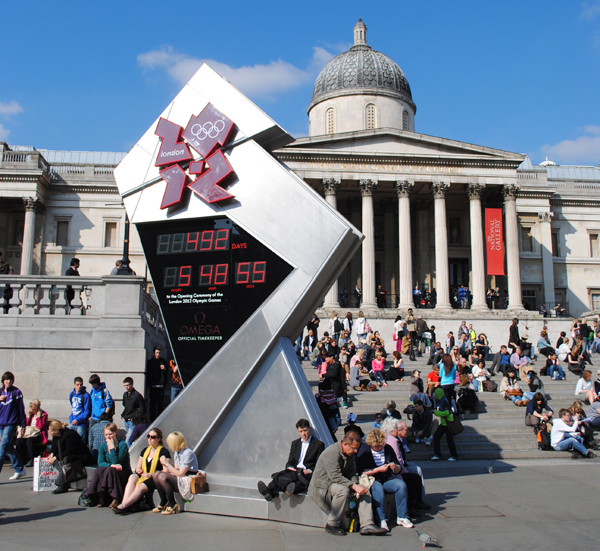
OK, it’s had some teething issues (stopping less than 24 hours after it was launched was one; being daubed with paint another). But the countdown to next year’s Olympics on the official 6.5 metre high clock located in Trafalgar Square continues unabated. The clock was unveiled in mid-March, 500 days before the start of the Games.
Trafalgar Square
Merry Christmas from Exploring London!
What’s in a name?…Whitehall
Running southward from Trafalgar Square towards the Houses of Parliament (the southern part of Whitehall is actually known as Parliament Street), Whitehall is lined with government buildings – everything from the Foreign Office to the Cabinet Office, from the Scotland and Wales Offices to the Ministry of Defence – and has become so identified with government that its very name is now used to mean just that. But where does the name come from?
Whitehall takes its name from the Palace of Whitehall which once stood on the site of the current street. The palace’s origins go back to the 14th century when a grand house known as York Place was built as the London residence of the Archbishops of York.
The building was gradually expanded over the years – work which continued when Thomas Wolsey was made Archbishop of York in 1513. When Cardinal Wolsey fell from favour in the late 1520s, however, King Henry VIII seized the house along with his other assests.
With the royal Palace of Westminster badly damaged in a fire in 1512, King Henry VIII had been staying at Lambeth Palace. He saw the newly acquired palace, renamed Whitehall, as a suitable new home and continued expansion works, constructing a series of recreationally-oriented buildings on the west side of what is now Whitehall including tennis courts, a cockfighting pit and a tiltyard for tournaments. By the time of Henry VIII’s death in 1547, the palace covered 23 acres and was the largest in Europe.
The palace continued to be used by subsequent monarchs until much of it was destroyed by fire in 1698. These days the only surviving part of the palace is the Banqueting House. Built by Inigo Jones for King James I, it was from a window on the first floor of this 1622 building that King Charles I stepped onto a scaffold where his head was cut off.
Apart from the Banqueting House, other significant sites in Whitehall including the Cenotaph, the focus of Remembrance Sunday commemorations. Downing Street, meanwhile, runs off the south-eastern end of Whitehall and behind gates which have blocked it off since 1989, stands the Prime Minister’s official residence.
Around London…
• A 9 ft (2.7 metre) tall bronze statue of Air Chief Marshal Sir Keith Park, commander of the RAF in London and the south-east during the Battle of Britain, was unveiled in Waterloo Place, just off Pall Mall, this week. Sir Keith, a New Zealander who joined the RAF after fighting at Gallipoli and the Somme during World War I, was described as the “brain” behind London’s air defences. The unveiling of the statue on Battle of Britain Day (12th September) follows a three year campaign to honor Sir Keith, who died in 1975, with such a monument. A prototype of the statue occupied the Fourth Plinth at Trafalgar Square for six months after it was unveiled in November last year. For more information, see www.sirkeithpark.com.
• Spend a night at the museum (well, part of one anyway). The Natural History Museum is opening its doors for one night only as part of European Researchers’ Night on Friday, 24th September. Scientists will be on hand to chat and there will be opportunities to see rare specimens not usually on display including a giant squid. There will also be three bars offering drinks and food. The event, which we can promise won’t include you being chased down hallways by dinosaur skeletons, runs from 4pm – 10pm. For more information, see www.nhm.ac.uk.
• Don’t forget! Open House London kicks off this weekend. For more information, see last week’s Around London post.