10 atmospheric ruins in London – 2. St George’s Garrison Church…

This mid-18th century church in Woolwich was constructed to serve the soldiers of the Royal Artillery but was badly damaged when hit by a bomb during World War II.

View of the church apse with altar and mosaic. PICTURE: Kleon3 (licensed under CC BY-SA 4.0)

Designed by Thomas Henry Wyatt with the aid of his younger brother, Matthew Digby Wyatt, in the style of an Early Christian/Italian Romanesque basilica, the church was built between 1862 and 1863 on the orders of Lord Sidney Herbert, the Secretary of State for War.

It was among a number of buildings built to provide for the well-being of soldiers after a public outcry about their living conditions during the Crimean War.

The interior featured lavish decoration including mosaics said to have been based on those found in Roman and Byzantine monuments in Ravenna, Italy. Those that survive at the church’s east end – which include one of St George and the Dragon and others featuring a peacock and phoenix – are believed to have been made in Venice in the workshop of Antonio Salviati.
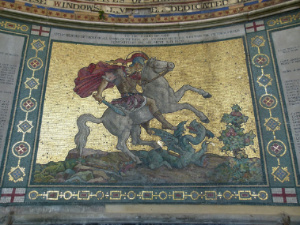
A mosaic featuring St George and the Dragon. PICTURE: Kleon3 (licensed under CC BY-SA 4.0)

The mural of St George formed part of a memorial to the Royal Artillery’s Victoria Cross recipients located in the church and paid for through public subscription in 1915. The interior also featured five tall stained glass windows which served as memorials to fallen officers.

Plaques on the perimeter walls record the names of soldiers killed in military conflict or Royal Artillery servicemen who died of natural causes. 

The church was visited by King George V and Queen Mary in 1928.

The church, which had survived a bombing in World War I, was largely destroyed on 13th July, 1944, when it was hit by a V1 flying bomb. Most of the interior was gutted in the fire that followed.

While plans to rebuild it after World War II were shelved, in 1970 it became a memorial garden with a roof placed over the church’s east end to protect the mosaics.

Services are still held in the Grade II-listed ruin, located opposite the Woolwich Barracks, and since 2018 it has been under the care of the Woolwich Garrison Church Trust.

WHERE: St George’s Garrison Church, A205 South Circular, Grand Depot Road, Woolwich (nearest DLR station is Woolwich Arsenal); WHEN: 10am to 1pm Sundays (October to March) and 10am to 4pm Sundays (April to September); COST: Free; WEBSITE: https://www.stgeorgeswoolwich.org.

Note that we’ve changed the title of this special series to allow us to explore a bit wider than the medieval period alone!
Where’s London’s oldest…(still operational) ferry service?

There’s a couple of contenders for this title – the ferry service at Woolwich and that at Hampton.

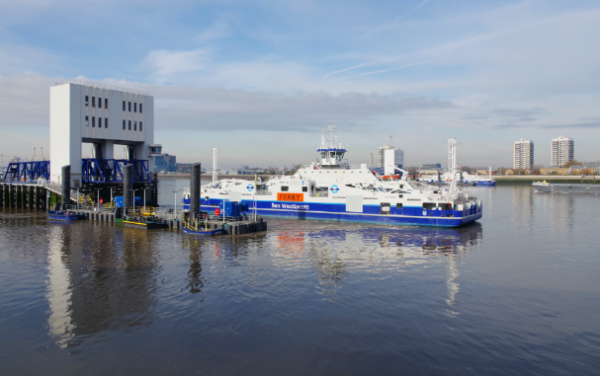
Ferry services linking the north bank of the Thames at Woolwich North to the south bank at Woolwich have operated on the Thames since at least the 14th century.

The Woolwich Ferry’s northern terminal. PICTURE: Matt Buck (licensed under CC BY-SA 2.0)

While they were previously commercial operations, in 1889 a free passenger and vehicle ferry service started operation. By the early 1960s increasing demand saw the paddle steamers retired and the ferry service upgraded to a roll-on/roll-off model. The Woolwich Ferry service, which has been run by numerous authorities over the past century, is currently run by Transport for London.

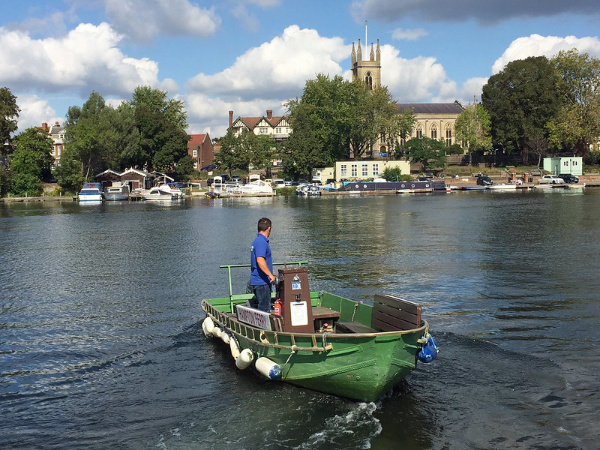
Another contender for the title of London’s oldest (still operational) ferry service is the Hampton Ferry, a pedestrian service, which operates on the Thames about a mile west of Hampton Court Bridge between Hampton on the north bank and Hurst Park, Molesey, the south bank.

The Hampton Ferry. PICTURE: diamond geezer (licensed under CC BY-NC-ND 2.0)

The ferry service, which was first used by fishermen and agricultural workers, dates back to 1514 and was incorporated by statute, making it one of the oldest British companies. The ferry, which costs £2 for a single crossing, operates seasonally from April to October.

Lost London – Prison hulks on the Thames…

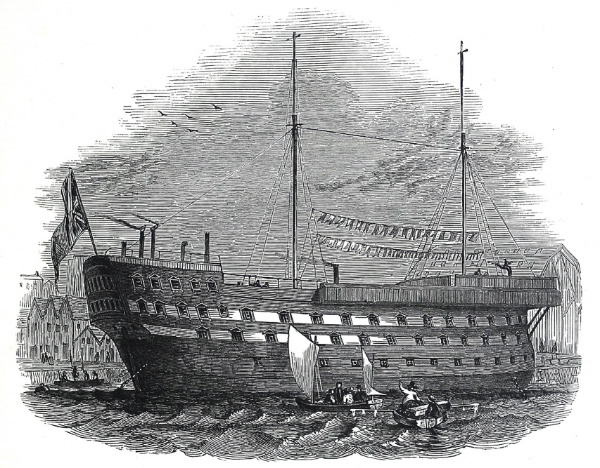
Floating prisons known as ‘hulks’ were a regular site on the Thames in London between the late 18th century and mid-19th century, used to house convicts awaiting transportation to British penal colonies including in what is now Australia.

The ‘hulks’ were actually decommissioned warships, dismasted and repurposed for the purpose of housing prisoners.

The Warrior’ converted into a prison hulk off Woolwich. PICTURE: Illustration for The Illustrated London News, 21st February, 1846.

The decision to use the former warships – some of which had a storied history – for such a purpose was initially seen as a temporary measure to ease overcrowding in the jails with an Act of Parliament in 1776 only authorising their use for two years.

But, despite rising concerns over conditions on the hulks, they remained in use until 1857 when the act finally expired for good. Some 8,000 convicts were housed upon them in the first 20 years alone.

The hulks were initially moored off Woolwich – the former East Indiaman Justitia and a former French Navy frigate Censor were among the first – and the convicts aboard them put to use working to improve the river and at Woolwich Arsenal and nearby docks. The hulks were also later positioned at sites including Limehouse and Deptford (and the idea of using hulks was also exported to colonies in Australia and the Caribbean).

The hulks were initially operated by private individuals under a government contract but from 1802 they were placed under the supervision of the Inspector of Hulks. Aaron Graham was first to hold the post while his successor John Capper, who was appointed Superintendent of Prisons and the Hulk Establishment in 1814, oversaw numerous reforms of the system. During Capper’s tenure, the use of private contractors was later phased out with the government assuming direct responsibility for the hulks.

Some hulks – like positioned at Limehouse – were used as “receiving hulks” where prisoners were initially sent for several days where they were inspected and issued clothing, blankets, and a mess kit. They were then sent to “convict hulks” where they were assigned to a mess and a work gang for the long-term. Other hulks were to serve specific purposes such as being a “hospital hulk” (there was also a hulk off Kent, the Bellerophon, which was specifically designated for boys).

Conditions on board the vessels were indeed appalling and disease spread quickly with mortality rates of 30 per cent not uncommon. Prisoners were kept chained when aboard and floggings handed out as punishment for any offences. Food and clothing were of poor quality.

Despite this, the hulks continued to be seen as a convenient means of housing convicts and, in 1841, there were still more than 3,500 convicts on board hulks in England. It was said that one ship – a second vessel named Justitia – housed as many as 700 convicts alone.

Following several government inquiries into the hulks and the construction of more prisons on land, the hulks were gradually decommissioned. But altogether, between  1776 and 1884, the British Government had converted more than 150 ships into hulks in both the UK and the colonies.