Around London – Imperial War Museum’s WWI revamp; St Paul’s Christmas broadcasts; House Mill to be restored; Henry III’s rolls online; and, Winter Wonderland in Hyde Park

The Imperial War Museum has unveiled plans for a major rebuilding project at its Lambeth headquarters to culminate with the 100th anniversary of the start of World War I in 2014. Under a £71 million proposal, the size of the existing World War I galleries will be doubled and a new atrium will be created with further works – including a new sunken entrance – to be completed by 2019. The museum moved to its Lambeth location, formerly the Bethlem Royal Hospital, in 1936. Prince William is fronting the first £29 million appeal for funds. Meanwhile plans have reportedly been mooted to have the decommissioned aircraft carrier, the HMS Ark Royal, brought to London where it would be permanently moored in the Thames as a tourist attraction akin to the HMS Belfast.

St Paul’s Cathedral has announced it will provide live outdoor broadcasts of its three most popular Christmas services for the first time to allow those who can fit in the cathedral to participate. A 25 metre screen will be set up in Paternoster Square, next to the cathedral, where ‘A Celebration of Christmas’ will be screen on 16th December at 6.30pm along with Christmas Carol services on the 23rd and 24th December at 4pm. See www.stpauls.co.uk.

An historic 18th century mill in East London will undergo restoration after the granting of a £248,000 lottery grant. House Mill, which dates from 1776, is believed to be the largest tidal mill still in existence anywhere in the world. Built across the River Lea, the mill was used for flour-making and for a distillery located next door on Three Mills Island in Bow. The project, which is being managed by the River Lea Tidal Mill Trust, involves the restoration of the mill as well as the adjoining Miller’s House and the creation of a visitor’s centre. The trust says it has also been given the “green light” for a further £2.65 million Heritage Lottery Fund grant. See http://housemill.org.uk.

A three year project has made documents drawn up for King Henry III in the 13th century available on the internet for the first time. Project partners Canterbury Christ Church University, King’s College London, and the National Archives in Kew have translated and digitised the king’s ‘fine rolls’, written to record money and favours owed to the king. The rolls consist of 56 parchments – one for each year of his reign which started in 1216 and ended in 1272 – and contain as many as 40,000 entries amounting to some two million words. Some of the parchments, the originals of which are held at the National Archives, measure up to three metres in length. See www.finerollshenry3.org.uk.

On now: Winter Wonderland in Hyde Park. Christmas festivity on a vast scale, Winter Wonderland includes the city’s largest open air ice rink, circus acts, a giant observation wheel, rides and eating places including the igloo-style E:Cube and the Spiegel Saloon. For more information see www.hydeparkwinterwonderland.com.
Around London – New VC gallery at Imperial War Museum; Roman remains unearthed at Syon Park; and, High Society at the Wellcome Collection…

An exhibition containing the world’s largest collection of Victoria Crosses has opened at the Imperial War Museum, housed in what is the museum’s first new major permanent gallery for 10 years. The Extraordinary Heroes exhibition – housed in the Lord Ashcroft Gallery – contains his Lordship’s collection of 162 Victoria Crosses, awarded for parts played in wars stretching from the Crimean to the Falklands, displayed alongside the 48 Victoria Crosses and 31 George Crosses already held by the museum. As well as the awards, the new gallery will display many objects for the first time, including a badly damaged backpack worn by Lance Corporal Matt Croucher when he leapt on a grenade during action in Afghanistan in 2008 to save the lives of his fellow soldiers (he survived as well), and the diving suit worn by Acting Leading Seaman James Magennis who won a VC for his role in placing limpet mines in the Johore Straits in World War II. The gallery was paid for with a £5 million donation from Lord Ashcroft. Admission is free. For more information, see www.iwm.org.uk.

The remains of a Roman settlement have been unearthed at historic home, Syon Park, in London’s west. Archaeological experts from the Museum of London have already removed around 11,500 pieces of pottery, jewellery and about 100 coins from the site on the Syon Park estate. Syon Park, the home of the Duke of Northumberland, sits on the northern bank of the Thames, opposite Kew Gardens. The site was excavated in 2008 in preparing for the construction of a new luxury hotel there. Some of the artefacts will go on display at the new hotel, the London Syon Park, A Waldorf Astoria Hotel, which will open early next year. The settlement, which includes a Roman road and burials, was discovered only half a metre below ground level. For more information on the property, see www.syonpark.co.uk.

Now on: From an early morning coffee in European cities to chewing betel nut in Asia, the Wellcome Collection’s major winter exhibition, High Society, traces the role mind-altering drugs have played in history and culture. The display includes more than 200 exhibits, from an 11th century manuscript written by monks in Suffolk detailing poppy remedies, to a 17th century account by Captain Thomas Bowrey describing his crew’s experiments with the cannabis drink bhang, and an account of NASA’s experiments with intoxicated spiders. Admission is free. The exhibition runs until 27th February. For more information, see www.wellcomecollection.org.

Remembrance Day

It’s Remembrance Day and all across the UK – and around the world – people are pausing to reflect on those who gave their lives fighting for their country. While the main events related to the day – the laying of wreaths at the Cenotaph and a parade – takes place on Remembrance Sunday, we’re marking the day today with a list of 10 of London’s World War I and II-related war memorials.

This list is by no means comprehensive – there are scores of other memorials in London which relate to the two world wars – but we’d welcome your comments of any others you think we should mention. Lest We Forget…

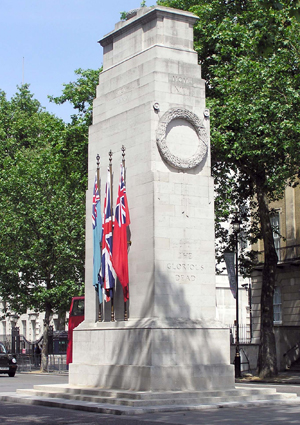
1. The Cenotaph – The most famous of London’s war memorials (pictured right), this simply designed – almost plain – monument stands in the middle of Whitehall and was designed by Sir Edwin Lutyens to commemorate the dead of World War I. It is here that the Queen and other dignitaries lay wreaths on Remembrance Sunday in remembrance of the war dead of both world wars.

2. The Monument to the Women of World War II – Located just along from the Cenotaph, this much criticised memorial marks the role more than seven million women played during World War II. Unveiled in 2005, the memorial was designed by John W. Mills and depicts a series of coats worn by women during the war hanging as though on pegs.

3. The Tower Hill Memorial – This memorial, which was originally unveiled in 1928 and then added to after World War II, commemorates the men and women of the merchant navy and fishing fleets who were killed in either world war and have no known grave. It lists more than 36,000 names. For more information, see www.cwgc.org/search/cemetery_details.aspx?cemetery=90002&mode=1.

4. The Battle of Britain Monument – Located on the north bank of the Thames at Victoria Embankment, this monument pays tribute to those who took part in the Battle of Britain during World War II. Sculpted by Paul Day, it features scenes from the battle in high relief bronze with virtually life-sized statues of airmen scrambling to their aircraft at its centre. Unveiled on 18th September, 2005, the 65th anniversary of the battle. For more information, see www.bbm.org.uk

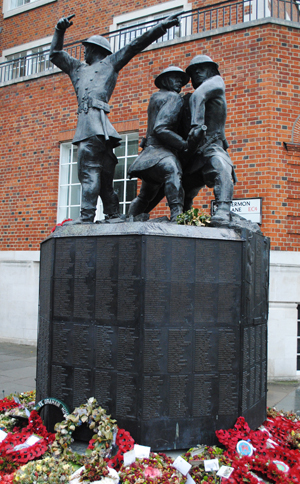
5. The National Firefighters Memorial – Marking the role played by firefighters during the Blitz of London in World War II (as well as the role of firefighters generally), the memorial (pictured right) was designed by John Mills and features the “Blitz” statue – two life-sized firefighters and an officer cast in bronze – standing atop a plinth. First unveiled in by Queen Elizabeth II in 1991, it originally featured the names of 997 men and women who died during the Blitz inscribed upon it but this was extended to include firefighters who have died in peacetime and an additional 1192 names were added prior to a rededication in 2003. Located just south of St Paul’s on the main route to the Millennium Bridge, it is the focus of the annual Firefighters Day of Remembrance held each September. For more information, see www.firefightersmemorial.co.uk.

6. The Animals in War Memorial – Commemorating all the animals that died alongside British, Commonwealth and Allied forces during the wars and conflicts of the 20th century, this unusual monument at Brook Gate in Park Lane was unveiled in 2004. The sculptures include two mules, a horse and a dog all cast in bronze while other animals are depicted in bas-relief on a wall of Portland stone. For more information, see www.animalsinwar.org.uk

7. Canada Memorial – Located in Green Park (just inside Canada Gate), the memorial, designed by Quebec artist Pierre Granche, honors the more than 100,000 Canadians who died in the world wars as well as the more than one million who served. Made of red granite inset with bronze maple leaves, it was designed to create the impression of maple leaves floating down a stream. Unveiled by Queen Elizabeth II in 1994.  www.vac-acc.gc.ca/remembers/sub.cfm?source=memorials/ww2mem/green-park-memorial

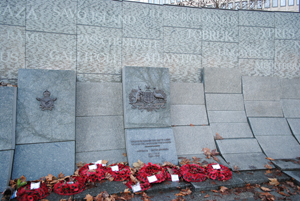
8. Australian War Memorial – Located close to Wellington Arch at Hyde Park Corner, this monumental wall (pictured right) marks the role Australians played in both World Wars. More than 100,000 Australians died during the conflicts and the names of the 23,844 towns in which they were born are inscribed on the wall over which is superimposed the names of 47 battles in which Australians fought in. Unveiled on the 85th anniversary of Armistice Day, 2003. For more information, see www.awmlondon.gov.au.

9. New Zealand War Memorial – Located at Hyde Park Corner diagonally opposite the Australian War Memorial, this monument was designed by architect John Hardwick-Smith and sculptor Paul Dibble and features 16 bronze cross-shaped ‘standards’ of varying heights set in formation and inscribed with text, patterns and some small sculptures. Dedicated on Armistice Day, 2006, by Queen Elizabeth II.

10. Soviet War Memorial – Found in the Geraldine Mary Harmsworth Park – adjacent to the Imperial War Museum in Southwark, the Soviet War Memorial was unveiled in 1999. Designed by sculptor Sergei Shcherbakov, it commemorates the 27 million people who died in the Soviet Union during World War II. For more information, see www.scrss.org.uk/sovietmemorial.htm.