This Week in London – Celebrating Tower Bridge’s 130th; Dame Peggy Ashcroft and Iris Murdoch honoured; modern art in Ukraine; and, Michael Rosen’ illustrators…

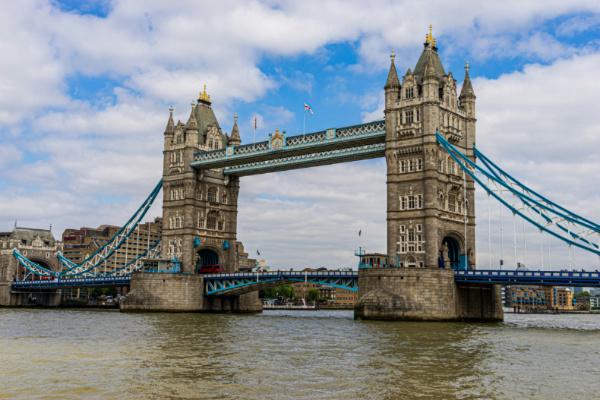
PICTURE: Sung Shin/Unsplash

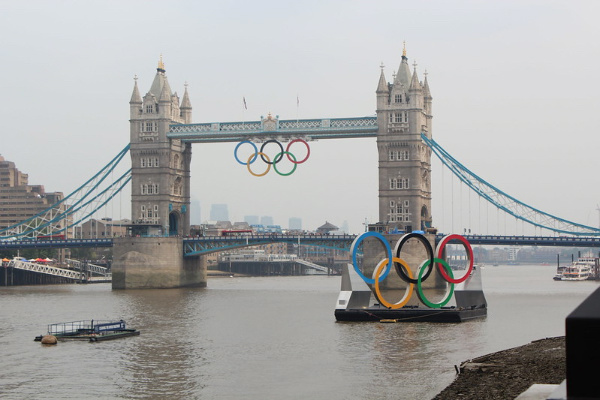
Tower Bridge marks its 130th birthday this year and to mark the event, the London Metropolitan Archives are hosting a free exhibition charting its history at the City of London’s Heritage Gallery. Designed by Horace Jones, the bridge opened on 30th June, 1894, and the display reflects on the splendour of that royal event as well as examining how and why the bridge was built, the engineering involved and how the bridge played a role in defending London during World War I. The exhibition runs until 19th September at the gallery, located in the Guildhall Art Gallery. Booking tickets is recommended. For more, see https://www.cityoflondon.gov.uk/events/tower-bridge-at-the-heritage-gallery.

Actor Dame Peggy Ashcroft and Dublin-born novelist Iris Murdoch have been honoured with English Heritage Blue Plaques. A leading figure in 20th century theatre, Dame Peggy has been remembered with a plaque on her childhood home in South Croydon. It was in what was then a “leafy market town” that at the age of 13 Peggy first dreamt of performing on the stage while standing outside the local grocers on George Street and to which she returned in 1962 to open a theatre named after her. The plaque honouring Murdoch, meanwhile, has been placed on 29 Cornwall Gardens, part of a Italianate stucco-fronted mid-Victorian terrace in Kensington where she occupied a top floor flat. Murdoch lived in London for more than 25 years and during that time would spend three days a week in the flat. For more, see www.english-heritage.org.uk/visit/blue-plaques/

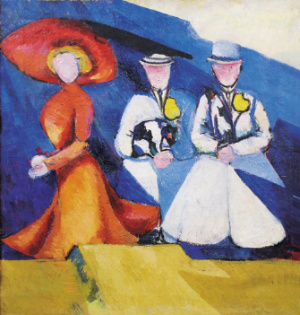
Alexandra Exter, ‘Three Female Figures’, 1909-10Oil on canvas, 63 x 60 cmNational Art Museum of Ukraine

The most comprehensive UK exhibition to date of modern art in Ukraine opens at the Royal Academy on Saturday. In the Eye of the Storm: Modernism in Ukraine, 1900–1930s, features some 65 works, many on loan from the National Art Museum of Ukraine and the Museum of Theatre, Music and Cinema of Ukraine. Artists represented in the display, which is divided into six sections, include such renowned names as Alexander Archipenko, Sonia Delaunay, Alexandra Exter and Kazymyr Malevych as well as lesser-known artists such as Mykhailo Boichuk, Oleksandr Bohomazov and Vasyl Yermilov. Runs in the The Gabrielle Jungels-Winkler Galleries until 13th October. Admission charge applies. For more, see www.royalacademy.org.uk.

The work of artists who have illustrated Michael Rosen’s many books for children are the subject of a new exhibition at the Heath Robinson Museum. Michael Rosen: The Illustrators explores Rosen’s books and the many artists who illustrated them over his 50 year career including the likes of Quentin Blake, Helen Oxenbury, Chris Riddell and Korky Paul. Among the works on show are original drawings for titles including We’re Going on a Bear HuntMichael Rosen’s Sad Book and Michael Rosen’s Book of Nonsense! Runs until 22nd September. Admission charge applies. For more, see https://www.heathrobinsonmuseum.org/.

Send all items for inclusion to exploringlondon@gmail.com.

This Week in London – The lives of Henry’s wives; West End Live; and, ‘NAOMI’ at the V&A…

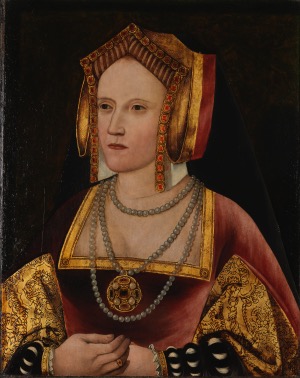
NPG L246. Katherine of Aragon (c 1520) by Unknown artist © National Portrait Gallery, London. By permission of the Archbishop of Canterbury and the Church Commissioners; on loan to the National Portrait Gallery, London.

• The first major exhibition to focus on the six wives of King Henry VIII opens at the National Portrait Gallery today. The first historical exhibition at the gallery since its reopening, Six Lives: The Stories of Henry VIII’s Queens features more than 140 works and includes everything from 16th century portraits by Hans Holbein the Younger through to costumes from SIX the Musical. The display will examine representation of the queens in chronological order starting with Katherine of Aragon before moving on to Anne Boleyn, Jane Seymour, Anne of Cleves, Katherine Parr and Katherine Howard, and, as well as historic paintings, includes miniatures, drawings and some of the queen’s personal possessions such as letters and books. Highlights include a three-quarter length painted panel of Katherine Parr attributed to ‘Master John’, a portrait of Anne of Cleves by Edgar Degas and contemporary portraits by Hiroshi Sugimoto. Personal possessions on show include Katherine of Aragon’s writing box, Anne Boleyn’s inscribed Book of Hours with her signature deliberately erased, an illustrated Bible commissioned by Thomas Cromwell following the death of Jane Seymour, Anne of Cleve’s expense account book, a miniature portrait believed to be of Katherine Howard by Hans Holbein the Younger and a prayer book written by Katherine Howard. Admission charge applies. Runs until 8th September. For more, see www.npg.org.uk.

West End Live takes place in Trafalgar Square this weekend with a line-up of more than 50 acts – from productions ranging from Disney’s Frozen to Mrs Doubtfire set to hit the stage. The unticketed free event, now in its ninth year, will also be streamed on Official London Theatre’s YouTube after the event. Gates will open at approximately 10.15am on Saturday and 11.15am on Sunday. Entry to all areas is managed on a first come, first served basis and queues are expected. Entry cannot be guaranteed. For more, head to the West End LIVE website.

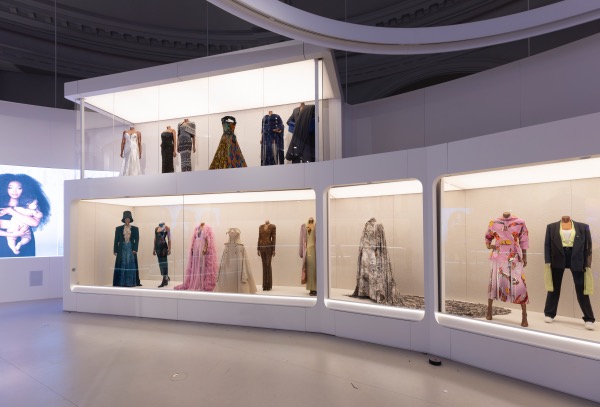
A scene from the NAOMI exhibition. PICTURE: Courtesy of the V&A

An exhibition exploring the 40 year career of leading British fashion model Naomi Campbell opens at the V&A on Saturday. NAOMI features around 100 looks from global high fashion and draws upon Campbell’s own extensive wardrobe of haute couture and leading ready-to-wear ensembles along with loans from designer archives and objects from V&A collection. Designers represented include everyone from Alexander McQueen, Chanel, and Dolce & Gabbana to Gianni and Donatella Versace, Jean Paul Gaultier, John Galliano, Karl Lagerfeld, Vivienne Westwood and Yves Saint Laurent. The display also includes photography by Nick Knight, Steven Meisel and Tim Walker. Runs until 6th April, 2025. Admission charge applies. For more, see www.vam.ac.uk.

Send all items to exploringlondon@gmail.com.

This Week in London – Degas and Miss La La; World Oceans Day in Greenwich; and life at the Old Royal Naval College captured…

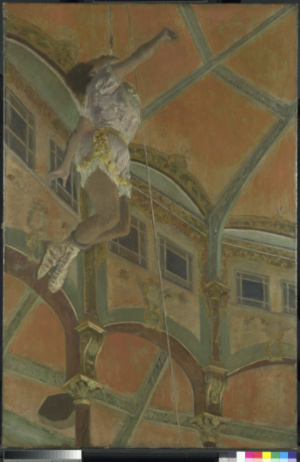
Hilaire-Germain-Edgar Degas,
‘Miss La La at the Cirque Fernando’ (1879) © The National Gallery, London

• Edgar Degas’ Miss La La at the Cirque Fernando (1879) takes centre stage in a new free exhibition at The National Gallery. Part of the free ‘Discover’ series of displays, Discover Degas & Miss La La takes a close look at the painting and reveals new information about the sitter, circus artist Miss La La, or Anna Albertine Olga Brown (1858‒1945). The display features new material, from rare, hitherto untraced drawings of her by Degas and entirely unpublished photographic portraits. In the Sunley Room until 1st September. For more, see www.nationalgallery.org.uk.

Daily life at the Old Royal Naval College has been captured in a series of photographic images now on show at the Greenwich institution. A Year in the Life: People and places of the Old Royal Naval College features 12 images snapped by award-winning photographer Hugh Fox over the past 12 months and includes some portraits of staff show alongside short interviews. Visitors are encouraged to bring their own headphones to better experience the audio-visual display in the Ripley Tunnel. Free to attend, the display can be seen until 1st September. For more, see https://ornc.org/whats-on/.

Send information for inclusion to exploringlondon@gmail.com.

This Week in London – Exploring Bushy Park’s D-Day history; lost and found umbrellas; and, British comics in the US…

The Eisenhower Memorial in Bushy Park. PICTURE: Matt Brown (licensed under CC BY 2.0)

A new digital exhibition revealing the role Bushy Park played in planning D-Day has gone online ahead of the 80th anniversary of D-Day on 6th June. The exhibition, which is on the Royal Parks website and coincides with new interpretative material at the park itself, features previously unseen archive images of Camp Griffiss which once housed more than 3,000 service personnel. For more, see www.royalparks.org.uk/read-watch-listen/operation-bushy-park-plotting-d-day-royal-park

Umbrellas lost on London’s trains, Tubes and buses have been transformed into
yōkai – a class of supernatural beings and entities that abound in Japanese folklore, literature, art and popular culture – in a new installation at the Young V&A.
Lost and Found Yōkai, which features the sounds of supernatural Japan, celebrates Young V&A’s current exhibition, Japan: Myths to Manga and takes visitors on a journey through “Kasa-obake Alley”, where the umbrellas once lost, now dance with life. The installation can be experienced until 1st December which Myths to Manga runs until 8th September. For more, see vam.ac.uk/young.

• On Now: HEROES: The British invasion of American comics. This exhibition at how early American comics such as Buster Brown, Miss Fury and Superman influenced British artists and culture, and then explores how subsequent British comic creations, such as Watchmen and V For Vendetta, were then exported to the US. Highlights include British imitations of American comic strips dating from the 1940s; an exploration of the story behind the 1972 launch of Marvel UK; see rarely-seen full-colour early American comic newspaper pages by RF Outcault, Harold Foster and Alex Raymond; and artwork by key figures from the history of British and American comics, including works by Jack Kirby, Jack Davis and Tarpe Mills. Runs until 19th October. Admission charge applies. For more, see www.cartoonmuseum.org.

Send all items to exploringlondon@gmail.com.

This Week in London – RNLI’s first HQ commemorated; “weird and wonderful” birds; and, Princess Diana in photographs…

The City of London has unveiled a new blue plaque commemorating the Royal National Lifeboat Institution which is this year marking its 200th anniversary. The plaque is on the Furniture Makers’ Hall in Austin Friars which is where the organisation has its first headquarters from 1824 to 1826. The plaque was unveiled by the Lord Mayor of London, Professor Michael Mainelli. The RNLI, which today operates 238 lifeboat stations in the UK and Ireland including four on the River Thames, was founded by Sir William Hillary in the City of London Tavern in Bishopsgate on 4th March, 1824, and early meetings were held at various addresses until it moved into 12 Austin Friars. Meanwhile, ‘Ian Visits’ reports that a new plaque has also been installed at Limehouse Basin to commemorate Lifbåt 416 which was built there by Forrestt & Son’s boatyard in 1868 and sent as a gift to the King of Sweden, Karl XV. The Lifbåt 416, which has been restored, returned to Limehouse Basin this week after attending RNLI commemorations in Poole, Dorset (where it was the oldest lifeboat to take part in a mile-long flotilla).

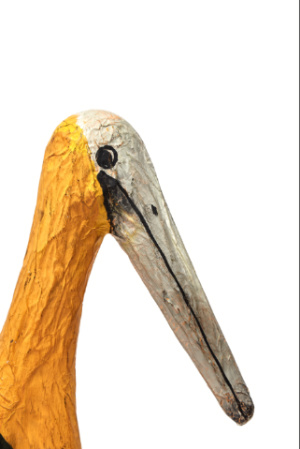
Hargila army papier-mache headdress close up. PICTURE: Courtesy of Natural History Museum

The “weird and wonderful” ways birds have adapted to survive are celebrated in a new exhibition at the Natural History Museum. Birds: Brilliant and Bizarre, which opens at the South Kensington institution on Friday, has been created in partnership with the Royal Society for the Protection of Birds and features installations and hands-on exhibits which allow visitors to feel how fast a hummingbird’s heart beats when in flight, smell the strange oil one bird uses to protect its eggs and listen to the sound of a dawn chorus of birds in the year 2050. Objects on show include the ‘Wonderchicken’ – the oldest known fossil of a modern bird, a replica of a stork that flew across the world from the African continent with a spear lodged in its neck, and a headdress of the ‘Hargila army’ (pictured), a group of women in the Indian state of Assam who work to protect one of the world’s rarest storks. Admission charge applies. Runs until 5th January. For more, see www.nhm.ac.uk/visit/exhibitions/birds-brilliant-bizarre.html.

A walk-through photographic exhibition featuring some of the most iconic photos of Princess Diana opens on Saturday. Princess Diana: Accredited Access features 75 life-sized photographs by her official royal photographer, Anwar Hussein, and his two sons – Samir and Zak – which include behind the scenes access. The exhibition at the Dockside Vaults, St Katharine Docks, runs until 2nd September. Admission charge applies. For more, see www.princessdianaexhibit.com.

Send all items to exploringlondon@gmail.com.

This Week in London – Royal portraits; Sir Elton’s photographic collection revealed; and, women artists…

• Royal portrait photography, from the 1920s through to today, is the subject of a new exhibition opening at the King’s Gallery at Buckingham Palace on Friday. Royal Portraits: A Century of Photography features more than 50 photographic prints, proofs and documents from the Royal Collection and the Royal Archives. Among the royal photographers whose work is on show are everyone from Cecil Beaton and Dorothy Wilding to Annie Lebovitz and Rankin as well as Lord Snowdon (born Antony Armstrong-Jones). Highlights include Beaton’s 1939 shoot featuring Queen Elizabeth, The Queen Mother, in Buckingham Palace Gardens dressed in her “White Wardrobe” by Norman Hartnell, and his original coronation portraits of Queen Elizabeth II. Admission charge applies. Runs until 6th October. For more, head here.

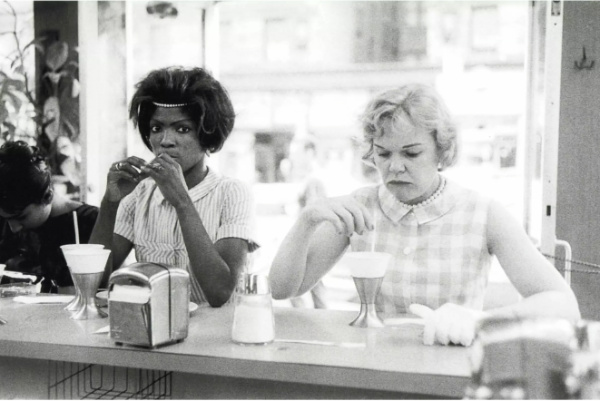
Bruce Davidson, Black Americans. New York City. 1962 © Bruce Davidson Magnum Photos

More than 300 prints from the private photographic collection of Sir Elton John and David Furnish got on display at the V&A from Saturday. Fragile Beauty: Photographs from the Sir Elton John and David Furnish Collection will showcase the work of more than 140 photographers and the V&A’s largest temporary exhibition of photography to date. Photographers include everyone from Robert Mapplethorpe, Cindy Sherman, and William Eggleston to Diane Arbus, Sally Mann, Zanele Muholi, Ai Weiwei and Carrie Mae Weems and the subjects explored include fashion, reportage, celebrity, the male body, and American photography. Portraits of Marilyn Monroe, Miles Davis, and Chet Baker are among the highlights. Runs until 5th January in The Sainsbury Gallery. Admission charge applies. For more, see www.vam.ac.uk.

Anna Airy, ‘Shop for Machining 15-inch Shells: Singer Manufacturing Company’, Clydebank, Glasgow, 1918. © Imperial War Museum

An exhibition focusing on the path women have taken to being recognised as professional artists opens today at Tate Britain. Now You See Us: Women Artists in Britain 1520-1920 features more than 200 works, including oil painting, watercolour, pastel, sculpture, photography and ‘needlepainting’, created by more than 100 artists including Artemisia Gentileschi, Angelica Kauffman, Julia Margaret Cameron and Gwen John. Highlights include Tudor miniatures by Levina Teerlinc, Gentileschi’s Susanna and the Elders (1638-40), the work of 18th century needlewoman Mary Linwood, Elizabeth Butler (née Thompson)’sThe Roll Call (1874), and, the work of Laura Knight and Ethel Walker, who, on the 120th century achieved critical acclaim and membership of the Royal Academy. Runs until 13th October. Admission charge applies. Head to tate.org.uk.

Send all items to exploringlondon@gmail.com.

This Week in London – Victorian London captured; and, contemporary art at the British Museum…

See a glimpse of London as it was during the Victorian era at a new exhibition opening at the London Metropolitan Archives. Lost Victorian City: a London disappeared features photographs, prints, watercolours and documents depicting buildings, horse-drawn transport, docks and various forms of entertainment along with artists’ views of the capital. Highlights include images taken in 1875 by the Society for Photographing Relics of Old London of the 17th century coaching inn, the Oxford Arms, which was demolished two years later, two images by Philip Henry Delamotte showing the moving of the Crystal Palace from Hyde Park to Sydenham following the Great Exhibition of 1851, and a photograph showing the public disinfects whose job was to remove all textiles after an infectious disease outbreak. The display can be seen at the Clerkenwell-based archives until 5th February next year. For more, see

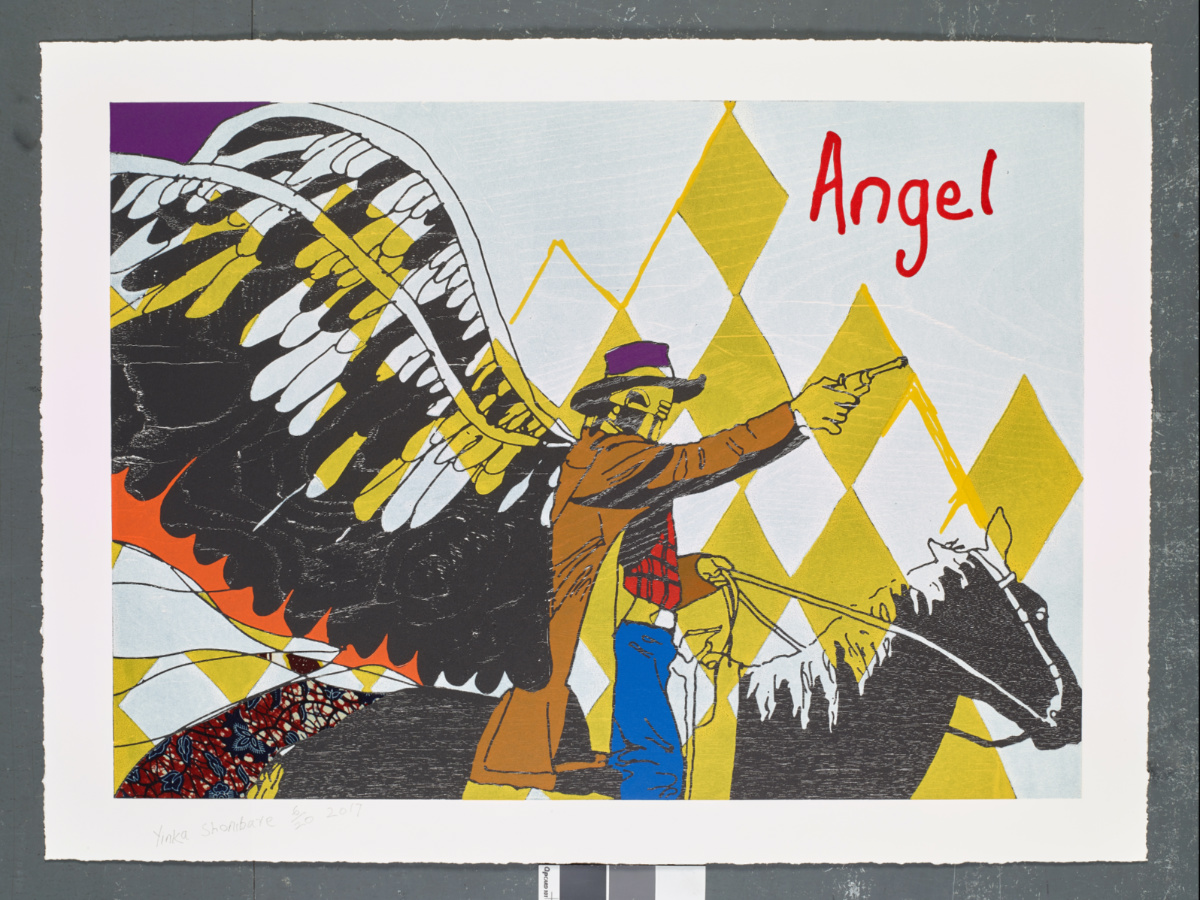
Yinka Shonibare CBE, Cowboy Angel V from the series Cowboy Angels. Colour woodcut and collage of Dutch wax batik fabric. Reproduced by permission of the artist.

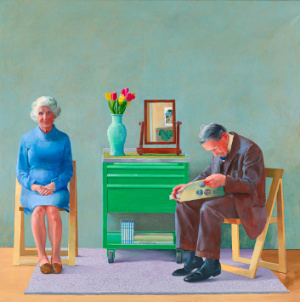
An exhibition has opened featuring works of art acquired by the British Museum over the past two decades including works by David Hockney, Damien Hirst, Julian Opie, Yinka Shonibare and Cornelia Parker. Contemporary collecting: David Hockney to Cornelia Parker features around 100 works acquired since 2001. Many of the works, which span the period from the 1960s onwards, are being exhibited for the first time. Highlights include Hockney’s prints The Marriage (1962) and Henry Seated with Tulips (1976), Parker’s Articles of Glass and Jug Full of Ice from One Day This Glass Will Break (2015), Michael Craig-Martin’s CoathangerLight bulb and Watch from Drawings (2015); Caroline Walker’s colour lithograph Bathed (2018); Shonibare’s colour woodcuts Cowboy Angel I, II, V (2017) and Joy Gerrard’s Vigil/Protest (Westminster 14th March 2021), a 2023 drawing in Japanese ink. Runs until 29th September in Room 90. Admission is free. For more, see www.britishmuseum.org/david-hockney-cornelia-parker.

This Week in London – Michelangelo’s last decades; expressionists on show; and, Dinosaur rEvolution…

Michelangelo Buonarro (1475–1564) – study for the ‘Last Judgment’ (Black chalk on paper, about 1534–36); the fall of Phaeton (Black chalk, over stylus underdrawing, on paper, about 1533); and, Christ on the Cross between the Virgin and St John (Black chalk and white lead on paper, about 1555–64.) All images © The Trustees of the British Museum

A landmark exhibition exploring the final three decades of the life of Renaissance master Michelangelo has opened at the British Museum. Michelangelo: the last decades focuses on how his art and faith evolved and centres on the two metre high Epifania (about 1550–53), which is being displayed for the first time since conservation work on it began in 2018. Showing alongside it is a painting made from it by Michelangelo’s biographer, Ascanio Condivi, as well as preparatory drawings from the Last Judgment, which chart how Michelangelo invented a fresh vision of how the human form would be refashioned at the end of the world, and works created as part of his correspondence with his friends Tommaso de’ Cavalieri and the poet Vittoria Colonna. The latter include The Punishment of Tityus (about 1532) showing an eagle tearing out the liver of a bound naked man which was gifted to Tommaso as moral guidance for the young man. Other highlights include a group of drawings of Christ’s crucifixion which he made during the last 10 years of his life and through which he explored his feelings about mortality, sacrifice, faith, and the prospect of redemption. Runs until 28th July in the Joseph Hotung Great Court Gallery. Admission charge applies. For more, see www.britishmuseum.org/michelangelo.

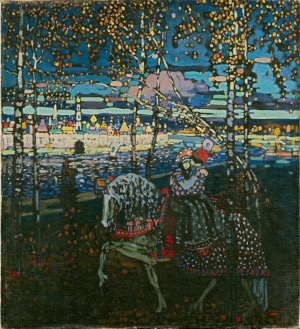
Wassily Kandinsky, ‘Riding Couple’, 1906-1907, Lenbachhaus Munich, Donation of Gabriele Münter, 1957

• A new exhibition has opened celebrating the expressionists’ radical experimentations with form, colour, sound and performance at the Tate Modern. Expressionists: Kandinsky, Münter and the Blue Rider features masterpieces from the Lenbachhaus in Munich and includes some works never previously seen in the UK. Among the artists whose work is on display are everyone from renowned artists like Wassily Kandinsky, Gabriele Münter, Franz Marc and Paul Klee, through to lesser known figures like Wladimir Burliuk and Maria Franck-Marc. Highlights include Marianne Werefkin’s Self-Portrait (c1910), Münter’s Listening (Portrait of Jawlensky) (1909), Erma Bossi’s Circus (1909), Kandinsky’s Impression III (Concert) (1911), Franz-Marc’s Deer in the Snow II (1911), Klee’s Legend of the Swamp (1919), and a selection of photographs from the Masterpieces of Muhammadan Art exhibition staged in Munich in 1910. Runs until 20th October. Admission charge applies. For more, see tate.org.uk.

On Now – Dinosaur rEvolution. This exhibition at the Horniman Museum in Forest Hill highlights discoveries from recent decades which have changed the way we envisage dinosaurs – not all as scaly green reptiles but many with an array of colours, feathers, quills and spikes. At the centre of the display are five large animatronic dinosaur models – including a seven metre-long Tyrannosaurus rex – as well as well as artworks by artist and exhibition curator Luis V Rey. The exhibition also features fossil casts including the horned skull of a Diabloceratops, the claw of a Therizinosaurus, and skeletons of Velociraptor and Compsognathus – a chicken-sized, feathered dinosaur. Runs until 3rd November. Admission charge applies. For more, see www.horniman.ac.uk.

Send all inclusions to exploringlondon@gmail.com.

This Week in London – Caravaggio’s last painting; Hampton Court’s Tulip Festival; and, ‘Beyond the Bassline’….

Caravaggio’s last painting – the 1610 work known as The Martyrdom of Saint Ursula – has gone on display in the UK for the first time in almost 20 years. The National Gallery is displaying the work – lent by the Intesa Sanpaolo Collection (Gallerie d’Italia – Naples) – alongside another late work by the Italian artist from the gallery own collection – Salome receives the Head of John the Baptist (about 1609–10). The Martyrdom of Saint Ursula, which features a self-portrait of the artist, was only reattributed to Caravaggio in 1980 following the discovery of an archival letter describing its commission. The letter – which is being displayed along with the painting – was sent from Naples, where Caravaggio created the work, to Genoa, where his patron, Marcantonio Doria, lived. Caravaggio died in Porto Ercole on 18th July, 1610, less than two months after finishing the work. He was attempting to return to Rome where he believed he would be pardoned for a 1606 murder at the time. Admission to the display is free. Runs until 21st July. For more, see www.nationalgallery.org.uk.

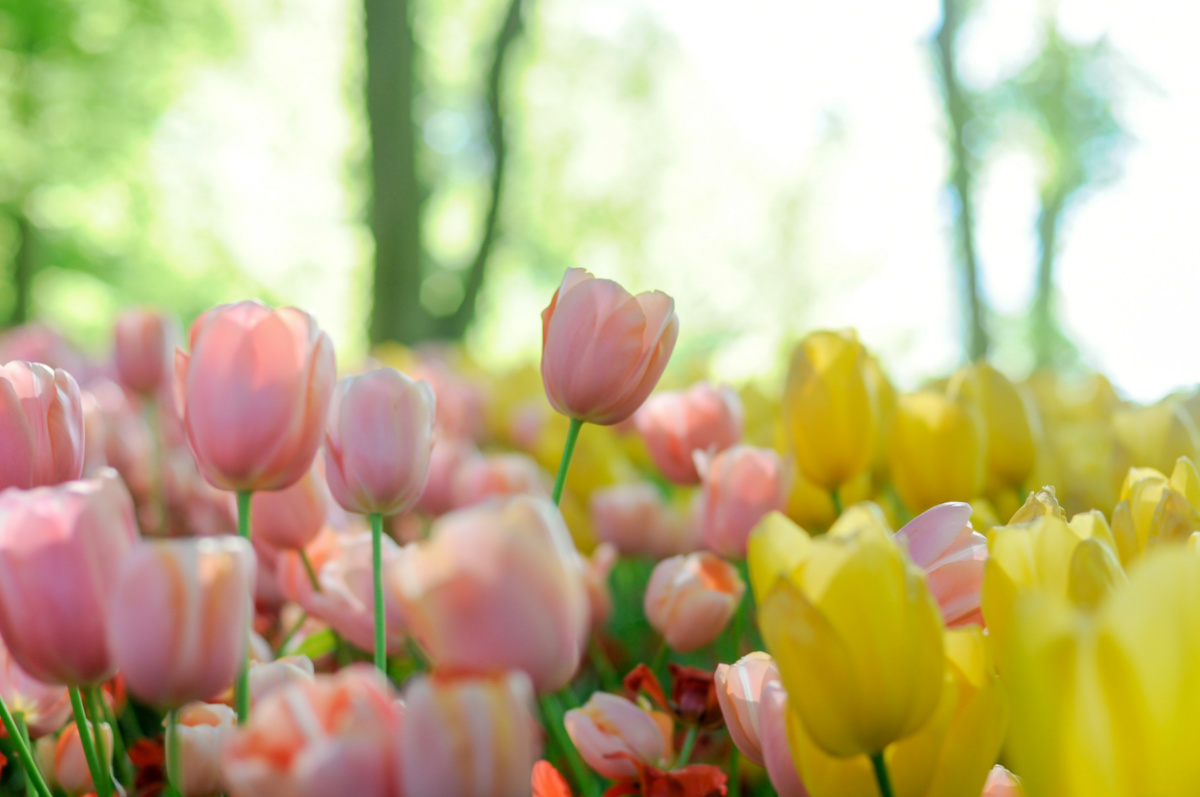
Tulips in the Netherlands. PICTURE: Giu Vicente/Unsplash

Hampton Court Palace’s Tulip Festival is on again. Displays include thousands of tulips spilling from a Victorian horse cart in the heart of the palace courtyards, giving the appearance of a Dutch flower seller’s cart, ‘floating’ bowls in the Great Fountain, free-style plantings in the kitchen gardens and more than 10,000 tulips in a display in Fountain Court. There are also daily ‘Tulip Talks’ sharing the history of the flower and Queen Mary II, who was responsible for introducing them to Hampton Court. Runs until 6th May (including in palace admission). For more, see www.hrp.org.uk/hampton-court-palace/whats-on/tulip-festival/.

Five hundred years of Black British music is being celebrated in a new exhibition at the British Library. Beyond the Bassline: 500 Years of Black British Music features soundscapes, artworks and films along with costumes, interactive displays, and of course, music. Highlights among the more than 200 exhibits include letters from 18th-century composer Ignatius Sancho, records by likes of Fela Kuti and Shirley Bassey, a nostalgic video archive of grime’s golden era captured on Risky Roadz DVD, and the equipment that Jamal Edwards used to start SB.TV, theYouTube channel dedicated to Black British music. The display concludes with a multi-screen film installation by South London-based musical movement and curatorial platform Touching Bass. Admission charge applies (with Pay What You Can days on the first Wednesday of each month). Runs until 26th August. For more, see https://beyondthebassline.seetickets.com/timeslots/filter/beyond-the-bassline.

Send all items to exploringlondon@gmail.com

This Week in London – National Gallery prepares for its 200th; Trafalgar Square hosts Eid, St George’s Day celebrations; and, ‘Silent Testimony’ at the National Portrait Gallery…

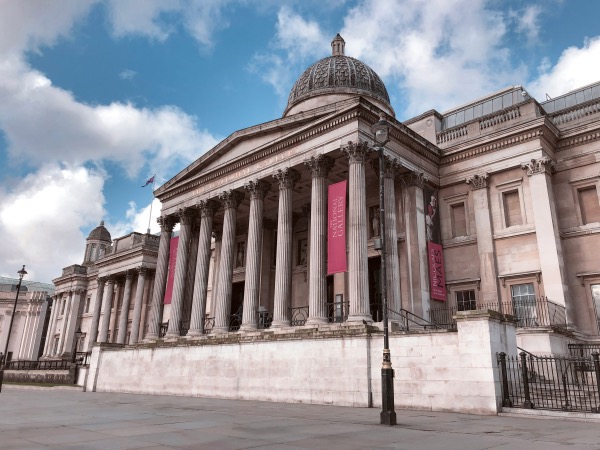
The National Gallery. PICTURE: Lucia Hatalova/Unsplash

The National Gallery is celebrating its 200th anniversary with festivities kicking off with a special night of celebrations on Friday, 10th May, and continuing over the weekend. In a special Friday night late, Jools Holland is performing in the Rausing Room with friends including Ruby Turner, Louise Marshall, and Sumudu while across the rest of the gallery there will be DJ sets, music from London Contemporary Voices, soundscapes by Anna Phoebe and poetry from Ben Okri. There will also be a celebration of music collaboration past and present in the Future Room and creative workshops offering sculptural postcard making and ‘Renaissance Selfies’ with London Drawing while outside on Trafalgar Square the building’s facade will be illuminated in a light show featuring projections of paintings from the gallery as well as the story of its history. Meanwhile, across the weekend visitors to the gallery will have the chance to join in the making of a creative “birthday day” by contributing their own paper creations. All events are free but booking is advised and tickets to the public open today. For more, see nationalgallery.org.uk/whats-on/big-birthday-weekend-late.

Trafalgar Square hosts two days of celebrations this weekend with Eid in the Square on Saturday and St George’s Day festivities on Sunday. Eid in the Square runs from noon to 6pm and features creative arts workshops, storytelling and VR experiences with musical performances on the main stage and food stalls from across the world. Among those performing will be Love’s Pilgrim, Raghad Haddad and Raghad Haddad and members of the Orchestra of Syrian Musicians, Muslim Belal and Chahat Mahmood Ali Qawwal and Group. For more, see www.london.gov.uk/Eid-in-the-Square-2024. Meanwhile, St George’s Day, which also runs from noon to 6pm, features a wide range of entertainment, food stalls and music with artists including The Kurfew, Natalie Shay of Busk in London, West End Kids and Snottledogs. Folkdance Remixed will present a mass barn dance while She’s Got Brass, an all-female brass group, Nick Howe and the Stringbeats Trio and Tom Carradine will lead a cockney sing-a-long. Other activities will include an English Pentathlon – events include welly wanging, pancake tossing, human Crufts, bubble Olympics, the art of Morris Dancing and a chance to meet Pearly Kings and Queens. St George and the dragon will be available for selfies. For more, see www.london.gov.uk/st-georges-day-celebrations-trafalgar-square-sunday-21-april. Both events are free to attend.

A new display revealing stories of loss from The Troubles in Northern Ireland opens at the National Portrait Gallery opens on Monday. Silent Testimony features 18 large-scale portraits by Belfast-born artist Colin Davidson which were painted between 2014 and 2015 and speak to the impact of the conflict on the sitters, their families and friends and the wider community. The paintings were first displayed at the Ulster Museum in Belfast and most recently at Stormont’s Parliament Buildings and the Irish Arts Center in New York. The display in Room 14, level three, is free to see and runs until 23rd February next year. For more, see www.npg.org.uk.

For all inclusions, email exploringlondon@gmail.com.

This Week in London – Maharaja Ranjit Singh at the Wallace Collection; Anne Desmet’s Kaleidoscope/London and displaced Ukrainians at the Foundling Museum…

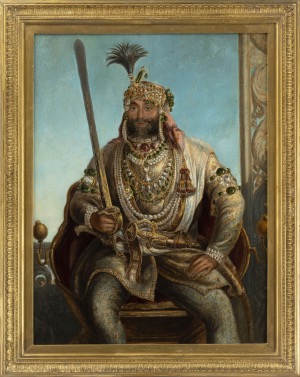
August Schoefft, Maharaja Sher Singh (1807–1843) seated on his father’s golden throne
Lahore, Punjab or Delhi, c 1841–42 © Toor Collection 

The remarkable life and legacy of Maharaja Ranjit Singh (1780-1839), the founder of the Sikh Empire, is the subject of a new exhibition which opened at the Wallace Collection this week. Ranjit Singh: Sikh, Warrior, King features historic objects from Ranjit Singh’s court, courtiers and family members, including those personally owned by the Maharaja and the most famous of his wives, Maharani Jind Kaur, as well as their son, Maharaja Duleep Singh. Highlights include a fine miniature painting of Ranjit Singh and his favourite, a Golden Throne made by Hafez Muhammad Multani, and a sword richly mounted in gold and gemstones which was thought to belong to the Maharajah. Runs until 20th October at the Manchester Square institution. Admission charge applies. For more, see www.wallacecollection.org/whats-on/events/ranjit-singh-sikh-warrior-king/.

A “fresh perspective” on London can be seen in a new exhibition by multi-award-winning wood engraver Anne Desmet at the Guildhall Art Gallery. Inspired by looking at a fragmented view of the world through a toy kaleidoscope, Anne Desmet: Kaleidoscope/London features works created by the artist slicing into prints focused on London from her earlier wood-engravings, linocuts and hand-drawn lithographs to make a new series of digital collages. The display features 150 works including 41 London-themed kaleidoscopic prints created exclusively for this exhibition. Among highlights is a complex collage, Fires of London, created using 18 razor-clam shells to present a theme of the many historic fires of London over the last 1,500 years. Admission is ‘pay what you can’. There are an accompanying series of artist-led tours. Runs until 8th September. For more, see www.cityoflondon.gov.uk/events/anne-desmet-kaleidoscopelondon-exhibition.

• Photographs depicting women and children forced to leave their Ukrainian homes following Russia’s invasion is on at the Foundling Museum in Bloomsbury. Polly Braden: Leaving Ukraine features the work of photographer Polly Braden and includes first-hand photographs, personal films and recorded conversations. It focuses on four central stories – that of three school friends trying to forge new lives and continue their education; that of a young graduate making a fresh start as a lawyer in London; that of a mother whose baby was born shortly after a perilous escape from Kherson to Warsaw; and that of two friends and their children who fled to Moldova with help from a kickboxing club, now struggling to find work in Italy. Admission charges apply. Can be seen until 1st September. For more, see https://foundlingmuseum.org.uk/event/polly-braden-leaving-ukraine/.

Send all items to exploringlondon@gmail.com

This Week in London – Buckingham Palace to open East Wing; ‘Now Play This’ marks 10 years; Vaisakhi at Trafalgar Square; and, the warden’s private apartments opened at Walmer…

The East Wing of Buckingham Palace with the Central Balcony. PICTURE: Mike Marrah/Unsplash

• The East Wing of Buckingham Palace – including the room off which the famous central balcony sits – is being opened to the public for the first time this year as part of the annual summer opening. Tours will take visitors to locations including the Principal Corridor, where paintings by artists such as Thomas Gainsborough, Sir Thomas Lawrence and Franz Xaver Winterhalter are on display, as well as the Yellow Drawing Room, decorated with recently restored Chinese hand-painted wallpaper from the 18th century, where visitors will see two hexagonal, nine-tiered Chinese porcelain pagodas and the Kylin Clock. They’ll also see the Centre Room, which leads on to the balcony, where highlights include a newly restored glass chandelier shaped to resemble a lotus flower, and two Chinese 18th-century imperial silk wall hangingspresented to Queen Victoria by Guangxu, Emperor of China, for her Diamond Jubilee in 1897. A limited number of tours will run daily from 15th July and through August. Tours must be booked in addition to standard entry. Admission charge applies. For more, see https://www.rct.uk/event/the-state-rooms-and-east-wing-highlights-tour-07-2024.

Now Play This, London’s festival of innovative and experimental games marks its 10th anniversary as part of the city-wide London Games Festival from Saturday. The eight day event at Somerset House, this year running under the theme of ‘Liminal: Playing Between Worlds’, features games including Atuel (Matajuegos) which involves shapeshifting into animals within Argentina’s Atuel River Valley ecosystem and Proteus (Ed Key & David Kanaga) in which players explore unknown fantasy worlds as well as daytime events such as GOLF, a build-your-own mini-golf course, and evening events such as the Boring office party, a twist on the classic murder mystery. Admission charges apply. Runs until 14th April. For more, see https://nowplaythis.net.

Trafalgar Square will host celebrations for the Sikh festival of Vaisakhi this Saturday. From noon until 6pm, the celebration of Sikh and Punjabi culture and heritage will be co-hosted by DJ and presenter Tommy Sandhu and entrepreneur, disability specialist and speaker Shani Dhanda. Events include Kirtan performances, demonstrations of Gatka, a Sikh martial art and talks by expert chefs as well as turban tying, film screenings, sports with the Sikh Games, and Sikh artists displaying their work. There’s also a children’s marquee with free activities from Kiddie Sangat and free vegetarian treats and traditional Indian tea will be available over the course of the afternoon. For more, see www.london.gov.uk/vaisakhi.

Walmer Castle in Kent. PICTURE: Ben Garratt/Unsplash

Further Afield: The Lord Warden’s private apartment has opened to the public for the first time at Walmer Castle, the seaside retreat of the late Queen Elizabeth, The Queen Mother, in Kent. The private apartment is given to the Lord Warden of the Cinque Ports, a position the Queen Mother held between 1978 and 2002. Visitors are able to tour a selection of rooms in the apartment, including the sitting, dining and master bedroom, which were used by The Queen Mother, Lord Boyce and other 20th century Lord Wardens and their families. Among the private items on show are family photos of the Boyce family and artwork, including a selection of paintings from a private and much-treasured collection belonging to Sir Robert Menzies and which depict places connected with his political career, including his time as Prime Minister of Australia. The post of warden is currently vacant following the death of Lord Boyce in 2022. Some rooms in the castle are currently closed to allow for a major conservation project to take place, however visitors can still see Wellington’s bedroom and the famous Wellington boots. Admission charges apply. For more, see https://www.english-heritage.org.uk/walmer.

Send all items to exploringlondon@gmail.com.

This Week in London – Hampton Court’s bunny hunt returns; vintage prints at the National Portrait Gallery; and, ‘Sounds of Blossom’ at Kew…

Gardens at Hampton Court Palace. PICTURE: edwin.11 (licensed under CC BY 2.0)

The Lindt Gold Bunny hunt returns to Hampton Court Palace this Saturday with families once again invited to search the gardens for those elusive Gold Bunny statues. Each statue offers a chance to match the names of influential characters from Hampton Court Palace’s history to the distinctive red ribbons and a small Lindt bunny chocolate awaits those who succeed in finding the bunnies. Visitors will also have the chance to encounter a selection of the characters roaming the palace over the Easter period. The Gold Bunny hunt is included in general admission. Until 14th March. For more, see www.hrp.org.uk/hampton-court-palace/whats-on/easter-lindt-gold-bunny-hunt/.

Rare vintage prints by two of art history’s most influential photographers – Francesca Woodman (1958-1981) and Julia Margaret Cameron (1815-1879) – go on show at the National Portrait Gallery today. Francesca Woodman and Julia Margaret Cameron: Portraits to Dream In showcases more than 160 rare vintage prints including 97 by Woodman and 71 by Cameron as well as artist’s books by Woodman which have never been exhibited before in the UK. Key works include Cameron’s self-declared “first success” – a portrait of Annie Wilhemina Philpot taken in 1864, Woodman’s Self-portrait at thirteen, taken during a summer holiday in Italy in 1972, images from Woodman’s Angel series and Cameron’s ethereal portraits of actor Ellen Terry taken in 1864. Also featured are Woodman’s Caryatid pieces and Cameron’s portraits of her niece and favorite model Julia Jackson, Alice Liddell as the goddess Pomona, a portrait of John Frederick William Herschel called The Astronomer (1867), and those of her frequent muses, May Prinsep and Mary Ann Hillier. Runs until 16th June. Admission charge applies. For more, see www.npg.org.uk.

A new collaboration with the Royal College of Music blends music with spring blooms at Kew Gardens. Sounds of Blossom: Awaken your senses, the first ever spring festival to be held at the gardens, features six bespoke commissions that celebrate Kew’s unique landscape in the spring emerging from locations such as Cherry Walk, Asano Avenue and the Japanese Landscape. And on weekends during the festival, visitors can enjoy live musical performances from the Royal College of Music as they showcase a varied repertoire from classical favourites to jazz melodies. Included in general admission. Runs until 14th April. For more, see www.kew.org/kew-gardens/whats-on/sounds-of-blossom.

Send all items to exploringlondon@gmail.com

This Week in London – Underground shelters in wartime – then and now; new Ravenmaster at the Tower; and, ‘La Ghirlandata’ back at the Guildhall Art Gallery…

A new photographic exhibition exploring how Underground stations and metro systems provide shelter to citizens during periods of war, both now and in the past, opened at the London Transport Museum in Covent Garden last week. Echoes of the Blitz: Underground shelters in Ukraine and London features 70 images, including historical pictures from the museum’s collection as well as 38 contemporary photographs shot by six renowned, mainly Ukrainian, documentary photographers. The latter include photography showing ordinary Ukrainian citizens sleeping, waiting, cooking, washing clothes, caring for their pets and creating temporary make-shift homes in metro stations of Kyiv and and Kharkiv show alongside black and white archive images of Londoners taking refuge in Tube stations during World War II. The exhibition, which is being run in partnership with Berlin-based journalistic network n-ost, can be seen until spring next year. Admission charge applies. For more, see www.ltmuseum.co.uk.

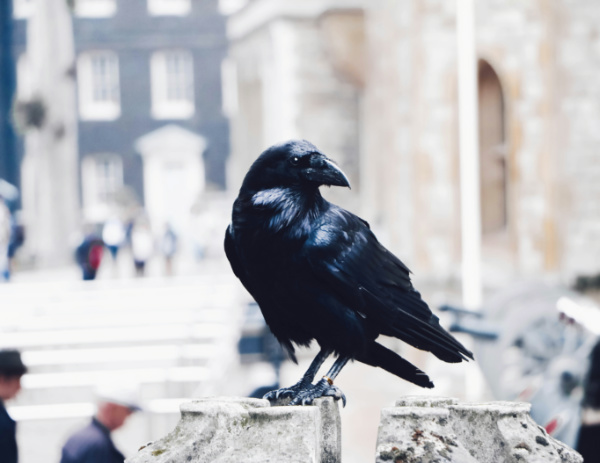
A raven at the Tower of London. PICTURE: Kasturi Roy/Unsplash

A new Ravenmaster has been appointed at the Tower of London. Yeoman Warder Michael ‘Barney’ Chandler took up the role at the start of this month, 15 years after he first became a Yeoman Warder at the Tower. The Ravenmaster oversees a team of four responsible for the care of the Tower’s seven ravens which legend says must remain at the Tower to ensure its protection. The legend apparently goes back to at least the reign of King Charles II – when the King’s astronomer John Flamsteed complained that the resident ravens were impeding his work at the Tower and requested their removal, the King was told that if the ravens left the Tower then the Kingdom would fall (and so they remained). While the Yeoman Warders have longed cared for the ravens, the post of Ravenmaster was only created in the past 50 years and was first held by Yeoman Warder Jack Wilmington. Yeoman Warder Chandler, who became the 387th Yeoman Warder at the Tower when he was appointed in March, 2009, is only the sixth person to hold the office. For more, see www.hrp.org.uk/tower-of-london/.

One of the most popular paintings at the Guildhall Art Gallery is being reinstalled to mark International Women’s Day on Friday. Dante Gabriel Rossetti’s La Ghirlandata has been on loan – first to the Tate Britain and then to the Delaware Art Museum in the US – but is now being returned. The painting dates from 1873 and depicts a ‘garlanded woman’ playing an arpanetta and looking directly at the viewer. The muse for the woman is said to have been the actor and model, Alexa Wilding, while the two ‘angels’ in the top corners were posed by William and Jane Morris’ youngest daughter, May Morris. The City of London Corporation acquired the oil on canvas work in 1927. On Saturday, free family activities will be held at the gallery to mark the work’s return. For more, see www.thecityofldn.com/la-ghirlandata.

Send items to exploringlondon@gmail.com.

This Week in London – Women of the RNLI; ‘Tropical Modernism’ at the V&A; and, a new memorial to Sir Ernest Shackleton unveiled at Westminster Abbey…

National Maritime Museum in Greenwich. PICTURE: Keith Murray (licensed under CC BY-NC-ND 2.0)

The role of women in the Royal National Lifeboat Institution is being celebrated in a new exhibition at the National Maritime Museum in Greenwich. Women of the RNLI, which marks the bicentenary of the organisation, features a series of 42 photographs depicting women volunteers and the lifeboat stations’ slipways where they work. The images by photographer Jack Lowe are part of his ongoing ‘Lifeboat Station Project’an attempt to photograph all 238 operational RNLI lifeboat stations and their crews.. Lowe uses a 12×10 inch (30×25cm) Thornton-Pickard field camera from about 1905 and develops the photos using a process called ‘wet collodion’, a technique invented in the mid-19th century. The display also features oral histories from some of the sitters. The display can be seen from Saturday until 1st December. For more, see www.rmg.co.uk.

• A new exhibition exploring the architectural style of Tropical Modernism in West Africa and India opens at the V&A on Saturday. Tropical Modernism: Architecture and Independence centres on the work of British architects Jane Drew and Maxwell Fry who developed Tropical Modernism in the 1940s, working primarily in Ghana and India. The style, which valued function over ornamentation, became a symbol of a post-colonial future. The exhibition includes models, drawings, letters, photographs, and archival ephemera as it documents the key figures and moments of the Tropical Modernist movement. There is also a half hour film installation displayed on three screens. Runs until 22nd September. Admission charge applies. For more, see vam.ac.uk.

A new memorial stone dedicated to Antarctic explorer Sir Ernest Shackleton has been unveiled at Westminster Abbey. The triangular-shaped memorial, which can be found on a wall in the south cloister, was unveiled at a service earlier this month attended by Princess Anne and members of Shackleton’s family. Located close to tributes to pioneering sailors Captain James Cook, Sir Francis Chichester and Sir Francis Drake, it was designed and made by sculptor Will Davies and its shape reflects Shackleton’s preference to be at the apex of a triangle in group photographs. The memorial incorporates stones including Connemara marble and Kilkenny limestone in reflection of Shackleton’s Irish heritage, and the names of his expedition ships, Nimrod and Endurance, are inscribed upon it, along with the lifeboat The James Caird, and his family motto, ‘FORTITUDINE VINCIMUS’ (‘By Endurance We Conquer’). For more, see www.westminster-abbey.org.

Send all items to exploringlondon@gmail.com.

This Week in London – John Singer Sargent at the Tate; vote for the Fourth Plinth occupants; and the Black figure celebrated in contemporary art at the National Portrait Gallery…

John Singer Sargent, Lady Helen Vincent, Viscountess d’Abernon, 1904 Birrmingham Museum of Art. Photo Sean Pathasema

The work of portrait painter John Singer Sargent (1856-1925) is the subject of a new exhibition opening at Tate Britain today. Sargent and Fashion features some 60 paintings as well as a dozen period dresses and accessories with many of the former worn by his sitters and several reunited for the first time with the portraits in which they are shown. Highlights include Lady Helen Vincent, Viscountess d’ Abernon (1904), Mrs. Charles E. Inches (Louise Pomeroy) (1887), which will be juxtaposed with the red velvet evening dress illustrated, and, Charles Stewart, sixth Marquess of Londonderry at the Coronation of Edward VII (1904) which will be reunited with the regalia worn by the marquess. Also on show is Sargent’s iconic painting of socialite Virginie Amélie Gautreau, Madame X (1883-4), which caused a stir by depicting Mme Gautreau with one diamond strap falling from her shoulder, Mrs Montgomery Sears (1899) which is being shown alongside Mrs Sears’ own dresses and her photographs of Sargent at work, and his dramatic image, Ellen Terry as Lady Macbeth 1889 which is being shown alongside Terry’s dress and cloak. Runs until 7th July. Admission charge applies. For more, see www.tate.org.uk/whats-on/tate-britain/sargent-and-fashion.

The public are being asked to vote on a shortlist of seven sculptural works to determine which of them will occupy Trafalgar Square’s Fourth Plinth in 2026 and 2028. The works include Ruth Ewan’s Believe in Discontent depicting a black cat, Chila Kumari Singh Burman’s The Smile You Send Returns to You featuring a colourful bus with a tiger atop it and Veronica Ryan’s Sweet Potatoes and Yams are Not the Same which features a sweet potato “island” with growing vine leaf sprouting out of it. Models of the short-listed works can be seen at The National Gallery (Room 1, entry is free) until 1st March. To vote, head to https://www.london.gov.uk/programmes-strategies/arts-and-culture/current-culture-projects/fourth-plinth-trafalgar-square/fourth-plinth-commissions

A major exhibition exploring the Black figure opens at the National Portrait Gallery today. The Time is Always Now: Artists Reframe the Black Figure features 55 contemporary works, including sculpture, paintings and drawings, by some 22 African artists working in the US and UK. The works include Amy Sherald’s life-size greyscale portraits of African Americans, American figurative artist Nathaniel Mary Quinn’s fragmented portraits, Thomas J Price’s life-sized fictional female figure, As Sounds Turn to Noise (2023), Noah Davis’ depiction of Greenwood, Oklahoma, known as Black Wall Street (2008), Kimathi Donkor’s history painting Nanny of the Maroons’ Firth Act of Mercy (2012) and Lubaina Himid’s work Le Rodeur: The Exchange (2016) which responds to a case of blindness that affected a French slave ship in 1819. The display is curated by writer Ekow Eshun, former director of the Institute of Contemporary Arts. Runs until 19th May. Admission charge applies. For more. see www.npg.org.uk.

Send all items to exploringlondon@gmail.com

This Week in London – Billingsgate Market history explored; new landscapes at Dulwich; and, recovered gems on show…

The history of Billingsgate Market in the City of London is being explored in am exhibition at the City of London Heritage Gallery. Billingsgate Market at the Heritage Gallery features items including the Liber Horn, a compilation of charters, statutes, and customs made by Andrew Horn, chamberlain of the City of London from 1320-1328, in 1311 which is illustrated by small images of fish showing their importance to Londoners, a late 17th century petition by the fishermen protesting the landing of vessels loaded with salt and oranges, 19th century volumes recording the collection of tolls and detailing the licensing of porters, and 20th century photographs of the market at work. Free to view, the display, located in the Guildhall Art Gallery, can be seen until 16th May. For more, see www.thecityofldn.com/billingsgateexhibition

Hurvin Anderson, ‘Limestone Wall’ (2020) © Hurvin Anderson. Courtesy the artist and Thomas Dane Gallery. Photo: Richard Ivey

A major new exhibition featuring new interpretations of landscape art has opened at the Dulwich Picture Gallery. Soulscapes features more than 30 contemporary works spanning painting, photography, film, tapestry and collage by artists such as Hurvin Anderson, Phoebe Boswell, Njideka Akunyili Crosby, Kimathi Donkor, Isaac Julien, Marcia Michael, Mónica de Miranda and Alberta Whittle. Highlights include Anderson’s Limestone Wall (2020), Akunyili’s Cassava Garden (2015) and Donkor’s Idyl series (2016-2020). Runs until 2nd June. Admission charge applies. For more, see www.dulwichpicturegallery.org.uk.

Blacas cameo depicting Augustus – Roman, AD 14–20 1867

A selection of gems recovered after news that around 2,000 objects from the British Museum’s collections were missing, stolen or damaged go on show at the museum from today. Rediscovering gems explores the significance of classical gems – used as seals, worn as jewellery or collected as objects of beauty in the ancient world – and the impression they have left throughout history. The gems are displayed in a typical 18th century gem cabinet, along with a collector’s equipment, in reflection of the huge interest in classical gems during the period. The display can be seen in Room 3 until 15th June. Admission is free. For more, see britishmuseum.org/exhibitions/rediscovering-gems.

Send all items to exploringlondon@gmail.com

This Week in London – Impressionists on paper; Vanessa Bell and Duncan Grant honoured with a Blue Plaque; new Burnham Beeches history app; and, young artists celebrated on London billboards…

Claude Monet, ‘Cliffs at Etretat: The Needle Rock and Porte d’Aval’, c 1885. National Galleries of Scotland.

A new exhibition exploring how Impressionist and Post-Impressionist artists in late 19th-century France radically transformed the status of works on paper opens at the Royal Academy on Friday. Impressionists on Paper: Degas to Toulouse-Lautrec features around 80 works on paper by artists including Mary Cassatt, Paul Cézanne, Edgar Degas, Paul Gauguin, Eva Gonzalès, Claude Monet, Berthe Morisot, Odilon Redon, Pierre-Auguste Renoir, Georges Seurat, Henri de Toulouse-Lautrec and Vincent van Gogh. Among the highlights are Degas’ Woman at a Window (1870-71), van Gogh’s The Fortifications of Paris with Houses (1887), Monet’s Cliffs at Etretat: The Needle Rock and Porte d’Aval (c1885) and Toulouse-Lautrec’s images of the urban underworld of Montmartre. The display can be seen in The Gabrielle Jungels-Winkler Galleries until 10th March. Admission charges apply. For more, see royalacademy.org.uk.

English Heritage have unveiled their final Blue Plaque for 2023 and it celebrates two of the most influential painters of the early-to-mid 20th century, Vanessa Bell and Duncan Grant. The plaque was unveiled at number 46 Gordon Square in Bloomsbury, from where the Bloomsbury Group – of which Bell and Grant were leading members – drew its name. Bell first lived at number 46 with her siblings, including Virginia Stephen (later Woolf), and, in 1914, Grant moved in with Vanessa and her husband, Clive Bell. Paintings the pair made at number 46 include Grant’s Interior at Gordon Square (c1915) and Bell’s Apples: 46 Gordon Square (c1909-10), a still-recognisable view from the drawing-room balcony to the square. For more on the English Heritage Blue Plaques scheme, head to www.english-heritage.org.uk/visit/blue-plaques/.
The history of Burnham Beeches has been brought to life with a new augmented reality app. The app allows users to superimpose periods of Burnham Beeches’ history – from the Iron Age, Middle Ages and World War II – over what they see when visiting the site and incorporates sounds from selected era as well. It can be accessed via a QR code which is being published on signs at Burnham Beeches. Burnham Beeches, located near the village of Burnham in Buckinghamshire, was acquired by the City of London in 1880 when the area was threatened by development and is managed as a free open space. For more, head here.

The work of 30 young artists celebrating African community and culture is being showcased on billboards across the city in conjunction with Tate Modern’s current exhibition, A World in Common. The photographs have been selected following a call from the Tate Collective for 16-to-25-year-olds to submit images responding to the exhibition. More than 100 entries were submitted by young people based across the UK and beyond and Londoners will be able to view the 30 shortlisted works on billboards in Haringey, Lambeth, Southwark and Tower Hamlets over the next two weeks.

Send all items to exploringlondon@gmail.com.

This Week in London – Hans Holbein at The Queen’s Gallery; ‘Crown and Coronation’ at the Tower; Christmas at Kew; and, Charles Dickens’ friendship with Wilkie Collins explored…

Hans Holbein the Younger, 
Anne Boleyn (1532)/Royal Collection Trust / © His Majesty King Charles III 2023.

The largest exhibition of the work of Tudor-era artist Hans Holbein the Younger has opened at The Queen’s Gallery, Buckingham Palace. Holbein at the Tudor Court features more than 50 works by Holbein including intimate portrait drawings of the royal family and the Tudor nobility including one of few surviving drawings of Anne Boleyn made during her lifetime, drawings of Jane Seymour and Sir Thomas More, and an unfinished portrait of King Henry VIII’s son Prince Edward. Other portraits include that of Derich Born, a 23-year-old Steelyard merchant, and one of Richard Southwell, a convicted murderer who was one of King Henry VIII’s closest advisors. The exhibition also features objects including a Brussels tapestry, jewel-like miniatures and Henry VIII’s magnificent armour, usually on show at Windsor and in London for the first time in a decade. Runs until 14th April. Admission charge applies. For more, see www.rct.uk/collection/themes/exhibitions/holbein-at-the-tudor-court/the-queens-gallery-buckingham-palace

The White Tower looking south-east, showing a coloured light projection of St Edward’s Crown, the crown used at the moment of Coronation. PICTURE: © His Majesty King Charles III 2023 -Royal Collection Trust – Historic Royal Palaces

The magnificence of coronations and the Crown Jewels will be on show at the Tower of London from tomorrow night in a new light and sound show. Crown and Coronation – which has been created by Historic Royal Palaces in partnership with Luxmuralis as part of an artistic collaboration between artist Peter Walker and composer David Harper – brings the “spectacle, significance and shared experience” of coronations to life and demonstrates the pivotal role of the Crown Jewels in the ceremony as it takes visitors on a journey through the past 1,000 years. Images of the jewels will be projected on the White Tower in the show with visitors then able to view the actual jewels themselves in a special after hours opening. But you’ll have to be quick – the show can only be seen for nine days, ending on 25th November before it embarks on a two year UK-wide tour. Admission charge applies. For more, see www.hrp.org.uk/tower-of-london/.

The Palm House light show, part of Christmas at Kew. PICTURE: © Raymond Gubbay Ltd, Richard Haughton

Christmas returned to Kew this week with the launch of it’s new festive light trail featuring seven new installations. Highlights of this year’s trail include three metre tall illuminated flowers, cascading lights suspended from the tree canopy, one of the longest light tunnels to ever feature in Kew’s Christmas celebrations and the Hive – which recreates life inside a beehive – as well as the iconic Palm House light show, the twinkling tunnel of light inspired by arched church windows known as the ‘Christmas Cathedral’, and a ‘Fire Garden’ at the Temperate House. There’s also festive treats to sample and visitors can experience a traditional Christmas dinner at The Botanical Brasserie. Admission charges applies. Runs until 7th January (advance bookings only). For more, see www.kew.org/christmas.

Charles Dickens’ friendship and collaboration with writer Wilkie Collins is explored in a new exhibition at The Charles Dickens Museum in Bloomsbury. Dickens met Collins, who would become one of his most significant friends, in 1851 as they performed together in a play at the house of John Forster and their personal and professional relationship lasted more than 15 years. The display features works produced as a result of the friendship – everything from articles in Dickens’s Household Words through to novellas and plays such as The Lazy Tour of Two Idle Apprentices and The Frozen Deep – and features original letters, historic objects, and interactive displays focusing on everything from the pair’s moustache-growing contests and cruising international entertainment districts to co-writing side by side, discussing writer’s block and plot devices. Admission is included with general admission. Runs until 25th February. For more, see https://dickensmuseum.com.

Send all items to exploringlondon@gmail.com.

This Week in London – Myanmar explored; Hockney portraits; and the world’s fastest all-electric aircraft…

The Golden Letter of Alaungpaya, Konbaung period, 18th century © Gottfried Wilhelm Leibniz Bibliothek –Niedersächsische Landesbibliothek, Hannover, Ms IV 751a
Oil Workers Helmet, 1900s © Calderdale Museums Services

A new exhibition exploring the history of Myanmar, also known as Burma, opens at the British Museum today. Burma to Myanmar, the first major exhibition in the UK to focus on the country’s history, features more than 110 objects and spans the period from around 450 AD through today. Highlights include: a golden letter sent from King Alaungpaya to George II which, made of gold, is set with 24 rubies and placed in an elephant tusk case; a wall hanging (a ‘shwe-chi-doe’ or ‘kalaga’) illustrating scenes from the Ramayana; a gold Buddhist reliquary from the 1400s; a late 19th or early 20th century blanket from the Nung-Rawang people; an oil worker’s helmet from the early 1900s; a map of several Shan states from the 1880s made to assist the British in the process of drawing hard borders with China; and, a bust of General Aung San (1915–47), leader of the Burma Independence Army. The exhibition in the Joseph Hotung Great Court Gallery can be seen until 11th February. Admission charge applies. For more, see http://www.britishmuseum.org/exhibitions/burma-myanmar

More than 30 portraits painted by British artist David Hockney at his Normandy studio between 2021 and 2022 can be seen for the first time in an exhibition of the artist’s works at the National Portrait Gallery. David Hockney: Drawing from Life was open for just 20 days prior to the gallery’s closure due to COVID-19 in 2020. It has now returned in an expanded form, featuring 160 works which trace the trajectory of Hockey’s practice largely through his intimate portraits of five sitters – Celia Birtwell, Hockney’s mother Laura Hockney; his former partner and curator Gregory Evans; master printer Maurice Payne and himself. The newly added portraits include depictions of the likes of actor and singer Harry Styles and people from the Normandy community in which he works. The exhibition can be seen until 21st January. Admission charge applies. For more, see ngp.org.uk/whatson/exhibitions/2023/hockney-drawing-from-life.

Rolls Royce’s Spirit of Innovation electric aircraft © Science Museum Group

The world’s fastest all-electric aircraft, Spirit of Innovation, has gone on show at the Science Museum in South Kensington. Suspended as if in mid-flight, the aircraft is the final object in Making the Modern World, a major gallery which presents advances in science and technology from the birth of the Industrial Revolution to the present day. Powered by a lightweight and energy efficient 400kW electric powertrain, Spirit of Innovation holds the all-electric aircraft world record for highest top speed over three kilometres, with an average of 555.9km/h (345.4 mph), breaking the previous record by over 200 kilometres per hour. The plane also set a new record for the fastest climb by an electric aircraft to three kilometres. Rolls-Royce created the aircraft as part of the Accelerating the Electrification of Flight (ACCEL) project, in collaboration with Electroflight (now part of Evolito), YASA, and the Aerospace Technology Institute. The gallery is free to visit. For more, see www.sciencemuseum.org.uk.

Send all items for inclusion to exploringlondon@gmail.com