10 small (and fascinating) museums in London…3. The Foundling Museum

Opened in 2004, the Foundling Museum was created to look after the former Foundling Hospital’s collection of art and artifacts and provides a unique and deeply moving insight into the work of the hospital and those who came under its care.
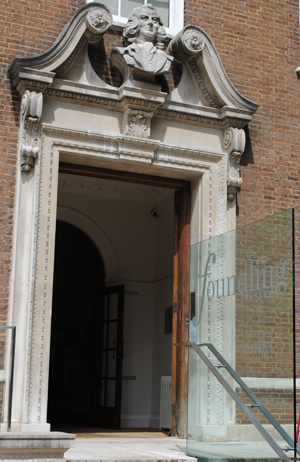
The Foundling Hospital’s origins go back to the 1720s when former mariner and ship-builder Captain Thomas Coram, shocked by the number of abandoned babies he saw in London (it’s estimated that in the early 1700s, there were as many as 1,000 babies being abandoned every year), began a campaign to found a hospital for “exposed and deserted young children”, that is, ‘foundlings’.

The hospital was founded in 1739 after King George II granted it a royal charter and, from that date until its closure in 1953, had some 27,000 children pass through its doors.

The museum’s story is not an easy one to tell for while the hospital was founded with the best of intentions, the life of the children who came into its care – even in the 20th century – remained far from easy; it was not, as one of those who formerly lived at the hospital notes, a life they would wish on anyone else. But the museum handles their story – as well as that of those behind the hospital’s founding – with care and dignity.

Located at 40 Brunswick Square – close to the site of the original hospital, the museum is spread over four floors. On the ground floor is an exhibition which details the hospital’s history and features objects including a series of sketches by the controversial 18th century artist William Hogarth, an ardent supporter of the hospital’s work and later one of the many artists who became a governor, as well as the founding charter document itself.

Among the most poignant of the artifacts to be found in the museum are the tokens mothers left with their children so they could later identify them (these were removed from the children on being taken into the hospital, however, to ensure the child’s anonmity).

The lower ground floor has a space for temporary exhibitions – at present this contains the ‘Foundling Voices’ exhibition in which those who once lived under the care of the hospital tell their stories firsthand in what is an emotional journey into the hospital’s relatively recent past (the exhibition runs until 30th October). It is also home to the reconstructed Committee Room, built as part of the original hospital in the mid-1700s, dismantled and then reconstructed in the new headquarters.

Upstairs (the stairs themselves were taken from the boy’s wing of the original hospital), is a reconstruction of the hospital’s original Picture Gallery which was London’s first public art gallery and was instrumental in raising the profile of the work of the hospital. Among the works it contains is Hogarth’s 1740 portrait of Captain Thomas Coram. Nearby is the Court Room, another reconstruction from the original hospital, this time of the building’s most splendid room, used for meetings of the Board and Governors and other special occasions. It too contains numerous artworks.

The top floor of the building houses the Gerald Coke Handel Collection, said to be the greatest collection of artifacts relating to composer George Frideric Handel in the world. Handel’s assocation with the museum goes back to 1749 when he offered a performance of his music to help fund the hospital’s completion. He held another the following year, this time performing the Messiah, and after that Handel agreed to an annual benefit performance – a practice which continued until his death in 1759.

Key artifacts in the Handel collection include the composer’s will and codicils, written in his own hand, as well as programme from the first performance of the Messiah along with other documents and artworks.

WHERE: The Foundling Museum, 40 Brunswick Square, Bloomsbury (nearest Tube station is Russell Square); WHEN: 10am to 5pm, Tuesday to Saturday/11am to 5pm Sunday (closed Mondays); COST: £7.50 an adult/£5 concessions/children under 16 free; WEBSITE: www.foundlingmuseum.org.uk.

Famous Londoners – Sir Hans Sloane

An Ulster-Scots born physician, scientist and avid collector, Sir Hans Sloane served as doctor to no less than three British monarchs during the 17th and 18th centuries and during his life amassed a vast collection of natural specimens and curiosities which after his death were used to form the core of the British Museum’s collection.

Born on 16th April, 1660, at Killyleagh in County Down, Ireland, Sir Hans was the son of Alexander Sloane, a “receiver-general of taxes” who originally hailed from Scotland.

Even as a young man, he developed a keen interest in the natural sciences. Having suffered from some ill-health which, at the age of 16 is said to have kept him confined to a room for a year, in 1679, at the age of 19, he moved to London where he studied chemistry at the Apothecaries Hall and botany at the Chelsea Physic Garden – a period during which he befriended the botanist John Ray and chemist Robert Boyle.

Four years later, he travelled through France where he received his Doctorate of Physics. On his subsequent return to London in 1685, he was made a Fellow of the Royal Society and in 1687 a Fellow of the Royal College of Physicians.

Given the chance to travel to Jamaica as physician to the new Governor, Christopher, the 2nd Duke of Albemarle, he only spent 15 months there (the Governor died soon after arrival). But it was an important period during which not only did he document and collect a vast amount of flora and fauna (bringing some 800 specimens back to London), he also came up with the idea of drinking chocolate with milk after witnessing locals drinking the dark chocolate with water but finding the mix made him “nauseous” (back in England, his concoction was first sold as a medicine and was later manufactured as a drink by Cadburys).

Having returned to London in 1689, he published the information he had gathered in Jamaica, and in 1693 he become secretary to the Royal Society.

In 1695 he married a Jamaican sugar planter’s widow, Elizabeth Langley Rose (with whom he had several children but of whom only two daughters, Sarah and Elizabeth, survived) and, thanks in part to an ongoing association with the duke’s widow, was able to set up a fashionable medical practice at 3 Bloomsbury Place on the northern end of Bloomsbury Square.

The house, not far from where the British Museum now stands, become something of an attraction in its own right, filled with objects and specimens he had collected on his travels as well as those – in some cases complete collections – given to him by others including friends and patients (in fact, he had to purchase the property next door, number four, to find room for them all – this property is now marked with a Blue Plaque).

The composer Handel is said to have been among those who visited the property and there is a delightful tale that says Sir Hans was outraged when Handel placed a buttered scone on one of his rare books.

With his services as a physician highly prized, in 1696, he was appointed physician to Queen Anne, the first of the three monarchs he would serve. In 1712-13, with his collection still growing, he purchased the Manor of Chelsea to help house it (four acres of which were leased to the Chelsea Physic Garden, which had been founded in 1673 with the idea of providing a training ground for apprentice apothecaries, in perpetuity).

He subsequently moved his collection out to this property and his connection with Chelsea is still celebrated in place names such as name Sloane Square (not to mention Sloane Street, Sloane Gardens, Hans Street, Hans Crescent, Hans Road and Hans Place). There is also a statue of the bewigged man in Duke of York Square (pictured), not far from Sloane Square – this is a 2007 copy of 1737 original by John Rysbrack, another (older) copy of which can be found in the Chelsea Physic Garden.

Following Queen Anne’s death in 1714, in 1716 Sir Hans was appointed physician to her successor, King George I (he was also created a baronet the same year, becoming the first medical practitioner to receive a hereditary title).

Three years later, in 1719, he become president of the Royal College of Physicians, an office he held for 16 years, and in 1727, he was appointed physician to King George II. The same year he succeeded Isaac Newton as president of the Royal Society, an office which he held until 1741.

In 1742, Sir Hans retired to his property in Chelsea.

By the time of his death on 11th January, 1753 at the ripe old age of 93, Sir Hans had collected more than 71,000 objects including books, manuscripts, drawings, coins and medals and plant specimens which he bequeathed to King George II in exchange for a payment of £20,000 to his executors.

Parliament agreed, following a lottery to raise the money, his collection went on to form the basis of the British Museum, first opened to the public in 1759 in Bloomsbury. It was also to form the basis of the museum’s later offshoot, the Natural History Museum at South Kensington.

Sir Hans was buried at Chelsea Old Church with his wife Elizabeth who died in 1724.

Famous Londoners – Peter, the Wild Boy

Found living ‘wild’ in the woods near Hamelin in northern Germany, in 1725, Peter was brought to London at the behest of King George I the following year (the king had heard of his plight while visiting his Hanoverian homeland and had initially had him taken to his summer palace at Herrenhausen). Peter subsequently spent time at the court of the king as well as those of the Prince of Wales, the future King George II, and his wife, Caroline of Ansbach.

On his arrival in London, Peter, believed to be about 15 or 16 years old when he was found, quickly acquired celebrity status – Daniel Defoe wrote a pamphlet, Mere Nature Delineated, in which he mused about his nature and Jonathan Swift wrote a satire on the excitement surrounding his arrival in London while a wax figure of him was exhibited in the Strand and along with other palace courtiers, he appears in a now famous painting by William Kent which still hangs on the king’s grand staircase in Kensington Palace.

Treated by the royals as something of a ‘pet’, efforts were made to educate Peter but later abandoned due to his apparent lack of progress. Many were also said to have been shocked at his lack of manners – something that may have helped contribute to his eventual departure from court.

When the king died in 1727, his daughter-in-law, now Queen Caroline, granted a yeoman farmer in Hertfordshire, James Fenn, a pension in return for looking after Peter.  He is recorded as having wandered off on a couple of occasions and, after one incident involving a fire in 1751, was fitted with a collar to prevent further escapes (the collar is still in the keeping of the Berkhamsted School in Hertfordshire).

Peter subsequently spent the remainder of his life in rural England (where he was known to have developed a love for gin but was generally remarked upon as being timid). Meeting him a few years before his death, Scottish philosopher and judge James Burnett, Lord Monboddo, recorded that while Peter could understand what was said to him, he could only say the words ‘Peter’ and ‘King George’.

Peter died in 1785, when he was at least 70-years-old. He was buried in the churchyard of St Mary’s Church in Northchurch, Hertfordshire.

It is now believed that Peter may have been affected by the chromosomal disorder Pitt-Hopkins Syndrome, thanks to the work of Historic Royal Palaces historian Lucy Worsley who, while researching the lives of courtiers at Kensington Palace for her book Courtiers, noted features such as Peter’s “cupid bow lips”, coarse hair and drooping eyelids in Kent’s portrait and passed on a description to a professor of genetics.

It is thought such a diagnosis may help explain why Peter ended up living alone in the German forest where he was found.

Wren’s London – 7. Kensington Palace

A once favored residence of British monarchs, Kensington Palace’s connections with royalty date back to 1689 when, then a private country home known as Nottingham House, the building was purchased by King William III and Queen Mary II.

The royal couple turned to Sir Christopher Wren, then Surveyor of the King’s Works, who was charged with adapting the property into a suitably regal residence.

Wren’s work included the addition of four new pavilions – one at each corner – to provide extra accommodation for the king and queen. The King’s Apartments, approached by a Grand Staircase, were located in the south east, and the Queen Apartment’s in the north west. While many later additions were made, the basic layout of these buildings remains true to Wren’s original design.

Among the many spectacular original rooms is the King’s Gallery, built for William in 1695. It features an 1694 wind dial connected to a weather vane which turns according to the direction of the prevailing wind.

The property’s subsequent royal residents have included Queen Anne, King George I and King George II (it was King George III who made Buckingham Palace his primary London residence). Princess (later Queen) Victoria was born here in 1819 (it was she who first opened the State Apartments to visitors in 1899) while more recent residents in the palace’s private areas have included Princess Margaret and, of course, Diana, Princess of Wales.

WHERE: The Broad Walk, Kensington Gardens, Kensington (nearest tube stations are High Street Kensington or Queensway); WHEN: Daily 10am to 5pm (last admission 4pm); COST: £12.50 adult/£11 concession/£6.25 child/£34 family (online booking discounts available, Historic Royal Palaces members free); WEBSITE: www.hrp.org.uk/KensingtonPalace

PICTURE: Historic Royal Palaces/newsteam.co.uk