The Royal Wedding – London’s Royal Wedding venues

In the first of a series this week looking at aspects of royal weddings in London in days past, we canvas some of the venues which have hosted the sometimes glittering occasions.
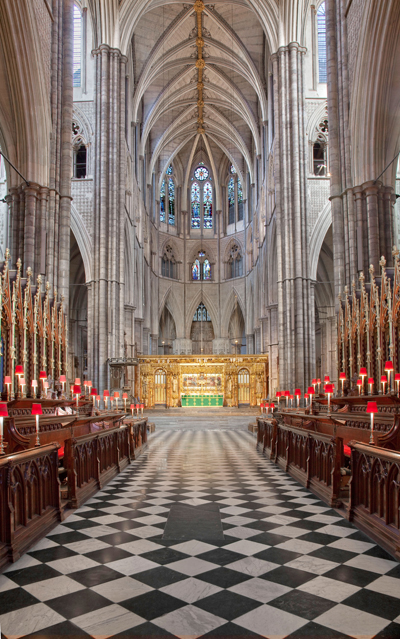
First up is Westminster Abbey (pictured), the location of Prince William and Kate Middleton’s wedding this Friday, which, despite its thousand year history, is only believed to have hosted 15 royal weddings.

Among them is said to have been the wedding of King Henry I to Matilda of Scotland on 11th November, 1100, as well as that of Richard, Earl of Cornwall and brother of King Henry III, who married his second wife, Sanchia of Provence, there on 4th January, 1243, and Joan of Acre, daughter of King Edward I, who married Gilbert, Earl of Gloucester, on 30th April, 1290 (her sister Margaret married John, Duke of Brabant, at the same venue less than three months later). The abbey also hosted the wedding of King Richard II to Anne, daughter of Emperor Charles IV of Bohemia, on 20th January, 1382.

The abbey church has become increasingly favored as a venue for royal weddings in more recent times. Among the most prominent hosted there last century were that of Prince Albert, Duke of York (later King George VI), who married Lady Elizabeth Bowes-Lyon on 26th April, 1923 and that of their daughter Princess Elizabeth (later Queen Elizabeth II) who married Prince Philip of Greece (later the Duke of Edinburgh) there on 20th November, 1947.

Two of the current Queen’s children were also married there – Princess Anne, who married Captain Mark Phillips on 14th November, 1973, and Prince Andrew, who married Sarah Ferguson on 23rd July 1986. (For more on Royal Weddings at the Abbey, see www.westminster-abbey.org/our-history/royals/weddings)

A notable break with the trend in recent times was the marriage of Prince Charles and Lady Diana Spencer – they were married in a fairytale ceremony at St Paul’s Cathedral on 29th July, 1981.

Other London locations for royal weddings have included the now non-existent Greenwich Palace (King Henry VIII married Katherine of Aragon on 11th June, 1509) and Hampton Court Palace (another of King Henry VIII’s marriages – that in which he was wed to Catherine Parr – was held here in a private chapel on 12th July, 1543).

Along with St George’s Chapel at Windsor, the Chapel Royal at St James’s Palace  in London was particularly popular in Victorian times – Queen Victoria married Prince Albert there on 10th February, 1840, and their eldest daughter, Princess Victoria, married Prince Frederick (the future German Emperor Frederick III) there on 25th January, 1858. On 6th July, 1893, the chapel also hosted the wedding of the future King George V and Princess Mary of Teck.

PICTURE: Copyright Dean and Chapter of Westminster
Famous Londoners – Geoffrey Chaucer

Best remembered for his landmark Middle English work in The Canterbury Tales, Geoffrey Chaucer is known by many as “the father of English literature”.

But he also had a distinguished career as a diplomat, civil servant and courtier and while much of his life (and death) remain something of a mystery, there’s no doubt that he spent a considerable part of it in London.

Chaucer (the name comes from the Latin for ‘shoemaker’) was born into a wealthy London family sometime between 1340 and 1345 and nothing is known of his early life or education. In 1357 he was working as a page in the household of Elizabeth, Countess of Ulster and daughter-in-law of King Edward III.

Two years later, he travelled in the retinue of the countess’ husband, Lionel, Duke of Clarence, to France with the army of King Edward III but in 1360 was captured near Rheims. He was subsequently ransomed with the king himself contributing to the sum needed.

Soon after Chaucer formally joined King Edward III’s court and was over the next two decades was sent on numerous missions by him to places as far flung as France, Genoa, Florence and possibly Padua (it was on these trips that he was apparently exposed to the writings of men such as Dante, Boccaccio and Froissart).

In 1366 he married Philippa Roet, a lady-in-waiting to Philippa of Hainault, King Edward III’s queen (and, some suggest, the sister to Katherine Swynford, mistress to John of Gaunt). Chaucer and his wife are believed to have three or four children – their son, Thomas, was later chief butler to English kings and served as the Speaker of the House of Commons.

In 1374, Chaucer was appointed as Comptroller of Customs for the Port of London, a post which he held until 1386 or so. It was during this time that he wrote many of his other major works including Parlement of Foules and Troilus and Criseyde (he had written his first major work, The Book of the Duchess, in honor Blanche of Lancaster, the late wife of his friend John of Gaunt sometime earlier following her death in 1369). Chaucer was also known at this time to have lived rent free in an apartment above the now removed Aldgate.

At some time in the 1380s, it is suggested Chaucer moved out to Kent where he is thought to have started work on The Canterbury Tales and where he also served as a local MP. His wife is believed to have died while they were there.

In 1389, he was appointed to the position of Clerk of the King’s Works and oversaw building projects at the Palace of Westminster, St George’s Chapel at Windsor Castle, and at the Tower of London (building the wharf). Later he served as deputy forester of the royal forest of North Petherton in Somerset.

Chaucer’s name disappears from records in 1400 and he is believed to have died either that year or shortly after. The cause of his death remains unknown although writer Terry Jones, in his book Who Murdered Chaucer?, has suggested Chaucer was murdered in 1402 at the behest of Thomas Arundel, the Archbishop of Canterbury – a claim which has met with short shrift with many.

Chaucer’s remains were later transferred to a more elaborate tomb and he become the first writer to occupy a space in Poet’s Corner – a fitting place for a towering figure of English literature.

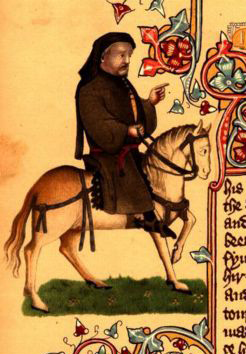
PICTURE: Image of Chaucer as a pilgrim from Ellesmere Manuscript in the Huntington Library in San Marino, California. The manuscript is an early publishing of the Canterbury Tales. Source: Wikipedia.

Happy Valentine’s Day!

It’s Valentine’s Day, so we’re pausing from our usual updates to give you a couple of interesting historical titbits…

• The first recorded written Valentine’s Day card is generally attributed to Charles, the Duke of Orleans, who wrote it to his wife while imprisoned in the Tower of London following King Henry V’s defeat of the French at the Battle of Agincourt in 1415;

• Geoffrey Chaucer, author of 1382 text Parlement of Foules – a poem written in honor of King Richard II’s engagement to Anne of Bohemia which is generally attributed with first linking St Valentine’s Day and romantic love, was born in and lived in London (although it should be noted that many don’t believe Chaucer was referring to 14th February in his reference but to another day associated with a different St Valentine).

PICTURE: Andrew C. (www.sxc.hu)