The Royal Wedding – Royal residences…

Word is that Prince William and his soon-to-be wife, Catherine Middleton, have yet to formally decide where they will live when in London (they are expected to spend much of their first two-and-a-half years of marriage in North Wales). 

Their initial London base, however, will reportedly be Clarence House. Located in The Mall, just down the road from Buckingham Palace and beside St James’s Palace, the grand building is currently the home of William’s father Charles, the Prince of Wales, his wife Camilla, Duchess of Cornwall, and, William’s brother, Prince Harry (it is also the home of William himself).

In years gone past, Clarence House served as the home of the newly married Queen Elizabeth II (then Princess Elizabeth) and her husband, Prince Philip, the Duke of Edinburgh. Prince Charles, who lived there with his parents until the age of three, returned to the property in August 2003 after the death of his grandmother Queen Elizabeth, the Queen Mother, who had lived in the building from 1953.

Clarence House was built between 1825 and 1827 to the designs of architect John Nash on the orders of Prince William Henry, the Duke of Clarence and later King William IV.

Choices for a permanent home in London for the soon-to-be married couple reportedly include Buckingham Palace (see yesterday’s entry), as well as Kensington Palace.

It was converted from a Jacobean mansion for King William III and Queen Mary II and has since been the home of many royals including, most famously, Diana, Princess of Wales. She and her then husband, Prince Charles, moved in following their wedding in 1981, and Princess Diana continued to live there after her divorce in 1996.

Other notable royal residents have included Queen Anne and Princess Margaret, sister of Queen Elizabeth II.

Another option – St James’s Palace – was built in 1531 on the site of a medieval leper hospital by King Henry VIII. Used initially for state occasions and to house royal relatives (Tudor monarchs actually lived at Whitehall Palace), it became the official royal residence in 1702, when Whitehall Palace burnt down, and remained so until the 1830s when King George III moved to Buckingham Palace.
Wren’s London – 8. Old Royal Naval College, Greenwich

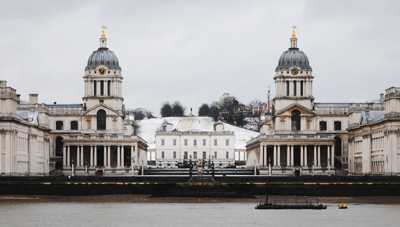
Hunkering down on the south bank of the Thames, the Old Royal Naval College at Greenwich is yet another Wren masterpiece and the centrepiece of the UNESCO-listed Greenwich Maritime World Heritage Site.

What is now known as the college was originally designed as a ‘hospital’ or retirement home for old or infirm sailors. Established by Royal Charter in 1694, it was King William III who pushed the project into fruition as per the wishes of his then late wife Queen Mary II.

Wren was selected to design the building and along with the diarist John Evelyn, who had been appointed treasurer, laid the foundation stone on 30th June, 1696.

Wren’s initial design – for a three side courtyard facing the river – was rejected by Queen Mary who insisted the view from the existing Queen’s House to the river be maintained. So, instead, the hospital was built as a series of four pavilions, each with its own court, with the Queen’s House standing as it’s centrepiece when viewed from the river.

Wren himself never lived to see the building’s completion – it was in the end completed by a number of other famous architects including Sir John Vanbrugh, Thomas Ripley, and Wren’s pupil Nicholas Hawksmoor. Fortunately Wren had laid out all the foundations which ensured the basic design conformed to his plans.

The first 42 pensioners moved in in 1706 and the numbers grew as buildings were completed to a peak of 2,710 in 1814. However, declining numbers of pensioners by the mid 1800s – thanks to a period of peace on the seas and the success of a program which saw more pensioners living with their families, eventually led to the hospital’s closure in 1860.

In 1873, the Royal Naval College took over the premises, assuming the role of both the former Naval College at Portsmouth and the School or Naval Architecture and Marine Engineering which had been based in South Kensington. The Naval Staff College opened on the site in 1919 and further navy departments including the Department of Nuclear Science and Technology moved there in later years. The Royal Navy left the college in 1998.

Now in the care of the Greenwich Foundation, the college is now used by the University of Greenwich and the Trinity College of Music as well as for public events. The public can also visit certain parts of the former college including the grounds, the spectacular Painted Hall and the Chapel.

The domed Painted Hall, which features a series of classically themed paintings with King William III and Queen Mary II at its heart, was originally planned by Wren to be the hospital’s dining hall but due to the length of time it took for Sir James Thornhill to complete – 19 years – his paintings it was never used as such. Instead it stood empty until the body of Admiral Lord Nelson was brought there to lie in state in January 1806. In 1824 it became the National Gallery of Naval Art but in the 1930s became a dining room again with the gallery’s contents transferred to the National Maritime Museum.

The Chapel of St Peter and St Paul, meanwhile was completed in 1751 to the design of Sir Thomas Ripley but was gutted by fire only 28 years later. It was then rebuilt, largely to the designs of James “Athenian” Stuart with some of the detailing designed by his Clerk of Works William Newton, and was reopened in 1789. Restored in the 1950s, it is said to look “almost as it was” when it opened in 1789. The chapel is still in use for services.

WHERE: Located adjacent to Greenwich Pier with entry from Cutty Sark Gardens, College Approach, Romney Road Gate, Royal Gate or Park Row, Greenwich (nearest DLR station is Cutty Sark for Maritime Greenwich); WHEN: The Painted Hall and Chapel are open daily from 10am to 5pm (chapel used for worship on Sunday mornings, open for sightseeing  from 12.30pm); COST: Free (Booked guided tours are available for £5 an adult/children under 16 free); WEBSITE: www.oldroyalnavalcollege.org

Wren’s London – 7. Kensington Palace

A once favored residence of British monarchs, Kensington Palace’s connections with royalty date back to 1689 when, then a private country home known as Nottingham House, the building was purchased by King William III and Queen Mary II.

The royal couple turned to Sir Christopher Wren, then Surveyor of the King’s Works, who was charged with adapting the property into a suitably regal residence.

Wren’s work included the addition of four new pavilions – one at each corner – to provide extra accommodation for the king and queen. The King’s Apartments, approached by a Grand Staircase, were located in the south east, and the Queen Apartment’s in the north west. While many later additions were made, the basic layout of these buildings remains true to Wren’s original design.

Among the many spectacular original rooms is the King’s Gallery, built for William in 1695. It features an 1694 wind dial connected to a weather vane which turns according to the direction of the prevailing wind.

The property’s subsequent royal residents have included Queen Anne, King George I and King George II (it was King George III who made Buckingham Palace his primary London residence). Princess (later Queen) Victoria was born here in 1819 (it was she who first opened the State Apartments to visitors in 1899) while more recent residents in the palace’s private areas have included Princess Margaret and, of course, Diana, Princess of Wales.

WHERE: The Broad Walk, Kensington Gardens, Kensington (nearest tube stations are High Street Kensington or Queensway); WHEN: Daily 10am to 5pm (last admission 4pm); COST: £12.50 adult/£11 concession/£6.25 child/£34 family (online booking discounts available, Historic Royal Palaces members free); WEBSITE: www.hrp.org.uk/KensingtonPalace

PICTURE: Historic Royal Palaces/newsteam.co.uk

Wren’s London – 4. Hampton Court Palace

Hampton Court Palace in London’s outer south-west is known to many as the palace of Henry VIII. Yet a considerable part of the complex of buildings we see today was also created during the reign of some time joint rulers William III and Mary II.

It was to Christopher Wren – assisted by the able Nicholas Hawksmoor – that the rulers turned when looking to update the Royal Apartments. Wren’s designs for a domed baroque palace to rival Versailles in France were apparently so ambitious that they were only half-built (and built in haste – two workmen died and another 11 were injured when the main wall collapsed in 1689). The death of the queen in 1694 also meant work on the palace stopped – it was resumed in 1697 (under control of Wren’s deputy William Talman who had offered a lower price than Wren) but again stalled after the death of the king in 1702.

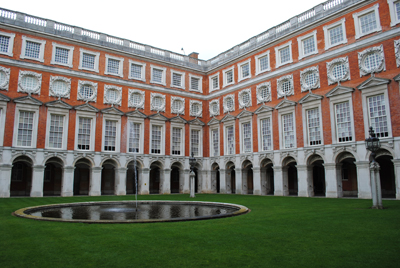
Wren’s imprint is on the palace we see today is nonetheless considerable and includes the Baroque-style South and East Front (the size of the formal gardens which radiate out from the latter give a glimpse into the grand plans Wren had for the palace), Fountain Court which replaced the Tudor Cloister Court and around which were located new state apartments for both the king and queen, and the Orangery.

Among those who worked on the interiors of were the famous woodcarver Grinling Gibbons and painter Antonio Verrio.

WHERE: Hampton Court Palace, East Molesey, Surrey (nearest station is Hampton Court from Waterloo); WHEN: 10am to 6pm everyday (winter hours 10am to 4.30pm from 31st October to 26th March); COST: Adult £15.40, Concession £12.65, Child under 16 £7.70 (under fives free), family tickets, garden only tickets and online booking discounts available; WEBSITE: www.hrp.org.uk/HamptonCourtPalace/