LondonLife – St Paul’s celebrates 300 years since its completion…

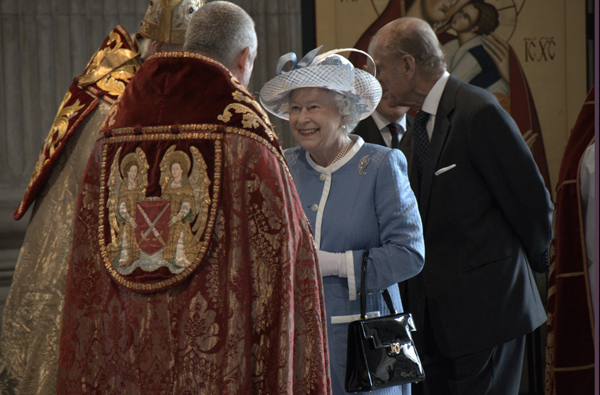
Queen Elizabeth II attends the tercentenary service at St Paul’s. PICTURE: Graham
Lacdao/St Paul’s Cathedral

A service was held at St Paul’s today in celebration of the 300 year anniversary of the cathedral’s completion.

The tercentenary service also marks the end of a massive 15 year, £40 million repair and cleaning project, meaning the cathedral is now clear of scaffolding for the first time in 15 years.

Designed by the indomitable Sir Christopher Wren, work on St Paul’s Cathedral began in 1677 and was formally completed in 1710 (although it had been holding services since 1697). (For more on the history of St Paul’s, see our earlier post, part of our series on Wren’s London, here).

Said to have the largest dome after St Peter’s in Vatican City, St Paul’s has been at the centre of London’s (and the United Kingdom’s) religious and political life for centuries, hosting state funerals (Lord Nelson, the Duke of Wellington and Winston Churchill’s were all held here) as well as the royal wedding of Prince Charles and Lady Diana and many celebration services.

Sights include the crypt – containing the tombs of both Nelson and Wellington – and the Whispering Gallery (see our earlier post on the Whispering Gallery here) as well as the exterior viewing galleries.

To celebrate the cathedral’s liberation from scaffolding, St Paul’s is holding a 300th Anniversary Photography Competition in which photographers are invited to submit their best exterior shots of the building. The 10 winning images will then be displayed in the cathedral crypt. The competition runs until 16th July.

To enter, upload pictures to St Paul’s 300th anniversary competition group at Flickr – www.flickr.com/groups/stpaulslondon/. For more information, see www.stpauls.co.uk/photocomp.

LondonLife – Knollys Rose Ceremony

A London tradition which has its origins in the fourteenth century, the Knollys Rose Ceremony surrounds the presentation of a single red rose to the Lord Mayor of London at Mansion House.

The ceremony, which was held in the City yesterday, relates to a judgement of 1381 in which the fine was the annual payment of a single red rose.

The fine was levied after Lady Constance Knollys, the wife of prominent citizen Sir Robert Knollys, bought a property opposite her own in Seething Lane and then added a footbridge linking the two without first gaining planning permission (it’s suggested that she bought the property which had previously been used as a threshing ground because she was annoyed with the constant chaff in the air).

Following discovery of her breach, it was agreed that she would pay the annual ‘peppercorn rent’ of a single red rose from the new property’s garden to the Lord Mayor.

Lady Constance’s footbridge is long gone but the tradition of paying the annual rent was revived last century and is now presided over by the Company of Watermen and Lightermen of the River Thames.

The ceremony starts at the church of All Hallows by the Tower and then involves a procession to Seething Lane Gardens (a modern garden close to where the original may have been; the gardens were once the site of the Navy Office) where the Master of the Company of Watermen and Lightermen snips off a rose before heading on to Mansion House where it is presented to the Lord Mayor on a velvet altar cushion from All Hallows.

The ceremony usually takes place on the second Monday in June.

LondonLife – Beating Retreat…

This week Horse Guards in London hosts the annual ceremony of Beating Retreat with massed bands playing and marching in formation. But where does the tradition come from?

The origins of the ceremony date back several hundred years to at least the 16th century when the beating of drums signalled the end of a day’s fighting, the closure of camp gates and the lowering of flags. Among the English kings credited with having ordered troops to “beat retreat” are old enemies King James II and King William III.

The ceremony was standard practice by the early 1700s with flutes or fifes added to the drum beating before, following the Napoleonic Wars, these were both replaced with bugles, to help ensure the sound reached greater distances.

The ceremony has been held annually at Horse Guards Parade since 1966 and this year involves the Massed Bands and Corps of Drums of the army’s Household Division along with The King’s Troop Royal Horse Artillery as well as The United States Army Europe Band and Chorus.

The event is a prelude to the Trooping the Colour on Saturday when more than 1,300 troops will parade in honor of the Queen’s Official Birthday.

Beating Retreat will be held at Horse Guards Parade on 8th and 9th of June (Wednesday and Thursday night), from 9pm. For more information and tickets, see www.guardsbeatingretreat.com

LondonLife – Beating the Bounds at All Hallows

Thursday is Ascension Day and, at All Hallows by the Tower in the City, that means conducting the ancient ceremony of Beating the Bounds.

The origins of the custom go back to medieval times when parishes annually reaffirmed their boundaries by undertaking a procession during which each parish boundary marker was beaten with wands while praying for protection and blessings.

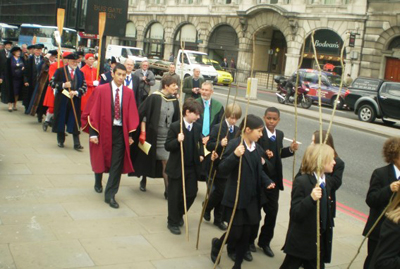
At All Hallows, the beating party consists of students from Dunstan College in Catford (these students have an association with the church of St Dunstan-in-the-East which is now part of the parish of All Hallows) along with parish clergy and the masters of livery companies associated with the parish and Thames waterboatmen. (Pictured right is last year’s procession).

Highlights of the procession at All Hallows include the beating of the parish’s southern marker – this is located in the middle of the Thames and must be reached by boat – and the mock ‘confrontation’ which occurs between the beating party and the Governor and Yeoman Warders of the Tower of London.

The ‘confrontation’ relates to the fact that the parish and the tower share a boundary – this was apparently a common cause of dispute in the Middle Ages and led, in 1698, to a ‘battle’ between the people of the parish and those of the tower. The ceremony is followed by attendance at a festal evensong at the church.

For more, see www.ahbtt.org.uk/history/beating-the-bounds/

PICTURE: Courtesy of All Hallows by the Tower.

LondonLife – The visit of the American President…

President Barack Obama has been in London for the past two days, so Exploring London decided to take a break from our series on King James’ I’s London and instead, in honor of the president’s visit, take a look at where you’ll find some other US presidents in London.

First up, it’s President George Washington. A life-sized statue of the first US president stands outside the National Gallery on the north side of Trafalgar Square. It’s a replica of an eighteenth century marble statue by Jean Antoine Houdon which stands in the State Capitol building in Richmond, Virginia. A gift of the Commonwealth of Virginia in 1924.

Civil War President Abraham Lincoln stands looking toward Parliament Square and the Houses of Parliament (pictured). The statue dates from 1920 – it was originally proposed to put a statue of President Lincoln in Parliament Square to mark the 1915 centenary of the last time the US and Britain were at war but the plans were put on ice until several years later. The statue, a gift of the US government, is a replica of the Chicago Lincoln Memorial by Augustus Saint-Gaudens. (There is also a bust of Lincoln inside the Royal Exchange building).

Next in the chronology is President Franklin D. Roosevelt, whose statue can be found on the north side of Grosvenor Gardens (overlooked by the vast and soon-to-be replaced US embassy). This bronze was unveiled by the president’s wife, Eleanor, on the third anniversary of FDR’s death- 12th April, 1948. The statue depicts the president standing – apparently at Mrs Roosevelt’s insistence – instead of seated in a wheelchair.

Across the gardens stands another wartime president, President Dwight D. Eisenhower. A bronze by sculptor Robert Dean, this life-size statue was the gift of the US city of Kansas in 1989 and was unveiled by British PM Margaret Thatcher and US Ambassador Charles Price. It stands only a short distance from Eisenhower’s wartime HQ. (Grosvenor Square has also been home to then future US President John Adams who lived at number nine as the first US Ambassador to the Court of St James between 1786-97).

A bronze bust of the 35th president, President John F. Kennedy, can be found on the corner of Park Crescent and Marylebone Road. Unveiled by his brother, Senator Robert Kennedy, in 1965, it’s a copy of a bust located in the Library of Congress in Washington DC.

Among those mooted for the future is one of President Ronald Reagan (also in Grosvenor Square), planning permission for which was granted by Westminster City Council in 2009.

LondonLife – Chelsea Flower Show

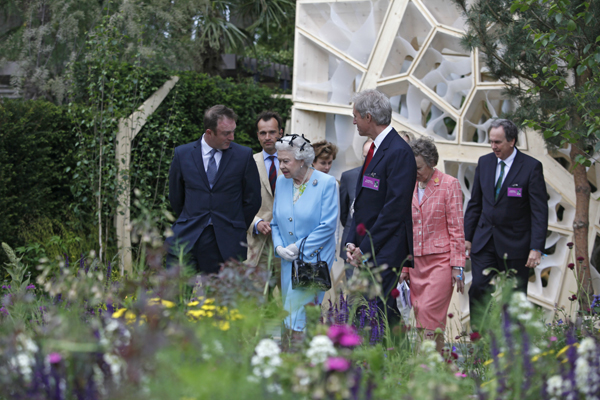
The Queen visits the Chelsea Flower Show. PICTURE: Courtesy Royal Horticultural Society.

More correctly known as the Royal Horticultural Society Great Spring Show, the history of the Chelsea Flower Show traces its origins back to the 1820s when the society, then known as the The Horticultural Society in London, held a series of “floral fetes” at the Duke of Devonshire’s estate in Chiswick.

The fortunes of the society were on the wane when, thanks in part to its then president, Prince Albert, it was reborn with a new charter and name – the Royal Horticultural Society – and a new garden in Kensington.

The first Great Spring Show was held there in 1862 and continued to be so for the next 26 years until, in 1888, the site of the show was moved to Temple Gardens near Embankment in central London.

It was subsequently held there until 1912. During this year, the show was cancelled and the Royal International Horticultural Exhibition held instead in the grounds of the Royal Hospital, Chelsea. So popular did this prove that the Great Spring Show was subsequently moved there. It’s been held almost every since with cancellations during World Wars I and II.

Today, the show – claimed to be “the world’s most famous gardening event” – attracts 157,000 visitors from around the world who view the exhibits of 600 companies including nurseries, florists and floral arranges. This year’s show, which has sold out, features 17 show gardens, 15 smaller gardens and 100 of nurseries and growers. It runs from today until Saturday.

For more information on the show, see www.rhs.org.uk/chelsea.

London Life – Pigeons feeding…

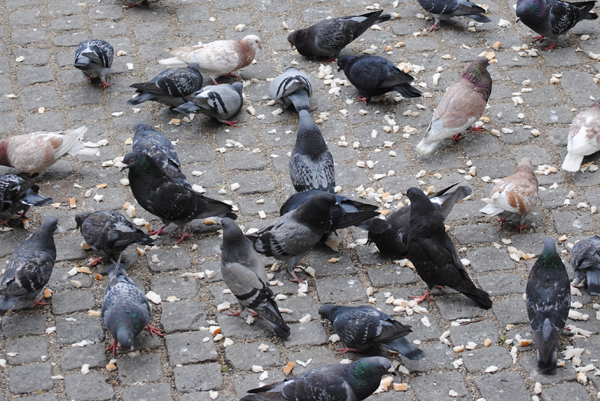
Although not as ubiquitous as they once were in London (particularly in Trafalgar Square), the offer of food – an activity frowned upon by authorities, by the way – will still always attract a crowd.

LondonLife – Reliving the Festival of Britain

Beach huts overlook the Thames at Queens Walk, Southbank, in celebration of the 60 year anniversary of the 1951 Festival of Britain. The huts have been individually designed by artists and reflect an element of life by the seaside – from an exhibition of vintage swimwear to a gallery of visual art which recalls when a storm surge flooded much of the North Sea coast in 1953. Nearby is an “urban beach” where you can pause to play in the sand. The huts will remain in position until 4th September. For more on the Festival of Britain 60th anniversary celebrations, see www.southbankcentre.co.uk.

LondonLife – The Olympic countdown…

OK, it’s had some teething issues (stopping less than 24 hours after it was launched was one; being daubed with paint another). But the countdown to next year’s Olympics on the official 6.5 metre high clock located in Trafalgar Square continues unabated. The clock was unveiled in mid-March, 500 days before the start of the Games.

LondonLife – A squirrel plays among the tombstones of Bunhill Fields

A squirrel spotted playing among the tombstones of Bunhill Fields Cemetery in the Borough of Islington. The Dissenters’ graveyard – burial place of the likes of writers John Bunyan and Daniel Defoe, artist and poet William Blake and Susanna Wesley, mother of Methodist founders John and Charles Wesley – was recently given a Grade I listing on the national Register of Parks and Gardens. For more information on the cemetery, see our previous post here.

LondonLife – Vroom Vroom


Lorenzo Quinn’s sculpture of a giant hand playing with a full-sized vintage Fiat 500 sits on a traffic island in the midst of busy Park Lane, not far from Hyde Park Corner. Vroom Vroom – which features the first car the sculptor bought using money from the sale of his art –  is on show until April. It was installed as part of Westminster council’s City of Sculpture Festival.

LondonLife – Jonquils in Bow Lane

Jonquils add a splash of color on a grey day during a busy lunchhour in Bow Lane in the City. Bow Lane runs from Poultry down to the junction of Queen Victoria and Cannon Streets.

LondonLife – 200th anniversary of Mexican independence marked in Westminster

Curious onlookers examine a series of giant sculptures in Victoria Tower Gardens, next to the Houses of Parliament in Westminster. The work of Mexican artist Rivelino, ‘Nuestros Silencios’ (Our Silences), will be on display until 11th February. The 10 giant bronze busts each weigh over a ton and are being displayed in London as part of a European tour celebrating the bicentenary of Mexican independence and the centenary of the Mexican Revolution.

LondonLife – Jelly babies at Marble Arch

The giant jelly baby family, created out of resin by Italian artist Mauro Perucchetti, stand in recent snow at Marble Arch. The family, the largest of which stands 10 foot (three metres) tall, is on display as part of Westminster Council’s City of Sculpture initiative which seeks to highlight Westminster’s cultural diversity in the run-up to the Olympics.

LondonLife – Ice skating at the Tower

Skaters take to the ice in the moat of the Tower of London. The rink, one of many about London, is open until 10th January, 2011. For more information, see www.toweroflondonicerink.com.

LondonLife – One New Change

London’s newest shopping mall (and the first to open in the City for 130 years), One New Change, has opened up some interesting new views of the city, in particular of St Paul’s Cathedral which stands opposite. The views including those seen from the 6th floor public rooftop terrace which was opened last week. Located in Cheapside (‘cheap’ meaning market), the more than £500 million development was designed by Pritzker Prize winning French architect Jean Nouvel. For more information, see www.onenewchange.com.