What’s in a name?…Pall Mall

This curiously named street in the heart of London’s St James district traces the origins of its moniker back to the 17th century when the game of “pall mall” (“pell mell” and “paille maille” being among a host of alternative spellings) was played there.

The game, mentioned by Samuel Pepys in his famous diary, involves the use of a mallet and ball similar to that used in modern croquet but, according to some commentators, pall mall was more likely a predecessor of golf than croquet, with players attempting to belt the ball as far as possible along a pitch before putting the ball through a hoop suspended high off the ground.

Pall Mall, which runs parallel to The Mall from St James’ Street in the west to Haymarket in the east with an eastern extension, Pall Mall East, completing the journey from Haymarket into the northern end of Trafalgar Square, became famous in the 19th and early 20th centuries for housing numerous ‘gentlemen’s clubs’. Among those still in business are the Travellers Club, the Athaenaeum Club, the Reform Club, the Army and Navy Club, the Oxford and Cambridge Club, and the Royal Automobile Club.

St James’s Palace sits at the street’s western end and it is of note that nearly all of the southern side of the street is still part of the Crown Estate (the exception being a home Charles II is believed to have given to the actress Nell Gwynne, who apparently sensibly demanded the freehold on the property).

Other buildings along the street include Schomberg House, built for the Duke of Schomberg in the late 17th century (only the facade of which remains), and the Sir Christopher Wren-designed Marlborough House, which is tucked in between Pall Mall and The Mall and sits opposite St James’s Palace. The National Gallery and the Royal Academy also both briefly had homes in Pall Mall.
Wren’s London – 9. Marlborough House

We’re nearing the end of our series on Wren’s London (next week we’ll take a final look at some of the Wren designs we’ve not yet mentioned), so this week we look at one of his lesser known (and less accessible) designs – Marlborough House.

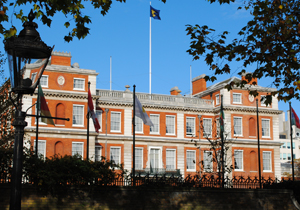
Tucked away behind high brick walls next to St James’ Palace just off Pall Mall, Marlborough House was built for Sarah Churchill, the Duchess of Marlborough – a confidant of Queen Anne – and completed in 1711.

The duchess, who secured a lease of the site from Queen Anne, selected Sir Christopher as the architect in preference to Sir John Vanbrugh, but she later fell out with Wren and, after dismissing him, oversaw the completion of the building herself. It is believed that the design of the house was actually the work of Wren’s son, also named Christopher, although the plans were undoubtedly drawn up under Wren senior’s watchful eye.

The house, built of red Dutch bricks brought to England as ballast in troop transports, was noted for its plain design. But the walls of the central salon and staircases were decorated with scenes of battles the Duke had fought in.

The property remained in the hands of the Dukes of Marlborough until it was acquired by the Crown in 1817. The building – which was substantially extended in the mid 1800s to the designs of Sir James Pennethorne – was subsequently used by members of the royal family including Princess Charlotte (only daughter of the future King George IV) and her husband Prince Leopold (later the King of the Belgians), Queen Adelaide, widow of William IV, Edward, Prince of Wales (later Edward VII), George, Prince of Wales (later George V), King Edward VII’s widow, Queen Alexandra, and, lastly, Queen Mary, widow of  George V.

Following the death of the Queen Dowager in 1953, Queen Elizabeth II donated it for use by the Commonwealth Secretariat who still occupy the building today.

WHERE: Pall Mall (nearest Tube stations are Green Park and Piccadilly); WHEN: Two hour tours are usually held every Tuesday morning (check first); WEBSITE: www.thecommonwealth.org/Internal/191086/34467/marlborough_house/

LondonLife – Horse Guards Parade…

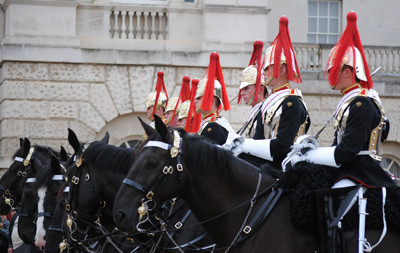
The Queen’s Life Guard at Horse Guards Parade. The parade ground, which lies between Whitehall and St James’ Park, was formerly the site of the tiltyard of the Palace of Whitehall and was the location for tournaments during the rule of Henry VIII. It now serves as the site for the annual Trooping the Colour ceremony. The men pictured (wearing blue tunics and red plumed helmets) are part of a squadron of The Blues and Royals (Royal Horse Guards and 1st Dragoons) who, along with a squadron of The Life Guards (wearing red tunics and white plumed helmets), make up the Household Cavalry Mounted Regiment, responsible for providing The Queen’s Life Guard. The “Horse Guards” have guarded this site – still regarded as the official entrance to St James’ Palace and Buckingham Palace – since the Restoration of Charles II in 1660 and can be seen there in the Changing of the Guard ceremony on weekdays and Sundays. For more information, visit www.army.mod.uk/events/ceremonial/2355.aspx

Around London – HMS Belfast restored, Buckingham Palace record, plumber’s new statue

• The HMS Belfast’s newly restored masts were unveiled to the public this week following an 18 month restoration project. Moored on the Thames between Tower and London Bridges, the ship is one of only a few surviving Royal Navy ships that served in Arctic convoys supplying Russia during World War II. The restoration was carried out for free by a team of more than 20 men and women from the JSC Shipbuilding plant, Severnaya Verf, in St Petersburg, Russia as a tribute to the British and Allied sailors who risked their lives on the convoys. The work involved removed and replacing all of the masts. For more information, see http://hmsbelfast.iwm.org.uk.

A record 413,000 people visited Buckingham Palace over the summer – the highest number in 16 years. The record numbers were partly ascribed to the new Garden Cafe which served 46,000 cups of tea. Meanwhile, the palace has announced the exhibition, Victoria & Albert: Art & Love, at the Queen’s Gallery has been extended until 5th December. For more information, see www.royalcollection.org.uk.

• The Worshipful Company of Plumbers has reportedly announced it will be installing a bronze statue of a plumbers’ apprentice outside Cannon Street station next year. The statue’s installation will  mark 400 years since the company first received its Royal Charter from King James I. The station was the site of the company’s livery hall until 1863 when the site was compulsorily acquired to make way for the new railway.

Wren’s London – 7. Kensington Palace

A once favored residence of British monarchs, Kensington Palace’s connections with royalty date back to 1689 when, then a private country home known as Nottingham House, the building was purchased by King William III and Queen Mary II.

The royal couple turned to Sir Christopher Wren, then Surveyor of the King’s Works, who was charged with adapting the property into a suitably regal residence.

Wren’s work included the addition of four new pavilions – one at each corner – to provide extra accommodation for the king and queen. The King’s Apartments, approached by a Grand Staircase, were located in the south east, and the Queen Apartment’s in the north west. While many later additions were made, the basic layout of these buildings remains true to Wren’s original design.

Among the many spectacular original rooms is the King’s Gallery, built for William in 1695. It features an 1694 wind dial connected to a weather vane which turns according to the direction of the prevailing wind.

The property’s subsequent royal residents have included Queen Anne, King George I and King George II (it was King George III who made Buckingham Palace his primary London residence). Princess (later Queen) Victoria was born here in 1819 (it was she who first opened the State Apartments to visitors in 1899) while more recent residents in the palace’s private areas have included Princess Margaret and, of course, Diana, Princess of Wales.

WHERE: The Broad Walk, Kensington Gardens, Kensington (nearest tube stations are High Street Kensington or Queensway); WHEN: Daily 10am to 5pm (last admission 4pm); COST: £12.50 adult/£11 concession/£6.25 child/£34 family (online booking discounts available, Historic Royal Palaces members free); WEBSITE: www.hrp.org.uk/KensingtonPalace

PICTURE: Historic Royal Palaces/newsteam.co.uk

The Tip – Cheaper palaces?

Thinking of visiting the Tower of London and Hampton Court Palace while in London? Become a member of Historic Royal Palaces and you could make substantial savings, especially if travelling as a family. The annual pass allows you to enter all five Royal Palaces – including Hampton Court and the Tower as well as Kensington Palace, the Banqueting House and Kew Palace – as many times as you like during the year and brings with it invitations to members only events. It’s certainly worth checking out whether its worth it. For more information, see www.hrp.org.uk/SupportUs/Membership/Default.aspx

Wren’s London – 4. Hampton Court Palace

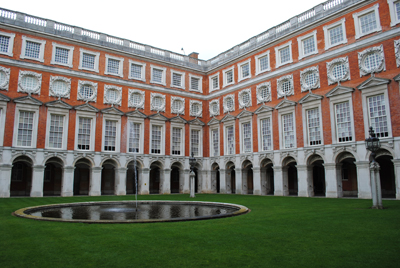
Hampton Court Palace in London’s outer south-west is known to many as the palace of Henry VIII. Yet a considerable part of the complex of buildings we see today was also created during the reign of some time joint rulers William III and Mary II.

It was to Christopher Wren – assisted by the able Nicholas Hawksmoor – that the rulers turned when looking to update the Royal Apartments. Wren’s designs for a domed baroque palace to rival Versailles in France were apparently so ambitious that they were only half-built (and built in haste – two workmen died and another 11 were injured when the main wall collapsed in 1689). The death of the queen in 1694 also meant work on the palace stopped – it was resumed in 1697 (under control of Wren’s deputy William Talman who had offered a lower price than Wren) but again stalled after the death of the king in 1702.

Wren’s imprint is on the palace we see today is nonetheless considerable and includes the Baroque-style South and East Front (the size of the formal gardens which radiate out from the latter give a glimpse into the grand plans Wren had for the palace), Fountain Court which replaced the Tudor Cloister Court and around which were located new state apartments for both the king and queen, and the Orangery.

Among those who worked on the interiors of were the famous woodcarver Grinling Gibbons and painter Antonio Verrio.

WHERE: Hampton Court Palace, East Molesey, Surrey (nearest station is Hampton Court from Waterloo); WHEN: 10am to 6pm everyday (winter hours 10am to 4.30pm from 31st October to 26th March); COST: Adult £15.40, Concession £12.65, Child under 16 £7.70 (under fives free), family tickets, garden only tickets and online booking discounts available; WEBSITE: www.hrp.org.uk/HamptonCourtPalace/

Treasures of London – The Great Vine at Hampton Court Palace

PICTURE: Historic Royal Palaces/newsteam.co.uk

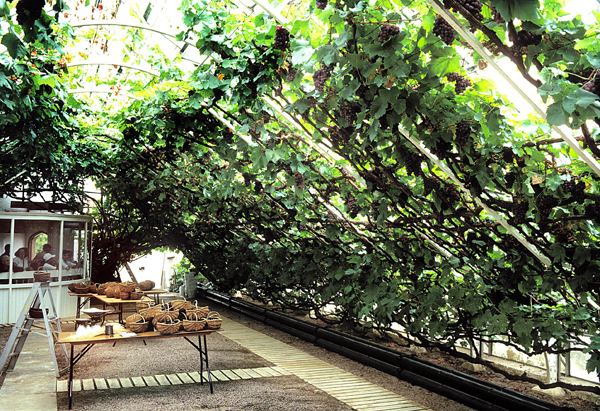
In the first in a series looking at some of the treasures held in museums, galleries and other collections London along with some of the more unusual things you’ll find in the city, we’re heading out to the southwest of the city firstly to Hampton Court Palace and what is perhaps a lesser known treasure, the Great Vine.

Claimed to be the oldest and largest vine in the world, it was believed to have been planted by Lancelot ‘Capability’ Brown around 1768 and has prospered ever since, now being an astonished 12 foot (3.65 metres) around the base and boasting ‘rods’ of up to 120 metres in length.

The vine, which is housed in a purpose-built greenhouse in the gardens, still produces a whopping 22o to 32o kilograms (500 to 700 bunches) of black, sweet grapes annually (you can even buy the grapes in Hampton Court’s Garden Shop – they’ve been sold to the public since the 1930s), although this is well down on the 2,245 bunches of grapes picked in 1807.

WHERE: Hampton Court Palace, East Molesey, Surrey (nearest station is Hampton Court from Waterloo); WHEN: 10am to 6pm everyday (winter hours 10am to 4.30pm from 31st October to 26th March); COST: Adult £15.40, Concession £12.65, Child under 16 £7.70 (under fives free), family tickets, garden only tickets and online booking discounts available; WEBSITE: www.hrp.org.uk/HamptonCourtPalace/