Thinking of visiting the Tower of London and Hampton Court Palace while in London? Become a member of Historic Royal Palaces and you could make substantial savings, especially if travelling as a family. The annual pass allows you to enter all five Royal Palaces – including Hampton Court and the Tower as well as Kensington Palace, the Banqueting House and Kew Palace – as many times as you like during the year and brings with it invitations to members only events. It’s certainly worth checking out whether its worth it. For more information, see www.hrp.org.uk/SupportUs/Membership/Default.aspx
Palaces
Wren’s London – 4. Hampton Court Palace
Hampton Court Palace in London’s outer south-west is known to many as the palace of Henry VIII. Yet a considerable part of the complex of buildings we see today was also created during the reign of some time joint rulers William III and Mary II.
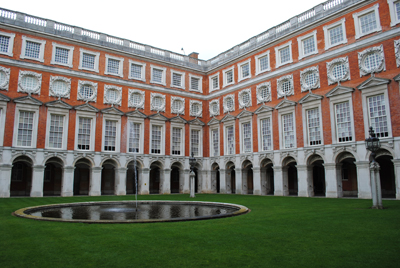 It was to Christopher Wren – assisted by the able Nicholas Hawksmoor – that the rulers turned when looking to update the Royal Apartments. Wren’s designs for a domed baroque palace to rival Versailles in France were apparently so ambitious that they were only half-built (and built in haste – two workmen died and another 11 were injured when the main wall collapsed in 1689). The death of the queen in 1694 also meant work on the palace stopped – it was resumed in 1697 (under control of Wren’s deputy William Talman who had offered a lower price than Wren) but again stalled after the death of the king in 1702.
Wren’s imprint is on the palace we see today is nonetheless considerable and includes the Baroque-style South and East Front (the size of the formal gardens which radiate out from the latter give a glimpse into the grand plans Wren had for the palace), Fountain Court which replaced the Tudor Cloister Court and around which were located new state apartments for both the king and queen, and the Orangery.
Among those who worked on the interiors of were the famous woodcarver Grinling Gibbons and painter Antonio Verrio.
WHERE: Hampton Court Palace, East Molesey, Surrey (nearest station is Hampton Court from Waterloo); WHEN: 10am to 6pm everyday (winter hours 10am to 4.30pm from 31st October to 26th March); COST: Adult £15.40, Concession £12.65, Child under 16 £7.70 (under fives free), family tickets, garden only tickets and online booking discounts available; WEBSITE: www.hrp.org.uk/HamptonCourtPalace/
Treasures of London – The Great Vine at Hampton Court Palace
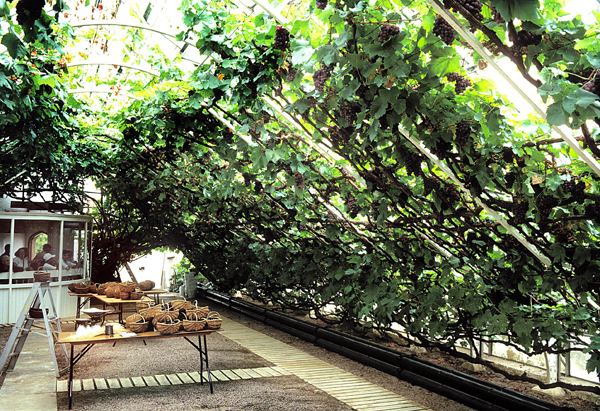
PICTURE: Historic Royal Palaces/newsteam.co.uk
In the first in a series looking at some of the treasures held in museums, galleries and other collections London along with some of the more unusual things you’ll find in the city, we’re heading out to the southwest of the city firstly to Hampton Court Palace and what is perhaps a lesser known treasure, the Great Vine.
Claimed to be the oldest and largest vine in the world, it was believed to have been planted by Lancelot ‘Capability’ Brown around 1768 and has prospered ever since, now being an astonished 12 foot (3.65 metres) around the base and boasting ‘rods’ of up to 120 metres in length.
The vine, which is housed in a purpose-built greenhouse in the gardens, still produces a whopping 22o to 32o kilograms (500 to 700 bunches) of black, sweet grapes annually (you can even buy the grapes in Hampton Court’s Garden Shop – they’ve been sold to the public since the 1930s), although this is well down on the 2,245 bunches of grapes picked in 1807.
WHERE: Hampton Court Palace, East Molesey, Surrey (nearest station is Hampton Court from Waterloo); WHEN: 10am to 6pm everyday (winter hours 10am to 4.30pm from 31st October to 26th March); COST: Adult £15.40, Concession £12.65, Child under 16 £7.70 (under fives free), family tickets, garden only tickets and online booking discounts available; WEBSITE: www.hrp.org.uk/HamptonCourtPalace/

