The Royal Wedding – London’s Royal Wedding venues

In the first of a series this week looking at aspects of royal weddings in London in days past, we canvas some of the venues which have hosted the sometimes glittering occasions.
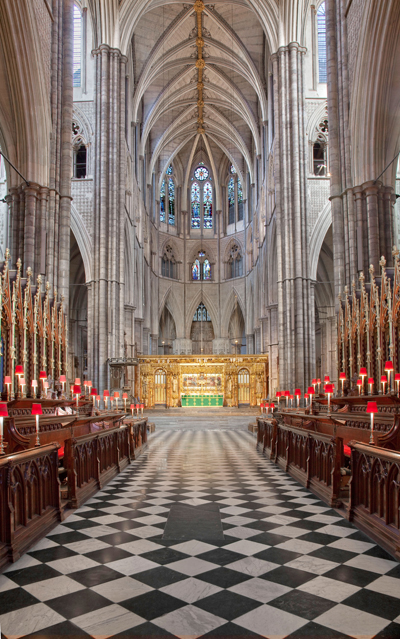
First up is Westminster Abbey (pictured), the location of Prince William and Kate Middleton’s wedding this Friday, which, despite its thousand year history, is only believed to have hosted 15 royal weddings.

Among them is said to have been the wedding of King Henry I to Matilda of Scotland on 11th November, 1100, as well as that of Richard, Earl of Cornwall and brother of King Henry III, who married his second wife, Sanchia of Provence, there on 4th January, 1243, and Joan of Acre, daughter of King Edward I, who married Gilbert, Earl of Gloucester, on 30th April, 1290 (her sister Margaret married John, Duke of Brabant, at the same venue less than three months later). The abbey also hosted the wedding of King Richard II to Anne, daughter of Emperor Charles IV of Bohemia, on 20th January, 1382.

The abbey church has become increasingly favored as a venue for royal weddings in more recent times. Among the most prominent hosted there last century were that of Prince Albert, Duke of York (later King George VI), who married Lady Elizabeth Bowes-Lyon on 26th April, 1923 and that of their daughter Princess Elizabeth (later Queen Elizabeth II) who married Prince Philip of Greece (later the Duke of Edinburgh) there on 20th November, 1947.

Two of the current Queen’s children were also married there – Princess Anne, who married Captain Mark Phillips on 14th November, 1973, and Prince Andrew, who married Sarah Ferguson on 23rd July 1986. (For more on Royal Weddings at the Abbey, see www.westminster-abbey.org/our-history/royals/weddings)

A notable break with the trend in recent times was the marriage of Prince Charles and Lady Diana Spencer – they were married in a fairytale ceremony at St Paul’s Cathedral on 29th July, 1981.

Other London locations for royal weddings have included the now non-existent Greenwich Palace (King Henry VIII married Katherine of Aragon on 11th June, 1509) and Hampton Court Palace (another of King Henry VIII’s marriages – that in which he was wed to Catherine Parr – was held here in a private chapel on 12th July, 1543).

Along with St George’s Chapel at Windsor, the Chapel Royal at St James’s Palace  in London was particularly popular in Victorian times – Queen Victoria married Prince Albert there on 10th February, 1840, and their eldest daughter, Princess Victoria, married Prince Frederick (the future German Emperor Frederick III) there on 25th January, 1858. On 6th July, 1893, the chapel also hosted the wedding of the future King George V and Princess Mary of Teck.

PICTURE: Copyright Dean and Chapter of Westminster

Happy St David’s Day!

It’s St David’s Day, Wales’ national day of celebration, so you may have noticed the Welsh flag flying in a few places you wouldn’t normally see it – including at 10 Downing Street. In keeping with the theme of all things Welsh, we’re taking a look at a couple of Welsh-related sites in London…

St Benet, Paul’s Wharf – Known as London’s “Welsh church”, the current St Benet’s was rebuilt to the designs of Christopher Wren after the Great Fire of 1666 although a church has stood on this site for 900 years. Services have been held at the church (pictured right) in Welsh since 1879 after Queen Victoria granted Welsh Anglicans the right to worship in their own language there. Known formally at St Benet’s Metropolitan Welsh Church, the premises, located just off Queen Victoria Street in the City, has also been the church of the College of Arms since 1555. Among other historic titbits is the suggestion that both Anne Boleyn and Lady Jane Grey – the “nine day Queen” – may have received the last rites here before going on to their executions at the Tower of London, that 17th century architect Inigo Jones was buried here, and that King Charles II had a special door built for himself in the side of the building and a private room where he could take part in services. See www.stbenetwelshchurch.org.uk

The London Welsh Centre – Located in Gray’s Inn Road, the centre’s origins go back to the founding of the Young Wales Association in 1920, created to provide a focus for young Welsh people in London. The organisation, which initially didn’t have a permanent home, held meetings in several locations before moving to the current premises in the 1930s. Today the premises is used by the London Welsh Centre and is the base for three choirs – the London Welsh Chorale, The London Welsh Gwalia Male Choir and The London Welsh Male Voice Choir. It also provides Welsh language classes and hosts concerts and other cultural events. See www.londonwelsh.org.

Memorial to Welsh poet Iolo Morganwg – A memorial plaque to this Welsh poet and antiquarian stands on Primrose Hill on the site where the first meeting of the Gorsedd of Bards of the Isle of Britain, convened by Morganwg, was held in 1792. The plaque was unveiled in 2009. Follow this link for more information.

Do you know of any other Welsh-related sites in London? Let us know…

Curious London memorials – 6. The Buxton Memorial Fountain

Standing in Victoria Tower Gardens at the southern end of the Houses of Parliament, not far from more high profile monuments such as Rodin’s The Burghers of Calais, is a memorial to those who fought for the emancipation of slaves.

The gothic memorial, designed by Samuel Sanders Tuelon, was erected in 1865 by MP Charles Buxton to commemorate the work of his father, Sir Thomas Fowell Buxton and his associates including William Wilberforce, Thomas Clarkson, Zachary Macaulay, Henry Brougham, and Dr Stephen Lushington – all of whom played important roles in the eventual passing of the 1833 Slavery Abolition Act.

Sir Thomas, a founding member of the Anti-Slavery Society along with Wilberforce and Clarkson, took over as leader of the abolitionist movement in parliament after Wilberforce retired in 1825.

The memorial, which looks a little like a smaller version of the Albert Memorial (without the figure within) and is actually a public drinking fountain, was originally erected in Parliament Square but was removed in 1949 and placed in its current location in 1957, marking the 150th anniversary of the 1807 Act which abolished the trans-Atlantic slave trade.

The memorial originally bore eight statues representing the rulers of Britain from the Roman era to Queen Victoria but these were long since stolen. It as restored by Royal Parks in the mid-Noughties and unveiled again on the 27th March, 2007, to commemorate the 200th anniversary of the same act.

PICTURE: © Giles Barnard

Treasures of London – The Crown Jewels

No series on the treasures of London would be complete without a mention of the Crown Jewels, housed – except when being used – under tight security in the same place they’ve been since the early 1300s – the Tower of London.

The jewels, which are described as a ‘working collection’, include the coronation regalia and feature some 23,578 gems  – the Imperial State Crown alone boasts 2,868 diamonds, 273 pearls, 17 sapphires, 11 emeralds and five rubies.

The regalia itself is made up of the crowns of the sovereigns, consorts and Princes of Wales as well as sceptres, orbs, rings, swords, spurs, bracelets, robes, and the oldest piece, a 12th century anointing spoon.

It and three steel coronation swords are the only pieces to survive the destruction of all the pre-Civil War regalia in 1649-50, carried out at the behest of Oliver Cromwell following the execution of King Charles I (many of the earlier crown jewels, dating from the Anglo-Saxon period, had already been replaced in the early 13th century after items were lost while being taken across The Wash during the reign of King John in 1216).

Following Cromwell’s destruction, new regalia was made on the orders of King Charles II. Modelled on that of his father, it was used in the king’s coronation on 23rd April, 1661, and cost more than £12,000.

Today, St Edward’s Crown – with which the sovereign is crowned by the Archbishop of Canterbury – is the principal piece of the regalia. Other items include the Sovereign’s Sceptre, topped with 530 carat First Star of Africa – the largest flawless cut diamond in the world, Queen Victoria’s small diamond crown, and the Imperial Crown of India. There is also a crown made for Queen Elizabeth, the Queen Mother, for her 1937 coronation which features the famous Koh-i-Nur (‘Mountain of Light’) diamond.

Until 1303, the Crown Jewels had been housed at Westminster Abbey. Following a successful robbery that year, however (after which most items were recovered), they were moved to the Tower.

The most famous attempt to steal the Crown Jewels was made by an Irishman, Colonel Thomas Blood, in 1671. He and his gang had arranged to see the jewels (this could be done for a fee) but when they arrived, used a mallet to knock out the jewel keeper before stabbing him.

Colonel Blood had hidden King Charles II’s crown under his cloak, squashing its arches of in the process, while his companion Robert Perot had stuck the coronation orb down his breeches and Blood’s son was in the process of sawing the sceptre in half when the keeper’s son returned unexpectedly and raised the alarm.

Arrested, Blood got off rather lightly – King Charles II decided, apparently for some unknown reason, to pardon him. Security around the jewels, however, was tightened – iron bars were used instead of wooden ones and people were thenceforth forbidden from handling the jewels.

The Crown Jewels are now housed in the Jewel House at the Tower, built in 1967 in the west wing of the Waterloo Barracks, and guarded by the Yeomen Warders.

WHERE: Tower of London (nearest tube station Tower Hill); WHEN: 9am to 4.30pm, Tuesday to Saturday, 10am to 4.30pm Sunday to Monday (until 28th February); COST: £18.70 adults; £10.45 children under 15; £15.95 concessions; £51.70 for a family (prices, which include a voluntary donation, are valid until 28th February); WEBSITE: www.hrp.org.uk/toweroflondon/. For more on the Crown Jewels, see www.royal.gov.uk/MonarchUK/Symbols/TheCrownJewels.aspx or the Royal Collection website, http://bit.ly/i9FM3

Curious London memorials – 2. The Albert Memorial

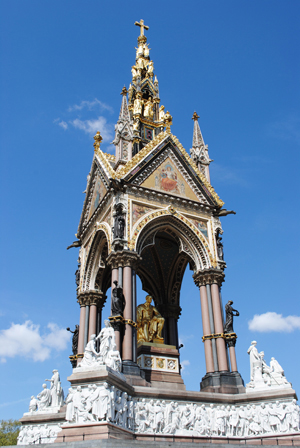
No list of London’s memorials could ever be complete without mentioning the extravagant Albert Memorial in Kensington Gardens.

Completed in 1876 at a cost of £120,000, the monument – officially known as the Prince Consort National Memorial – was commissioned by the Queen after Prince Albert died of typhoid in 1861. Queen Victoria, devastated at his loss and wanting a public memorial for Albert, invited seven leading architects to submit designs. In the end she chose the designs of Sir Gilbert Scott which featured an ornate canopy and spire standing to a height of 176 feet (54 metres) over a larger-than-life gilded bronze figure of Prince Albert sitting in regal splendour.

The resulting memorial – described “visual feast” – is an exemplar monument of the Victorian era’s Gothic Revival style. It highlights Albert’s role as a patron of the arts. Around the base of the podium is a frieze containing images of sculptors, composers, painters, architects and poets while at the four corners of the canopy are four clusters of statuetry relating to agriculture, commerce, engineering and manufacturing.

Further out, on the corners of the base, stand another four groups of statues – these relate to the continents of Europe, Asia, America and Africa. The canopy itself features mosaics and statues depicting historical figures associated with the arts as well as statues depicting the artistic and scientific disciplines, and angels and virtues.

The statue of Albert, sculpted by John Henry Foley, gazes benevolently towards Royal Albert Hall – another monument dedicated to the Prince Consort – and holds in its hand a catalogue of the Great Exhibition of 1851 (Albert was a key player in the exhibition’s organisation).

The monument, which was apparently used as a landmark by German bombers and Zeppelin pilots in World War I, underwent an extensive restoration in the 1990s which involved dismantling its entire upper half and then reassembling it.

While entry to the memorial is free, there are paid for tours available for those keen to find out more about the monument. For more information about the tours, see www.royalparks.org.uk/parks/kensington_gardens/tours/index.cfm.

WHERE: Kensington Gardens (nearest tube station is High Street Kensington or South Kensington); WHEN: Accessible when the park is open (6am to dusk) but it can be seen from Kensington Gore; COST: Entry is free (there are paid tours, see above); WEBSITE: Royal Parks has a page on its website, www.royalparks.org.uk/parks/kensington_gardens/tours/index.cfm.

Treasures of London – Cleopatra’s Needle

Sited relatively unobtrusively on the north bank of the Thames at Victoria Embankment, it’s easy to overlook this ancient Egyptian obelisk which was erected on its current site in 1878.

Although it’s commonly known as “Cleopatra’s Needle”, the red granite obelisk is in fact one of a pair originally constructed in the 15th century BC and placed in the Egyptian city of Heliopolis at the behest of Pharoah Thutmose III (the second one is now in New York’s Central Park and is also known by the name, Cleopatra’s Needle). The inscriptions were added later by Ramsses II. Both obelisks were subsequently moved to Alexandria and placed in a temple honoring Mark Antony. They later toppled over (and were covered in sand, which apparently helped with preservation).

The obelisk was given to the United Kingdom in 1819 by the grateful ruler of Egypt and Sudan, Mehemet Ali, in commemoration of British victories over the French at the Battle of the Nile and the Battle of Alexandria in 1801.

After the British government decided not to transport the obelisk to London due to the high expense, it remained in Alexandria until 1877 when Sir William James Erasmus Wilson contributed £10,000 toward the cost in an act of publicly-minded benevolence. After an eventful journey it which at one point it and the iron cylinder it was encased in – dubbed the Cleopatra – were declared sunk before being found again (tragically six crew drowned in the incident), it was finally erected in October 1878.

A time capsule is buried at the base of the obelisk which contains, among other things, a portrait of Queen Victoria, hairpins, copies of the Bible in several languages and a map of London. One of the two bronze sphinxes which these days guard the obelisk, meanwhile, still bears the scars of damage which took place in World War II when a bomb landed nearby.

Wren’s London – 7. Kensington Palace

A once favored residence of British monarchs, Kensington Palace’s connections with royalty date back to 1689 when, then a private country home known as Nottingham House, the building was purchased by King William III and Queen Mary II.

The royal couple turned to Sir Christopher Wren, then Surveyor of the King’s Works, who was charged with adapting the property into a suitably regal residence.

Wren’s work included the addition of four new pavilions – one at each corner – to provide extra accommodation for the king and queen. The King’s Apartments, approached by a Grand Staircase, were located in the south east, and the Queen Apartment’s in the north west. While many later additions were made, the basic layout of these buildings remains true to Wren’s original design.

Among the many spectacular original rooms is the King’s Gallery, built for William in 1695. It features an 1694 wind dial connected to a weather vane which turns according to the direction of the prevailing wind.

The property’s subsequent royal residents have included Queen Anne, King George I and King George II (it was King George III who made Buckingham Palace his primary London residence). Princess (later Queen) Victoria was born here in 1819 (it was she who first opened the State Apartments to visitors in 1899) while more recent residents in the palace’s private areas have included Princess Margaret and, of course, Diana, Princess of Wales.

WHERE: The Broad Walk, Kensington Gardens, Kensington (nearest tube stations are High Street Kensington or Queensway); WHEN: Daily 10am to 5pm (last admission 4pm); COST: £12.50 adult/£11 concession/£6.25 child/£34 family (online booking discounts available, Historic Royal Palaces members free); WEBSITE: www.hrp.org.uk/KensingtonPalace

PICTURE: Historic Royal Palaces/newsteam.co.uk