Located in Islington, the Caledonian Park Clock Tower is a local landmark and among all that now remains of the 19th century Metropolitan Cattle Market.
Subscribe for just £3 a month – less than the cost of a coffee – to get access to all of Exploring London’s content!
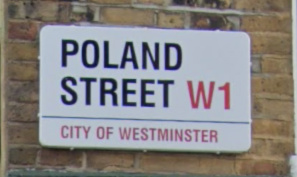
This Soho thoroughfare, which runs from Broadwick Street north to Oxford Street, isn’t directly named after Poland.
PICTURE: Courtesy of Google Maps
Instead its name comes from a tavern which once stood at the Oxford end of the street – the King of Poland, said to have been named in honour of King John III Sobieski who led a coalition of forces which defeated the Ottoman Empire at the Battle of Vienna in 1683.
Polish Protestants settled around the area in the 18th century, fleeing the Polish Counter-Reformation.
Famous residents have included Romantic poet Percy Bysshe Shelley (number 15; it’s marked with an English Heritage Blue Plaque) and William Blake (number 28).
The pub, incidentally, is said to have changed its name a couple of times – most latterly to the Dickens Wine House – before it was destroyed by a bomb in 1940.
Another pub in the street – the Kings Arms – stands on the site of an earlier tavern where the “Ancient Order of Druids” was revived in 1781.
The Poland Street Garage, meanwhile, opened here in 1934 and is said to have been the first multi-storey car park in London.
• The most complete Roman pottery kiln found in Greater London is going on public display in Highgate Wood in what is the first public showing since its discovery in 1968. The kiln has been restored thanks to a £243,550 National Lottery Heritage Fund grant and will be unveiled at 11am on Sunday as part of the annual Highgate Wood Community Heritage Day. The day, which runs until 4pm, will see the firing of a replica kiln and there will also be guided walks, a children’s Roman-themed woodland adventure workshop, arts, crafts, and other activities. The kiln will be on show in the Information Hut. For more, see www.cityoflondon.gov.uk/events/highgate-wood-community-heritage-day.
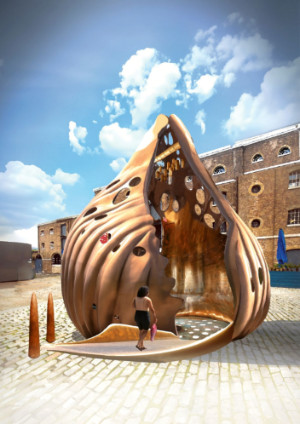
Concept image of Khaled Brooks’ ‘The Wake’. Courtesy of Mayor of London
• Khaleb Brooks’ sculpture The Wake has been selected as the new Memorial to Victims of Transatlantic Slavery to be located at West India Quay. The design, which features a seven metre tall cowrie shell in recognition of the shell’s role as symbol of slavery. A number of smaller shells will also be installed at other locations in London that have connections to the trade of enslaved people. Khaleb’s work was selected from a shortlist of six proposals by an artistic advisory panel of experts following a public consultation period. The memorial will be unveiled in 2026.
The M25 is an 117 mile-long orbital roadway which encircles most of the Greater London area.
Part of the M25 seen from a plane looking north as it took off from Heathrow. PICTURE: RFBailey (licensed under CC BY-SA 3.0)
Originally mostly built as a dual three lane motorway, widening has since taken place in more than half of it – to as much as six lanes in parts.
The idea was first proposed in the early 20th century and then re-mooted several times in subsequent decades before construction began in 1973.
The final section of the M23 was opened by then-Prime Minister Margaret Thatcher in 1986 (it was Europe’s longest ring road when it opened and has since been bypassed by the Berliner Ring).
The M25, which has 31 junctions, is these days one of the busiest motorways in Europe. It connects to 10 other motorways.
Connect Plus – a joint venture between Balfour Beatty, Atkins and Egis – works on behalf of National Highways to manage and operate the M25 network.
• ‘Lucky Jim’, a toy cat mascot belong to Jim Alcock – pilot of the first trans-Atlantic flight, has been reunited with the Vickers Vimy biplane aircraft that made the flight for the first time since 1919. The cat accompanied the famous aviator and his navigator Arthur Whitten Brown on their historic 17 hour, 1,880 mile journey. Following preservation efforts is now displayed alongside the aircraft in the Flight gallery at the Science Museum in South Kensington. Lucky Jim was previously displayed at the Science and Industry Museum in Manchester until 2019. A cartoon version of the cat is also the star of a new family trail around the gallery. For more, see https://www.sciencemuseum.org.uk/see-and-do/flight.
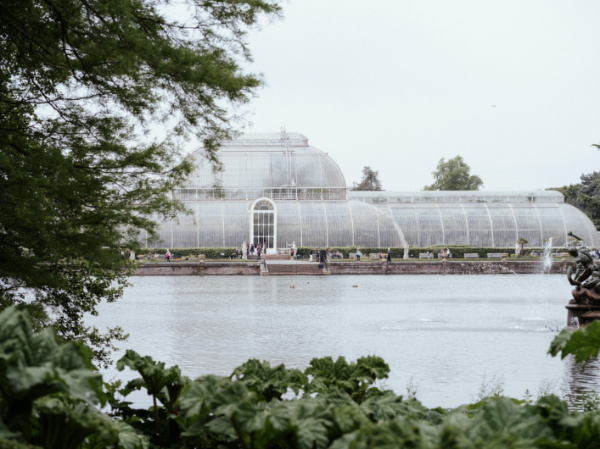
The Palm House at Kew Gardens. PICTURE: Annie Spratt/Unsplash
• Explore the plants of Kew Gardens’ historic Palm House with a new audio tour. Created by Kew’s Community Horticulture Programme in collaboration with outreach participants, Pollinators of the Palm House putsa spotlight on some of the remarkable stories and pollination tricks of incredible plants inside the 175-year-old structure. These include the giant cycad (Encephalartos altensteinii) – officially the oldest pot plant in the world, and the traveller’s palm (Ravenala madagascariensis), which is pollinated by lemurs in the wild on Madagascar. For more, see www.kew.org.
• An artwork by Banksy has been relocated to Guildhall Yard for its protection. The work, which depicts swimming piranhas, appeared on a sentry box near Ludgate Hill earlier this month.A City of London Corporation spokesperson saying a permanent home would be found “in due course”.
Send all items for inclusion to exploringlondon@gmail.com.
Located at the south-western end of the Houses of Parliament, the rather grand Victoria Tower was built as part of Sir Charles Barry’s 19th century redevelopment of the site in the Gothic Perpendicular style.
We invite you to support our work and subscribe for just £3 a month to gain access to all our coverage!
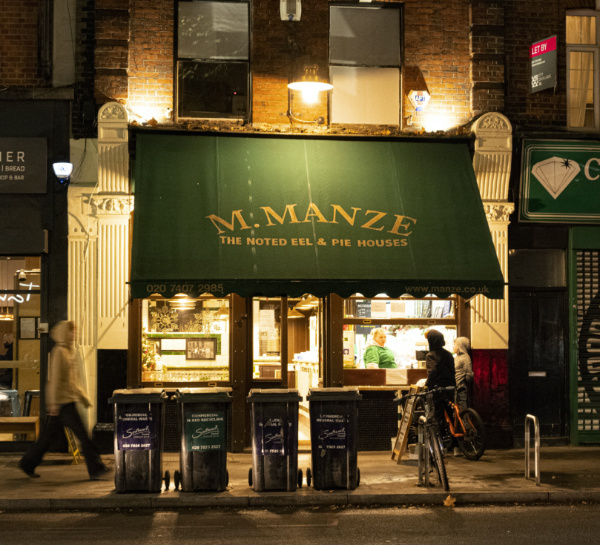
The shop was opened in 1902 by Michele Manze, who was born in Ravello, southern Italy, and has been serving their pies and mash with green liquor (a parsley sauce) and eels ever since.
Manze had arrived in London with his family when just three-years-old and settling in Bermondsey, south of the Thames, has started what was originally an ice supply business which soon started selling ice-cream. But Michele branched out into the pie and mash business.
The first shop under his name was at 87 Tower Bridge Road. It was established by Robert Cooke (of a famed family of pie and mash purveyors) in 1891 and Manze took over soon after his marriage to Cooke’s widowed daughter, Ada Poole.
Manze opened a second in Southwark Park Road in 1908. Three further shops followed – two in Poplar which were destroyed in World War II – one at Peckham High Street in 1927.
Several of his brothers including Luigi, meanwhile, opened their own pie and mash shops and so it’s said there were 14 pie, mash and eel shops bearing the Manze name by 1930.
That number has since been whittled down for various reasons and there are today there are three M Manze pie and mash shops – the Tower Bridge Road and Peckham establishments and a third which was opened in Sutton in 1998.
The Tower Bridge Road shop was damaged during World War II when the front of it was blown out.
Famous clientele have apparently included Roy Orbison, Rio Ferdinand and David Beckham and it even appeared in a music video of Elton John’s.
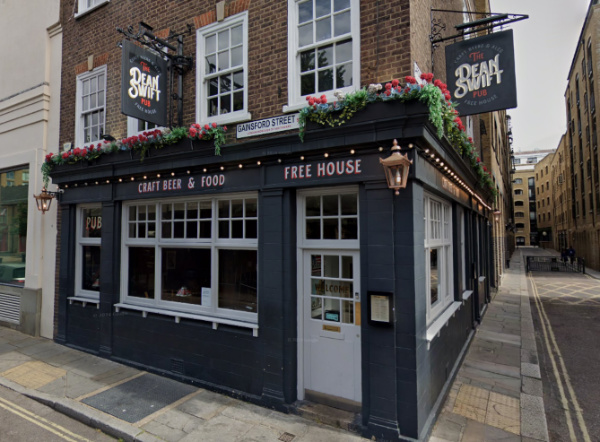
This pub in Bermondsey – just to the east of the southern end of the Tower of London – is named for the famous satirist and clergyman, Jonathan Swift (who was also appointed Dean of St Patrick’s Cathedral in Dublin in 1713).
Located at 10 Gainsford Street (on the corner with Lafone Street), the pub originally dates from the 1850s and was formerly known as The Bricklayer’s Arms.
While Swift spent much of his life in Ireland, he visited London on numerous occasions, particularly between 1701 and 1714, and was widely recognised in the city for his writings and wit.
Swift’s most famous work – Gulliver’s Travels – was published in 1726.
• Two pioneering photographers are being commemorated with English Heritage Blue Plaques today. Christina Broom (1862-1939) is believed to have been Britain’s first female press photographer while John Thomson (1837-1921) was a ground-breaking photo-journalist working at the advent of the medium. Broom’s plaque – the first to be located in Fulham – is being placed on 92 Munster Road, a terraced house of 1896, where she lived and worked for 26 years. Thomson’s plaque, meanwhile, will be located at what is now 15 Effra Road in Brixton where he and his family were living when one of his best-known and influential works, Street Life in London (1877-8), was published. For more, see www.english-heritage.org.uk/visit/blue-plaques/.
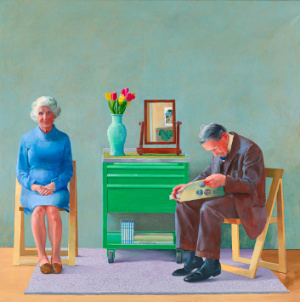
• Two of David Hockney’s key works – My Parents (1977) and Looking at Pictures on a Screen (1977) – which feature reproductions of 15th-century Italian painter Piero della Francesca’s The Baptism of Christ (probably about 1437–45) have gone on display alongside the Renaissance work at The National Gallery. Hockney and Piero: A Longer Look explores Hockney’s “lifelong association” with the National Gallery and its collections, particularly in the works of Piero della Francesca (1415/20–1492). Hockney once confessed that he would love to have The Baptism of Christ so he could look at it for an hour each day. My Parents features a reproduction of Piero’s work shown reflected in a mirror on a trolley behind the sitters while Looking at Pictures on a Screen depicts Hockney’s friend Henry Geldzahler, the Belgian-born American curator of 20th-century art at The Metropolitan Museum of Art in New York, peering at a folding screen in the artist’s studio on which are stuck four posters of National Gallery pictures including The Baptism of Christ. The display in Room 46 is free. Runs until 27th October. For more, see www.nationalgallery.org.uk.
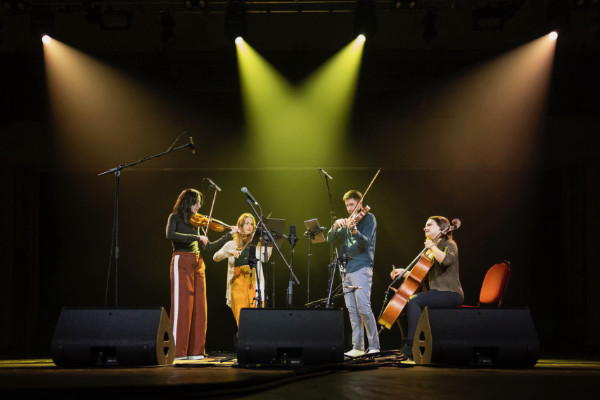
The City String Ensemble. PICTURE: Catherine Frawley
• Experience a prelude of Taylor Swift at Wembley Park with with City String Ensemble playing more than a dozen interpretations of Taylor Swift songs. The free open air concert comes ahead of Swift’s return to Wembley Stadium later this month. ‘Taylor on Strings’ will be held at the Sound Shell from 6:30pm on 13th August. Tickets are free but must be booked with 30 released at 10am each day in the lead-up to the concert. For more, head to wembleypark.com/taylor-on-strings.
Send all items for inclusion to exploringlondon@gmail.com
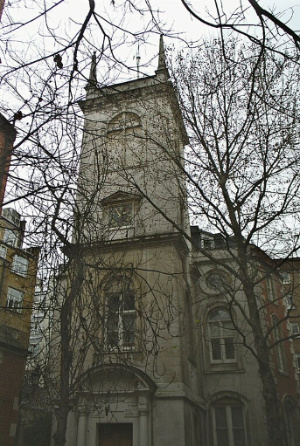
This tower is a survivor and was originally part of the rebuilt Church of St Olave, Old Jewry.
The medieval church, which was apparently built on the site of an earlier Saxon church, originally dated from 12th century. Its name referred to both the saint to whom it was dedicated – the patron saint of Norway, St Olaf (Olave) – and its location in the precinct of the City that was largely occupied by Jews (up until the infamous expulsion of 1290).
The former tower of St Olave, Old Jewry. PICTURE: Mark C Grant (public domain).
The church, which is also referred to as Upwell Old Jewry (this may have related to a well in the churchyard), was the burial place of two former Lord Mayors – mercer Robert Large (William Caxton was his apprentice) and publisher John Boydell (who apparently washed his face under the church pump each morning). Boydell’s monument was later transferred to St Margaret Lothbury.
The church was sadly destroyed in the Great Fire of 1666 but it was among those rebuilt under the eye of Sir Christopher Wren in the 1670s. It’s from this rebuilding that the current tower dates.
At this time, the parish was united with that of St Martin Pomeroy (which had already shared its churchyard and which was also destroyed in the Great Fire).
Wren’s church was eventually demolished in 1887 as moves took place to consolidate church parishes under the Union of Benefices Act – the parish was united with that of St Margaret Lothbury and proceeds from the sale were used to fund the building of St Olave, Monor House. It’s worth noting that a Roman pavement was found on the site after the church demolition.
The tower (and the west wall), meanwhile, survived. The tower was subsequently turned into a rectory for St Margaret Lothbury and later into offices.
Interestingly, the Grade I-listed, Portland stone tower is said to be the only one built by Wren’s office which is battered – that is, wider at the bottom than the top. It’s topped by some obelisk-shaped pinnacles and a weather vane in the shape of a sailing ship which was taken from St Mildred, Poultry (was demolished in 1872).
The tower’s former clock was built by Moore & Son of Clerkenwell. It was removed at the time of the church demolition was installed in the tower of St Olave’s Hart Street. The current clock was installed in 1972.
With the Olympics on Paris and all our minds turned to sporting endeavours, we thought it an appropriate time to recall the life of one of the most celebrated swordsmen of the 18th century.
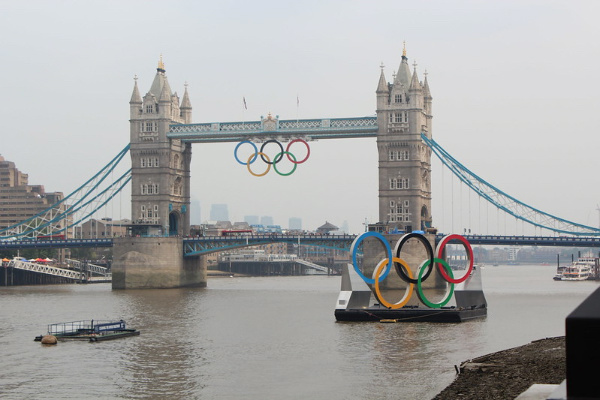
Memories of 2012. This year the Games are in Paris but there’s plenty of places to watch on a big screen in London. PICTURE: Peter Burgess (licensed under CC BY 2.0)
• The Olympics are in full swing across the Channel in Paris and to ensure you don’t miss any of the action, big screens are showing the coverage across London. Among them are official Team GB Fanzones – there’s a list of locations on the Team GB website here. Other locations include Lyric Square in Hammersmith, Bishops Square in Spitalfields, the Old Royal Naval College grounds in Greenwich and by the Thames at London Bridge as part of the Summer by the River festival.
• New portraits of human rights campaigner Peter Tatchell and singer Sam Smith have gone on display at the National Portrait Gallery as part of its History Makers Display. The full-length portrait of Tatchell, which has been acquired by the gallery, was painted by artist Sarah Jane Moon to coincide with his 70th birthday on 25th January, 2022, and is the first portrait of Tatchell to enter the gallery’s collection.. Meanwhile, titled Gloria, the portrait of five-time Grammy Award winner Smith is the work of artistic duo Pierre Commoy and Gilles Blanchard and was created in 2023. It’s on loan from the singer. For more, see www.npg.org.uk.
• On Now: Faithful Companions: Charles Dickens & his Pets. This exhibition at the Charles Dickens Museum in Bloomsbury takes a look at the many pets – dogs, ravens, goldfinches, and cats – that lived in the home of Charles Dickens, exploring the stories of the likes of Grip the raven and Timber the dog as well as those of animals made famous in his novels. The display includes hand-written letters, family photo albums and artworks. Runs until 12th January next year. Admission charge applies. For more, head to https://dickensmuseum.com/blogs/all-events/faithful-companions-charles-dickens-his-pets.
Send all items for inclusion to exploringlondon@gmail.com
It’s widely reported that the first banana went on sale in London in the mid-17th century but there is evidence bananas had been in the capital well before that date.
Used by the Lord Mayor of London and his retinue as a location for weekly worship for more than 200 years, the Guildhall Chapel was once an important part of the City infrastructure.
Please consider supporting our work for just £3 a month.



 Exploring London