We’re back this week after a Christmas-New Year break!
This year, as well as running our regular programme of content, we’ll be introducing some new features on Exploring London (and reviving some old ones that had fallen by the wayside).
Stay tuned for updates and if you can, please consider supporting our work with a £3 a month subscription which gives you access to all our content and helps ensure we can continue producing it.
This year we’ve expanded our annual list of our most read posts (this time for those published in 2025) to include 12 – that’s three a day with the final three to be released on New Year’s Day!
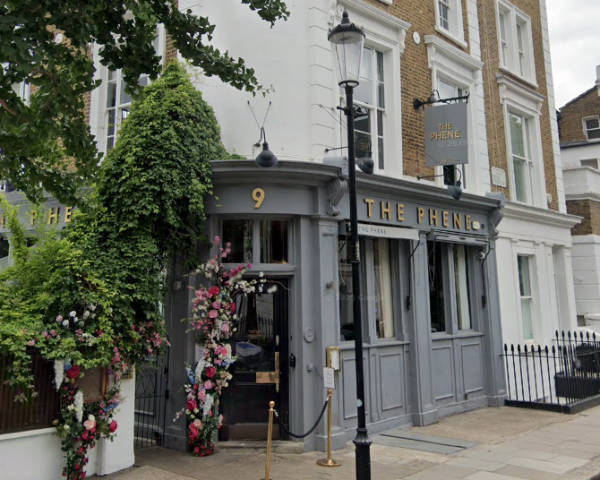
This Chelsea pub has a rather unusual name and it, like that of the street in which it can be found, comes John Samuel Phene, the architect who built it.
PICTURE: Courtesy of Google Maps
The pub dates from 1850 – Phene, who in 1903 constructed a now demolished five-storey house at in nearby Upper Cheyne Row which became known as “Gingerbread Castle” due to its elaborate decorations – had it constructed as a venue for servants and tenants to drink at.
It became known as a favourite of the likes of Northern Irish footballer George Best and the poet Dylan Thomas.
It was saved from being redeveloped in 2013 after a campaign by local residents backed by high profile celebrities such as Hugh Grant.
The pub at 9 Phene Street, which these days sports a rather plain sign, is now run by the City Pub Company.
• An exhibition exploring the influence of the art deco movement on graphic poster design in on now at the London Transport Museum in Covent Garden.Art deco: the golden age of poster design features more than a hundred original 1920s and 1930s transport posters and poster artworks alongside photography, short films, ceramics and other objects to mark the centenary of the 1925 Paris exhibition where art deco originated. In the UK, Frank Pick, then-chief executive of London Transport, was the individual most responsible for advancing this form of graphic style, master-minding the publicity for the Underground and LT from 1908 onwards. A number of the posters in the exhibition in the Global Poster Gallery have never been put on public display before. Admission charge applies. For more, see www.ltmuseum.co.uk/whats-on/art-deco.
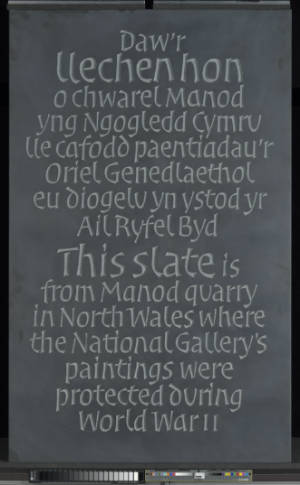
• An inscribed stone tablet commemorating the Welsh quarry where The National Gallery’s art was protected during World War II has been put on permanent display in the gallery. The tablet, made from slate taken from the Manod quarry in Eryri (Snowdonia), was conceived by the artist Jeremy Deller and designed and carved by letter-carver John Neilson. The work, which was commissioned by Mostyn, an art gallery in Llandudno and supported by CELF – the national contemporary art gallery for Wales, can be seen in the Portico Vestibule, close to Boris Anrep’s floor mosaic of Sir Winston Churchill depicted in war time. The Manod slate mine in north Wales was chosen to store the art after an earlier proposal to evacuate the works to Canada was vetoed over fears of U-boat attacks. At the mine, explosives were used to enlarge the entrance to allow access for the the largest paintings and several small brick ‘bungalows’ were built within the caverns to protect the paintings from variations in humidity and temperature. What was known as an ‘elephant’ case was constructed to transport the paintings on trucks from London and, by the summer of 1941, the entire collection had moved to its new subterranean home, where it was to remain for four years, returning to London only after the end of the war in 1945. For more see www.nationalgallery.org.uk/.
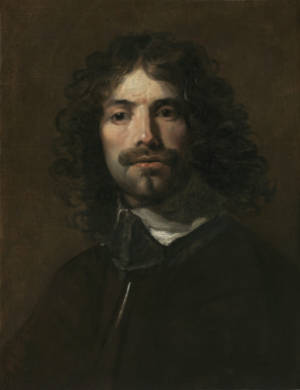
William Dobson, ‘Self-Portrait’, c1635-40. Image courtesy of Tate and the National Portrait Gallery
• A self-portrait by William Dobson, widely considered to be the first great painter born in Britain, has gone on display at Tate Britain alongside a Dobson’s portrait of his wife. Dobson’s painting, which was acquired by the Tate and the National Portrait Gallery, was made between 1635 and 1640 and is said to be a “groundbreaking example of English self-portraiture”. His Portrait of the Artist’s Wife (c1635-40), which joined Tate’s collection in 1992, depicts Dobson’s second wife Judith and would have been conceived around the time of their marriage in December, 1637. Dobson rose to the role of King Charles I’s official painter before his career was cut tragically short when he died at the age of 35. For more, see tate.org.uk/visit/tate-britain.
• Send items for inclusion to exploringlondon@gmail.com.
• The lights will be turned on the Trafalgar Square Christmas tree tonight. This year marks the 78th anniversary of the gift of the first Christmas tree to the people of London from the Norwegian city of Oslo in acknowledgement of the support Britain gave to Norway during World War II. The festivities will include the choir of St-Martin-in-the-Fields singing some well known Christmas carols to music led by the Regent Hall Band of the Salvation Army, the reading of a poem written by children who live in Westminster, a display by The Corps of Drums from the Band of His Majesty’s Royal Marines Collingwood and a performance by Det Norske Jentekor, The Norwegian Girls’ Choir, conducted by Anne Karin Sundal-Ask. Festivities start at 5pm and the lights switch on at 6pm. The tree will be in the square until 5th January after which it will be recycled. You can follow the tree on Instagram at @TrafalgarTree, on TikTok at @TrafalgarTree, and on X at @TrafalgarTree.
• A Blue Plaque commemorating Alice in Wonderland illustrator and political cartoonist Sir John Tenniel has been returned to London’s streets – but to a different location than that where it was first positioned. The plaque, which is actually jade-green and white, was originally unveiled by the London County Council in 1930 at Tenniel’s longtime Maida Vale home (the colour was due to the request of the house-holder). But following its removal when the house was demolished in 1959, the plaque was so damaged that its destruction was authorised. But this wasn’t carried out and the plaque, which features an early “wreathed” design, has been in storage since. Following restoration, however, it has now been relocated to a new home – a property at 52 Fitz-George Avenue in West Kensington where Tenniel spent the final years of his life.
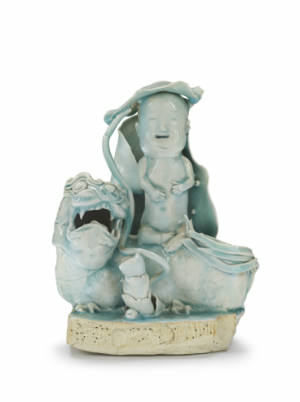
Figure from the ‘Century Doll’ series, glazed porcelain, by Yao Yongkang, 2004, Jingdezhen, China
• The first major UK exhibition exploring contemporary studio crafts in China is on now at the V&A South Kensington.Dimensions: Contemporary Chinese Studio Crafts features more than 80 objects including almost 50 new acquisitions and puts a spotlight on “contemporary and modern makers who build upon longstanding tradition to reinvent ancient practices, pioneer alternative techniques, and develop new channels for self-expression”. Many of the objects – displayed in the China and Ceramics galleries – sit in dialogue alongside permanent displays of historic Chinese craftsmanship. Highlights include large scale works such as Lin Fanglu’s She’s Bestowed Love (2025), that transforms intricate tie-dye practices into a monumental textile sculpture, more delicate pieces such as Zhang Huimin’s Golden Mammary 4 (2025), a brooch produced by pushing the boundary of filigree in a reinvention of traditional practice, a wall hanging by pioneering artist of studio pottery Tan Chang, as well as works by the three potters who were the first to be exhibited in China under the mantle of ‘modern ceramics’: Mei Wending, Zeng Li and Zeng Peng. Runs until 27th September next year. Free admission. For more, see www.vam.ac.uk/exhibitions/dimensions-contemporary-chinese-studio-crafts.
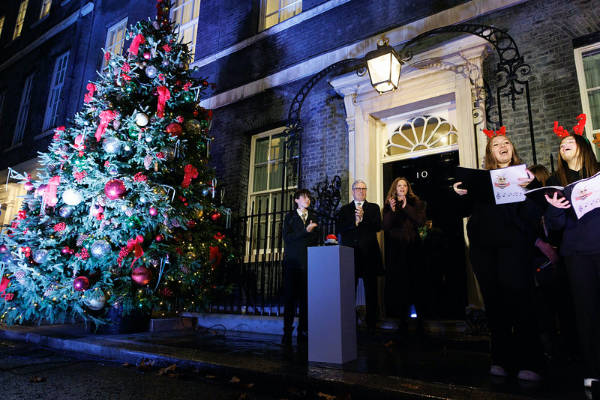
Prime Minister Keir Starmer turns on the Christmas tree lights outside 10 Downing Street. PICTURE: Simon Dawson/No 10 Downing Street (licensed under CC BY-NC-ND 4.0)
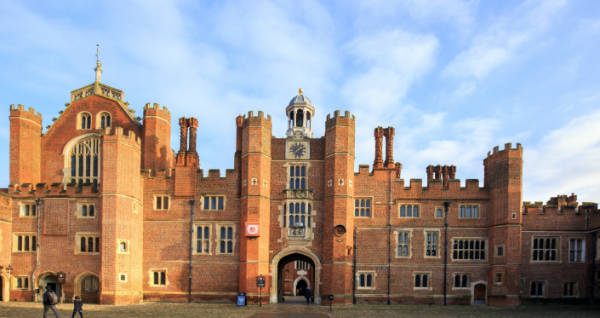
• Christmas has come to Hampton Court Palace with the one-time home of King Henry VIII decorated with traditional decorations and hosting a range of Christmas-related activities. Musicians located throughout the palace are playing a mixture of classical tunes and familiar Christmas melodies while in the Wine Cellar “intriguing history” of Christmas is being brought to life in story-telling sessions. The culinary Christmas traditions of the Tudors, meanwhile, are on display in the historic kitchens with, between 20th December and 4th January, the Historic Kitchens team recreating recipes from the Tudor court. The Magic Garden is hosting a special playful outdoor adventure for younger ones between 17th December and 4th January. The Hampton Court Palace Ice Rink has also returned (until 4th January) and there’s a Christmas market being held in the Great Fountain Garden on 5th to 7th December and again on 12th to 14th December. The Festive Fayre will feature more than 100 independent exhibitors offering artisan food and drink, unique gifts and stocking fillers while there will be live music on the East Front bandstand and horse and cart rides in the grounds. Admission charge applies. For more on Christmas activties at the palace head to www.hrp.org.uk/hampton-court-palace/whats-on/christmas-festivities/.
• Caravaggio’s Victorious Cupid – never-before seen in public in the UK – is at the centre of a new exhibition which has opened at the Wallace Collection. The sculpture is presented with two Roman sculptures that along with the Caravaggio were all once part of the portfolio of Marchese Vincenzo Giustiniani (1564–1637), one of the most celebrated collectors of his day. The life-sized Cupid was once displayed along with works by the likes of Raphael, Titian and Giorgione in his grand palazzo located near the Pantheon in Rome along with an extensive gallery of classical sculpture. Caravaggio’s Cupid, which is free to enter, can be seen in the Exhibition Galleries until 12th April. For more, see www.wallacecollection.org/whats-on/exhibitions-displays/caravaggios-cupid/.
• A new display honouring the livelihoods, creativity and craft of Romani communities and their contribution to British society has opened at the London Museum Docklands. By Appointment Only: Romani art, culture and heritage centres on three works, Sugar Coated (2025) by Corrina Eastwood, Tap Your Heels Together Three Times (2025) by Delaine Le Bas and What Makes a Home? (2025) by Dan Turner. There’s also timeline by John-Henry Phillips which illustrates the history of Romani communities from 500-1000 up to 2022. This is displayed along with the Historic England film Searching for Romani Gypsy Heritage with John Henry Phillips (2024) and an oral history piece both of which contextualise the timeline. The exhibition in the Reflections Room is free. For more, see www.londonmuseum.org.uk/whats-on/by-appointment-only/.
Send all items for inclusion to exploringlondon@gmail.com.
Dame Sarah Mullally, Bishop of London since 2018, was named as the 106th Archbishop of Canterbury in October so we thought it a good time to explore some of the grand palaces which served as bishop’s palaces, some of them still standing and others not.
And what more appropriate place to start than Lambeth Palace, the official Thames-side residence of the Archbishop of Canterbury.
Subscribe for just £3 a month to access all of Exploring London’s content…
The real person behind writer Charles Dickens’ ‘Inspector Bucket’, Charles Frederick Field was a police officer with the Metropolitan Police who rose to the rank of inspector before, following retirement, becoming a private detective.
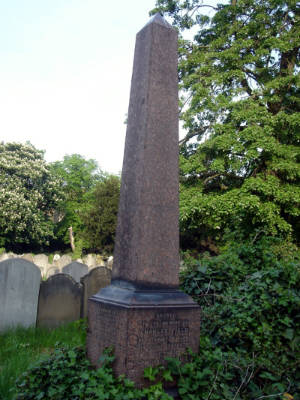
Field’s funerary monument in Brompton Cemetery. PICTURE: Edwardx (licensed under CC BY-SA 1.0)
Field, the son of a Chelsea pub proprietor, had apparently wanted to be an actor but due to his straitened economic situation had instead joined the Metropolitan Police at its founding in 1829.
Field served in several divisions across London, eventually rising to the rank of inspector. He joined the Detective Branch, which had only been formed in 1842, in 1846.
It was while with the Detective Branch that he encountered Dickens and they formed what’s described as a lasting friendship. From 1850 onwards Dickens wrote as series of articles about the world of the Detective Branch and the work of Field (sometimes using a pseudonym) including his essay ‘On Duty With Inspector Field’.
Dickens is also believed to have used Field as the model for Inspector Bucket in Bleak House, first published as a serial in 1852 and 1853.
Field, who was noted as a bit of a raconteur and for his love of disguises even when not really required (perhaps explained by theatrical bent), retired from the Met in 1852 and set up his own enquiry office. He apparently caused controversy after his retirement by using his rank in his private work which somewhat soured his relationship with the force.
Field, who died in 1874 and is buried in Brompton Cemetery, has since been the subject of several works of fiction.
• The first retrospective of the work of film-maker Wes Anderson has opened at the Design Museum in South Kensington.Wes Anderson: The Archives draws on the director’s own archives to chart the evolution of his films from early experiments in the 1990s and collaborations to an exploration of the design stories behind films such as The Royal Tenenbaums, The Grand Budapest Hotel, Fantastic Mr Fox and Isle of Dogs. The display features more than 700 objects including original storyboards, polaroids, sketches, paintings, handwritten notebooks, puppets, miniature models and costumes. Highlights include a candy-pink model of the Grand Budapest Hotel, vending machines from Asteroid City, a FENDI fur coat worn by Gwyneth Paltrow as Margot Tenenbaum in The Royal Tenenbaums, stop motion puppets used to depict the fantastical sea creatures in The Life Aquatic with Steve Zissou and Mr Fox wearing his signature corduroy suit and show dog Nutmeg alongside miniature sets. There’s also a screening of Bottle Rocket, Anderson’s first short film, created in 1993. Runs until 26th July. Admission charge applies. For more, see https://designmuseum.org/exhibitions/wes-anderson-the-archives.
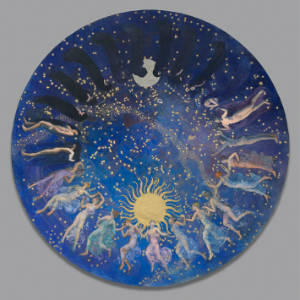
Edwin Austin Abbey, ‘Study for The Hours in the Pennsylvania State Capitol’ (about 1909–11), oil on canvas, 381 × 381 cm Yale University Art Gallery, Edwin Austin Abbey Memorial Collection. PICTURE: Courtesy of Yale University Art Gallery
• A design for the ceiling of the House of Representatives in the Pennsylvania State Capitol in the US has gone on show at The National Gallery as part of a new exhibition dedicated to its creator Edwin Austin Abbey (1852-1911). The 12-feet diameter half-scale design for The Hours, newly conserved by the Yale University Art Gallery, depicts 24 female figures representing the 24 hours of the day. The display, Edwin Austin Abbey: By the Dawn’s Early Light, also features six preparatory drawings for his work, The Apotheosis of Pennsylvania, a vast wall mural featuring representations of 16th and 17th century English explorer Sir Walter Raleigh and American frontiersman Daniel Boone behind the Speaker’s dais. Abbey, who lived and worked in the UK, displayed the first of his Harrisburg murals at the University of London in 1908 prior to shipping them to the US – guests included King Edward VII and Queen Alexandria. The free display can be seen in the HJ Hyams Room (Room 1) until 15th February. For more, see www.nationalgallery.org.uk/exhibitions/edwin-austin-abbey-by-the-dawn-s-early-light
• The Tower of London is being transformed into a “magical storybook world” to mark Christmas this year.A Storybook Christmas at the Tower of London features royal romances, legendary figures and treasured traditions which include animals who once lived in the Tower’s royal menagerie, the famous tower ravens, the chance to step onto a regal throne for a family portrait and find storybook backdrops among Christmas trees and wreaths, and an opportunity to explore the story of the Tower’s Royal Observatory where the first Royal Astronomer was appointed in 1675. The “storybook Christmas” opens on Sunday and runs until 4th January. Included in general admission. For more, see www.hrp.org.uk/tower-of-london/.

 Exploring London