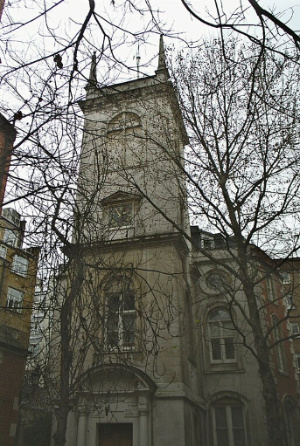
2. The tower of St Olave, Old Jewry…
4. Caledonian Park Clock Tower…
5. St Augustine’s Tower, Hackney…
6. Westminster Cathedral campanile…
7. Tower of the former Church of St Mary-at-Lambeth…
We return to the Tower of London this week to look at the history of another of its storied towers.
Support out work and subscribe for just £3 a month for full access to the site.
A well-known landmark in Westminster, the distinctive striped brick and stone campanile of Westminster Cathedral stands 284 feet or 64 metres high.
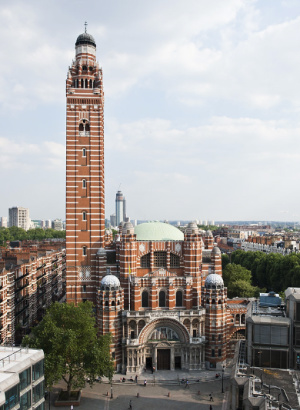
Building of a Roman Catholic cathedral in Westminster – what would be the largest in England and Wales – was the vision of Cardinal Herbert Vaughan. Construction started in 1895 and was complete eight years later. The campanile was the final part of the building’s structure to be completed.
Conscious that the Gothic Westminster Abbey only a short distance away, architect John Francis Bentley instead designed the cathedral in a neo-Byzantine style and the plans originally included two campanili or bell towers which may have been influenced by those in Venice (it was Cardinal Vaughn who famously said one campanile would be enough for him resulting in just one being built).
The 30 foot square dome-topped tower, like the rest of the building, was constructed of stripes of red brick and Portland stone which reflected existing residential buildings nearby.
Formally known as St Edward’s Tower, it contains the 55cwt St Edward’s Bell (named after St Edward the Confessor) which was a gift of Gwendoline, the Duchess of Norfolk, in 1910. It was cast at the Whitechapel Foundry and bears the inscription, “While the sound of this bell travels through the clouds, may the bands of angels pray for those assembled in thy church. St Edward, pray for England.”
Carved stone eagles surround the apex of the tower – a reference to St John the Evangelist (apparently patron saint of the architect) and the cross on top of the cupola is said to contain a fragment of the True Cross discovered by the Empress Helena in 326 AD.
The campanile famously appears at the end of Alfred Hitchcock’s 1940 thriller, Foreign Correspondent, in a scene in which the bad guy is thrown from the top.
The campanile, which has a lift to the top, is open to the public. Viewing balconies on all four sides of the tower provide 360 degree views of the surrounding city including over the stunning domes of the cathedral itself.
WHERE: The Campanile, Westminster Cathedral (nearest Tube stations are Victoria and St James’s Park); WHEN: 11am to 3:30pm Fridays, Saturdays and Sundays; COST; £6 adults; £12 families (two adults and up to four children); £3 concessions (aged 60+); WEBSITE: https://westminstercathedral.org.uk/tower-viewing-gallery-reopens/
This tower – said to be the oldest building in Hackney – is all that remains of a 16th century church and, as a local symbol, appears on the London Borough of Hackney’s coat-of-arms.
Support our work and subscribe for just £3 a month – less than the price of a cup of coffee – to see all of Exploring London’s content.
Located at the south-western end of the Houses of Parliament, the rather grand Victoria Tower was built as part of Sir Charles Barry’s 19th century redevelopment of the site in the Gothic Perpendicular style.
We invite you to support our work and subscribe for just £3 a month to gain access to all our coverage!
This tower is a survivor and was originally part of the rebuilt Church of St Olave, Old Jewry.
The medieval church, which was apparently built on the site of an earlier Saxon church, originally dated from 12th century. Its name referred to both the saint to whom it was dedicated – the patron saint of Norway, St Olaf (Olave) – and its location in the precinct of the City that was largely occupied by Jews (up until the infamous expulsion of 1290).
The church, which is also referred to as Upwell Old Jewry (this may have related to a well in the churchyard), was the burial place of two former Lord Mayors – mercer Robert Large (William Caxton was his apprentice) and publisher John Boydell (who apparently washed his face under the church pump each morning). Boydell’s monument was later transferred to St Margaret Lothbury.
The church was sadly destroyed in the Great Fire of 1666 but it was among those rebuilt under the eye of Sir Christopher Wren in the 1670s. It’s from this rebuilding that the current tower dates.
At this time, the parish was united with that of St Martin Pomeroy (which had already shared its churchyard and which was also destroyed in the Great Fire).
Wren’s church was eventually demolished in 1887 as moves took place to consolidate church parishes under the Union of Benefices Act – the parish was united with that of St Margaret Lothbury and proceeds from the sale were used to fund the building of St Olave, Monor House. It’s worth noting that a Roman pavement was found on the site after the church demolition.
The tower (and the west wall), meanwhile, survived. The tower was subsequently turned into a rectory for St Margaret Lothbury and later into offices.
Interestingly, the Grade I-listed, Portland stone tower is said to be the only one built by Wren’s office which is battered – that is, wider at the bottom than the top. It’s topped by some obelisk-shaped pinnacles and a weather vane in the shape of a sailing ship which was taken from St Mildred, Poultry (was demolished in 1872).
The tower’s former clock was built by Moore & Son of Clerkenwell. It was removed at the time of the church demolition was installed in the tower of St Olave’s Hart Street. The current clock was installed in 1972.

Carrying rather a gruesome name, this rectangular-shaped tower sits over a gate leading from outer ward into the inner ward in the Tower of London.
The tower, which once controlled the watergate before the outer walls were constructed, was originally known as the Garden Tower due to its location adjoining the Tower Lieutenant’s Garden.
To see the rest of this post (and all of our coverage), subscribe for just £3 a month. This small contribution – less than the cost of a cup of coffee – will help us continue and grow our coverage. We appreciate your support!
 Exploring London