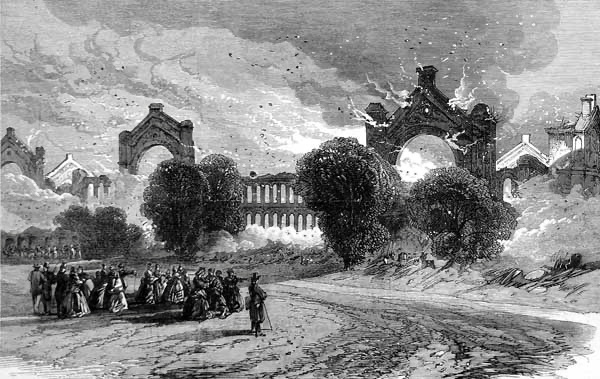
This month marks the 150th anniversary of the fire which destroyed the first Alexandra Palace in the north of London, only two weeks after it was opened.
Conceived by British architect Owen Jones as a “palace of the people”, the palace at Muswell Hill was created to serve as a public centre of recreation, entertainment and education for the people of north London as something of a counterpart to the Crystal Palace in the city’s south.
Designed by Alfred Meeson and John Johnson, the massive glass, iron and brick building covered some 250,000 square feet. It was constructed using recycled materials from the vast temporary building built for the 1862 International Exhibition in South Kensington. Building works commenced in September, 1865, and it was completed in early 1873.
Officially named Alexandra Palace after the popular Princess of Wales, Alexandra of Denmark (although the name Palace of the People – which had originally been given to the project – remained an alternative as did, later, the shortened “Ally Pally”), it featured a vast 900 foot long central nave capped with a 220 foot high dome as well as first floor galleries and terraces.
The palace and surrounding park were officially opened on 24th May, 1873, the 54th birthday of Queen Victoria. The grand celebration, which was attended by tens of thousands of people, featured concerts, recitals and ended with fireworks.
It was only 16 days after the opening, at lunchtime on 9th June, that the palace was destroyed by a fire believed to have started when a burning ember from a brazier being used by plumbers working on the roof set fire to the building’s timber. Numerous horse drawn and manual fire engines were dispatched to the scene along with some 120 firefighters but to no avail.
Tragically three staff members died as a result of the blaze which left only the outer walls of the palace standing. Among the items destroyed was a collection of English pottery and porcelain which, comprising some 4,700 items, had been on loan.
Plans to rebuild the palace were quickly acted upon and a new and improved palace opened on 1st May, 1875. This building survived a fire in 1980 but about a third of the building was destroyed.
The now Grade II-listed building has since been rebuilt(but that’s a story for a another time).
 Exploring London