This Week in London – Art deco at the London Transport Museum; art storage during WWII commemorated; and, William Dobson’s self-portrait…

An exhibition exploring the influence of the art deco movement on graphic poster design in on now at the London Transport Museum in Covent Garden. Art deco: the golden age of poster design features more than a hundred original 1920s and 1930s transport posters and poster artworks alongside photography, short films, ceramics and other objects to mark the centenary of the 1925 Paris exhibition where art deco originated. In the UK, Frank Pick, then-chief executive of London Transport, was the individual most responsible for advancing this form of graphic style, master-minding the publicity for the Underground and LT from 1908 onwards. A number of the posters in the exhibition in the Global Poster Gallery have never been put on public display before. Admission charge applies. For more, see www.ltmuseum.co.uk/whats-on/art-deco.
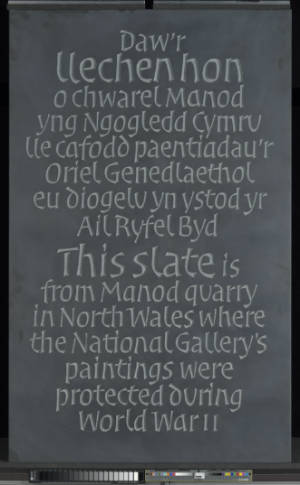
Jeremy Deller, designed and carved by John Neilson ‘Manod Slate Tablet’, 2025 © Jeremy Deller / John Neilson
Photo: The National Gallery, London

An inscribed stone tablet commemorating the Welsh quarry where The National Gallery’s art was protected during World War II has been put on permanent display in the gallery. The tablet, made from slate taken from the Manod quarry in Eryri (Snowdonia), was conceived by the artist Jeremy Deller and designed and carved by letter-carver John Neilson. The work, which was commissioned by Mostyn, an art gallery in Llandudno and supported by CELF – the national contemporary art gallery for Wales, can be seen in the Portico Vestibule, close to Boris Anrep’s floor mosaic of Sir Winston Churchill depicted in war time. The Manod slate mine in north Wales was chosen to store the art after an earlier proposal to evacuate the works to Canada was vetoed over fears of U-boat attacks. At the mine, explosives were used to enlarge the entrance to allow access for the the largest paintings and several small brick ‘bungalows’ were built within the caverns to protect the paintings from variations in humidity and temperature. What was known as an ‘elephant’ case was constructed to transport the paintings on trucks from London and, by the summer of 1941, the entire collection had moved to its new subterranean home, where it was to remain for four years, returning to London only after the end of the war in 1945. For more see www.nationalgallery.org.uk/.
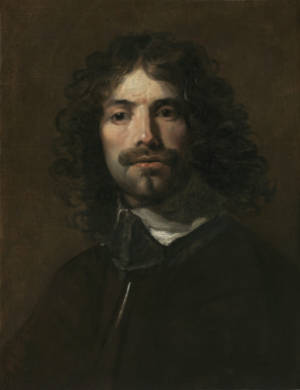
William Dobson, ‘Self-Portrait’, c1635-40. Image courtesy of Tate and the National Portrait Gallery

A self-portrait by William Dobson, widely considered to be the first great painter born in Britain, has gone on display at Tate Britain alongside a Dobson’s portrait of his wife. Dobson’s painting, which was acquired by the Tate and the National Portrait Gallery, was made between 1635 and 1640 and is said to be a “groundbreaking example of English self-portraiture”. His Portrait of the Artist’s Wife (c1635-40), which joined Tate’s collection in 1992, depicts Dobson’s second wife Judith and would have been conceived around the time of their marriage in December, 1637. Dobson rose to the role of King Charles I’s official painter before his career was cut tragically short when he died at the age of 35. For more, see tate.org.uk/visit/tate-britain.

• Send items for inclusion to exploringlondon@gmail.com.

10 London sites you may not know about – 1. Eltham Palace

London is a vast city and whether you’re a first-time visitor or a seasoned Londoner, there’s probably still many places you haven’t yet visited. So over the next few posts we’re running a list of 10 of the less well-known sites for your perusal…

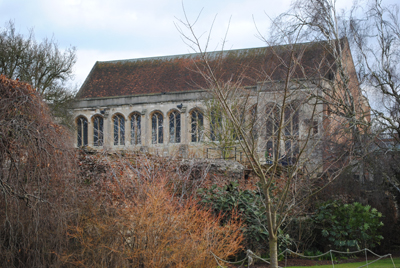
1. Eltham Palace. While Henry VIII’s final home, Hampton Court Palace, remains among London’s top 10 tourist sites, less well known is his childhood home, Eltham Palace. True, nowhere near as much of it remains from the Tudor and earlier medieval times, but with a later adjoined 1930s mansion housing some amazing Art Deco interiors, the medieval remains are just the start.

The palace’s history can be traced back to the Domesday survey of 1086. It passed into royal ownership in 1305 when then owner, Anthony Bek, Bishop of Durham, gave it to King Edward I.

Numerous kings and their families spent time at Eltham including Edward III, Henry IV, and Henry VI, and it was Edward IV who, between 1475 and 1480, ordered the Great Hall built – a treasure which still survives.

Henry VIII was the last English monarch to spend considerable time at Eltham – it was elipsed by Greenwich Palace as a royal residence – and, after falling into disrepair into the seventeenth century, it passed back into ‘non-royal’ hands.

Much of what stands at Eltham today dates from the 20th century when millionaire socialites Sir Stephen and Lady Virginia Courtauld oversaw the restoration of the medieval Great Hall and the construction of an adjoining mansion which is a masterpiece of 1930s style incorporating a combination of Art Deco, “ocean-liner style” and Swedish design.

The Courtaulds left for a new life in Southern Rhodesia in 1944 and from then until the early 1990s the military occupied the property. English Heritage subsequently oversaw a major restoration and opened it to the public in 1999.

It’s well worth a visit to see the medieval Great Hall (which apparently boasts the third largest hammer-beam roof in England) and the 1930s property (aside from the stunning interiors – including Virginia’s gold-plated bathroom and warmed sleeping quarters for the Courtauld’s pet lemur – there’s also some great Courtauld family movies on show which give an amazing insight into the family which once lived there and an audio guide tour fittingly narrated by David ‘Poirot’ Suchet). There’s also 19 acres of gardens to explore, including a magnificent medieval bridge spanning what remains of the moat, and a cafe to while away the afternoon.

WHERE: Off Court Road, SE9. Half a mile from Eltham and Mottingham train stations. COST: £8.30 adult/£7.20 concession/£4.20 child (garden only tickets are available). English Heritage members free. WEBSITE: www.elthampalace.org.uk