This Week in London – New artworks on the Tube network; Boulle clocks at the Wallace Collection; and, see extinct-in-the-wild doves at London Zoo…

Transport for London has announced it will be unveiling four major new artworks on the Tube network this year as part of its Art on the Underground programme which this year celebrates its 25th anniversary. The works include Saved by the Whale’s Tail, Saved by Art, a large-scale piece by artist Ahmet Öğüt in collaboration with New Contemporaries In Art which, to be unveiled at Stratford Underground station in March, explores the role art plays in everyday life. There’s also a new artwork by Hungarian-born American artist Agnes Denes which will be featured in a new pocket Tube map, a new audio work produced by artist and composer Rory Pilgrim with the Mayor of London’s Culture and Community Spaces at Risk (CCSaR) programme which will be heard at Waterloo Station in June and July, and, a new mural by Rudy Loewe which will be unveiled at Brixton Tube station in November. For more on Art on the Underground, see https://art.tfl.gov.uk.
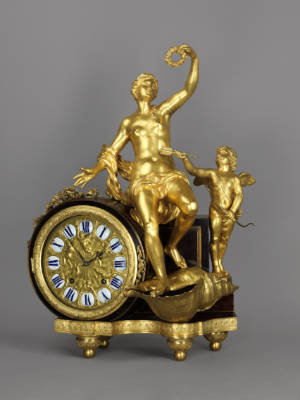
Attributed to André-Charles Boulle, movement by Jean Jolly, Mantel clock (About 1715)/© The Trustees of the Wallace Collection 

On Now: Keeping Time: Clocks by Boulle. This exhibition at the Wallace Collection in Manchester Square explores the art and science of timekeeping through a display of five pieces created by André-Charles Boulle (1642–1732). Boulle, the most famous cabinetmaker working for the court of the Sun King, Louis XIV (1638–1715), ended up giving his name to a style that featured elaborate veneer designs incorporating turtleshell, brass and other materials. The objects on show in the Housekeeper’s Room include a monumental wardrobe from 1715 that encloses a clock; two mantel clocks, one from around 1715 featuring Venus and Cupid, and another, from a decade later, with the figure of Father Time; as well as two pedestal clocks. A complementary display in the museum’s Billiard Room brings together two artworks as it explores the concept of time – The Dance to the Music of Time (about 1634-6) by Nicolas Poussin in which the Four Seasons dance to the song of Father Time, the composition of their rhythmic bodies echoing the workings of a clock movement, and The Borghese Dancers (1597–1656), where five female figures masquerade as the Hours, attendants to the goddesses of the Dawn and Moon. Runs until 2nd March. Free admission. For more, see www.wallacecollection.org.

Adult Socorro doves at London Zoo’s Blackburn Pavilion. PICTURE: © London Zoo

London Zoo has welcomed three new Socorro doves as part of a global effort to breed and reintroduce them to the wild. The three doves, which moved from Portugal’s Lagos Zoo at the end of 2024, have joined six other Socorro doves at the zoo. The species, which is extinct in the wild, is endemic to the tiny Socorro Island off the coast of Mexico and the Socorro Dove Project, an international initiative, is working to reintroduce the species to the island by 2030. The Socorro doves can be seen in Blackburn Pavilion, London Zoo’s historic tropical birdhouse, which is also home to the endangered Sumatran laughingthrush, the critically endangered Bali starling and the critically endangered blue-crowned laughingthrush. For more, see www.londonzoo.org

Send all items for collection to exploringlondon@gmail.com.
Around London – Bedchamber secrets at Hampton Court; Roman remains at the British Museum; Easter chocolate at Kew Gardens; Harry Beck’s blue plaque; and, Underground art…

Happy Easter! We’re taking a break over the Easter weekend…Our next update will be on Tuesday, 2nd April.

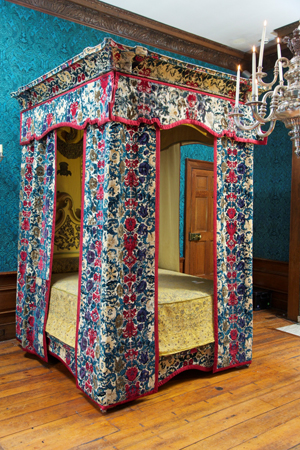
Mary-of-Modena's-bedA new exhibition exploring the secrets of the bedchambers of the Stuart and Hanoverian courts of the 17th and 18th centuries opened at Hampton Court Palace this week. At the heart of Secrets of the Royal Bedchamber are six royal beds which tell the story of why the bedchamber became the most important part of the palace and detail some of the events that took place there before an audience of courtiers, politicians and family members – from births and deaths to the consummation of marriages and the discussion of important affairs of state. It tells of why courtiers would fight for positions such as the ‘groom of the stool’ or ‘necessary woman’ and how beds which could cost the same as a London townhouse were sometimes never slept in. Among the beds on display is the ‘Warming Pan Bed’ (pictured), the State Bed of King James II’s queen, Mary of Modena, and scene of the royal birth that ultimately led to the end of the Stuart line, and the ‘Travelling Bed’ of King George II which travelled as far afield as Hanover and the battlefields of Europe. The exhibition also gives rare access into the Prince of Wales’ Apartments, designed by 17th and 18th architect Sir John Vanbrugh, and now open for the first time in 20 years.  Admission charge applies. Runs until 3rd November. For more, see www.hrp.org.uk. PICTURE: HRP

The Roman cities of Pompeii and Herculaneum are the subject of a major exhibition opening at the British Museum today. Life and death in Pompeii and Herculaneum brings together more than 250 objects from the two cities which were buried in just 24 hours during the eruption of Mount Vesuvius in 79 AD. The objects include celebrated finds and recent discoveries, many of which have never before been seen outside Italy, and help explore what daily life was like for the inhabitants. Artefacts include a beautiful wall painting from Pompeii showing baker Terentius Neo and his wife, wooden furnishings including a linen chest, inlaid stool, and even a baby’s crib from Herculaneum, and casts of victims including a family of four and a dog who died at Pompeii. Runs until 29th September. Admission charge applies. For more, see www.britishmuseum.org.

Find out more about the history of chocolate at Kew Gardens this Easter, from the ritualistic use of cacao in ancient Mayan and Aztec cultures to the arrival of chocolate in 17th century London, where it was a luxury item for high society to indulge in at newly fashionable chocolate houses. Running from tomorrow until 14th April, there will be a range of workshops taking place at the gardens around the chocolate theme along with a traditional Easter Egg Hunt on Easter Sunday (31st March). The garden’s cocoa tree can be found in the Princess of Wales Conservatory. Admission charge applies. See www.kew.org.

Harry Beck, designer of the innovative first diagrammatic Tube map, has been honoured by an English Heritage blue plaque – inscribed in the Underground’s new Johnston typeface – at his birthplace in Leyton in London’s east. Beck, who was born in a small terraced house at 14 Wesley Road in 1902, was working with London Transport as a draughtsman in the London Underground Serial Engineer’s Office, when, in 1931, he produced his first design for a diagrammatic map. He continued to update the map with new stations and lines even after leaving London Transport with the last version of his map published in 1960. Beck died in 1974. Meanwhile, a blue plaque commemorating railway engineer Sir Nigel Gresley (1876-1941) has been returned to King’s Cross station following the completion of building work. It can be found on platform 8. For more, see www.english-heritage.org.uk/discover/blue-plaques/.

On Now: The Underground. A commission from Art on the Underground, this exhibition of artist Mark Wallinger’s work at the Anthony Reynolds Gallery (60 Great Marlborough Street) features some examples of 270 labyrinth designs – one representing each of the Underground stations – which are being installed at the Tube stations themselves. Among those stations represented at this showing are Westminster, St James’s Park, Oxford Circus, Victoria, Embankment, Green Park, King’s Cross St Pancras, Baker Street and Tottenham Court Road. While labyrinths are already in place at these locations, the remainder of Wallinger’s labyrinth designs will be appearing at Tube stations over the coming months. Runs until 27th April. For more, see www.anthonyreynolds.com.