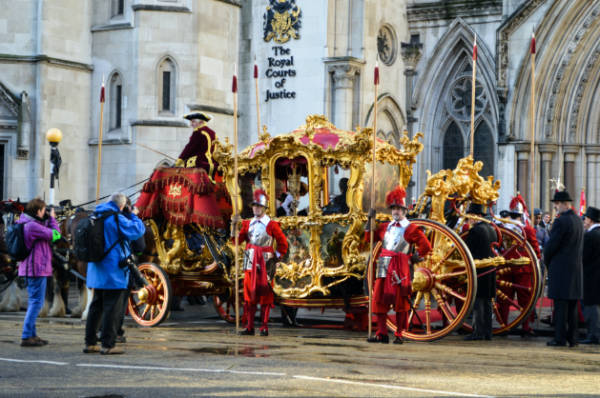
• The Lord Mayor’s Show – or this year, for the first time in its 800 year history, the Lady Mayor’s Show – takes place on Saturday as Dame Susan Langley is celebrated as the City of London’s 697th Lord Mayor of London. Langley, who takes office at Guildhall on Friday in the ancient ‘Silent Ceremony’, is the third woman to hold the role and the first to adopt the title “Lady Mayor”. The more than three mile-long procession, which kicks off at 11am, features around 7,000 participants, 200 horses and more than 50 decorated floats and travels from the Mansion House, the official mayoral residence, through the City to the Royal Courts of Justice, via St Paul’s Cathedral, before returning. The centrepiece as always is the State Coach carrying the Lady Mayor as she fulfills the dual purpose of showing herself to residents and swearing allegiance to the crown. For more – including details of the procession’s route, head to https://lordmayorsshow.london/.
• The first exhibition dedicated to the work of 18th century artist Joseph Wright ‘of Derby’ opens at The National Gallery tomorrow. Wright of Derby: From the Shadows focuses on his career between 1765 and 1773 when he created his candlelight series. On show are a number of works from this series including Three Persons Viewing the Gladiator by Candlelight (1765), A Philosopher giving that Lecture on the Orrery in which a lamp is put in place of the Sun (1766), and the gallery’s own An Experiment on a Bird in the Air Pump (1768). Mezzotint prints of Wright’s works – key to the establishment of his international reputation – will also be on display. The exhibition, in the Sunley Room, runs until 10th May. Admission charge applies. For more, see www.nationalgallery.org.uk/exhibitions/wright-of-derby-from-the-shadows.
• Hollywood icon Audrey Hepburn has been honoured with an English Heritage Blue Plaque on her former home in Mayfair. The plaque at 65 South Audley Street was where Hepburn lived in a flat with her mother between 1949 to 1954 as she launched her career as an actor. It was from here that she travelled to the West End to perform in chorus lines, appeared in British films such as 1951’s The Lavender Hill Mob and while living here that she was cast as the lead in Gigi on Broadway – a key stepping stone towards her breakthrough performance in 1953’s Roman Holiday. Hepburn was born in Brussels but had strong ties to London, training at the Ballet Rambert and working as a dancer and model before moving on to acting. Of course, as well as Roman Holiday, Hepburn performed notable roles Sabrina, Funny Face, Breakfast at Tiffany’s, My Fair Lady, and Charade. She later dedicated herself to humanitarian work, serving as a UNICEF Goodwill Ambassador, and was awarded the Presidential Medal of Freedom shortly before her death in 1993. For more on English Heritage Blue Plaques, see www.english-heritage.org.uk/visit/blue-plaques/.
Send all items to exploringlondon@gmail.com
 Exploring London