What’s in a name?…Amen Corner…

Located off Ave Maria Lane in the City of London is a tiny thoroughfare named Amen Corner.
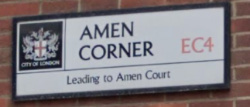
This location of this short laneway – which leads to the U-shaped (and gated) Amen Court – makes the name no great surprise. It lies just to the north-west of St Paul’s Cathedral and is one of a number of religiously named streets in the area (others include Paternoster Lane, Paternoster Square, Paternoster Row and Canon Alley).

The corner apparently became so-named in relation to a prayer chanted by monks. It’s said that on the day of the Feast of Corpus Christi, the monks would process through the streets, chanting prayers as they did so.

The first prayer, the Lord’s Prayer, was started in Paternoster Row – itself named after the first couple of words in the prayer when recited in Latin (“Pater Noster” which translates as “Our Father”). The monks would then process westward and by the time they reached the corner of Paternoster Lane and Ave Maria Lane, they would be at the end of the prayer – “Amen”. Hence Amen Corner.

Amen Corner was, from 1614 until the Great Fire of London in 1666 when it was destroyed, the location of a three storey house which served as the headquarters of the the Royal College of Physicians.

Ave Maria Lane, meanwhile, is named after the next prayer the monks would recite after turning the corner – “Ave Maria” (Hail Mary”).

Amen Court, which isn’t accessible to the public, is home to a short terrace of 17th-century houses where the cathedral’s canons have traditionally lived.

At its western end is a wall which once marked the boundary of Newgate Prison and which itself has an interesting history. The spectral ‘Black Dog of Newgate’ was said to have been sighted crawling along its top just prior to an execution taking place in the prison.
Famous Londoners – Wynkyn de Worde…

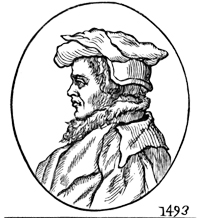
Known as the “Father of Fleet Street”, Wynkyn de Worde was key figure in the early use of the printing press in England.

Wynkyn_de_WordeBorn on the continent (candidates include Wœrth in Alsace in north-east France and Wœrden in The Netherlands), Wynkyn – whose name comes in various spellings, although it is said to have originally been Jan van Wynkyn – is believed to have become apprenticed to a printer in Cologne before meeting with famed pioneering English printer William Caxton in the early 1470s.

He apparently accompanied Caxton from Cologne to Bruges and then back to London in the late 1470s or early 1480s where he started working with Caxton at his premises in Westminster. During this period he is said to have lived with his English wife Elizabeth in a premises located with the sanctuary of Westminster Abbey (they are known to have attended St Margaret’s Church and even rented a pew there until Elizabeth’s death in 1498, after which Wynkyn is believed to have remarried.)

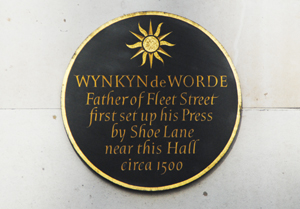
After Caxton’s death in 1492, Wynkyn took over his printing business and, around 1500, he relocated his office from Caxton’s Westminster premises to the “sign of the Sun” in Fleet Street near Shoe Lane – in fact, he is credited as being the first printer to locate in the street which becomes famously associated with publishing. There’s a plaque (pictured below), on the wall of the hall of the Worshipful Company of Stationers, located off Ave Maria Lane near St Paul’s Cathedral, commemorating the move (although Shoe Lane is located some distance away). Wynkyn later also ran a shop in St Paul’s Churchyard.

Wynkyn-de-Worde2While Wynkyn, like Caxton before him, relied on the patronage of the rich and famous (Margaret Beaufort, mother of King Henry VII among them), he also printed relatively inexpensive books in a bid to capture a wider market. In all he published more than 400 different books in at least 750 editions ranging from religious texts and poetry to fictional romantic works, educational textbooks and books aimed at children. He is noted for his use of woodcuts illustrations while his other claims to fame include being the first English printer to use italic type and the first to print music from moveable type.

De Worde died around 1534 but his legacy lives on through the mass media publishing of today (albeit not longer from Fleet Street). There is a Wynkyn de Worde Society based in Suffolk which is aimed at furthering the printing industry.

PICTURE: Wikipedia