What’s in a name?…Basinghall Street…

Looking north up Basinghall Street from Gresham Street. The buildings on the left are part of the Guildhall complex. PICTURE: Google Maps

This City of London street, which sits on the eastern side of the Guildhall complex, is named for the wealthy Basing (or Bassing) family who had a hall here in the 13th century.

The street, which links Gresham Street in the south to Basinghall Avenue in the north, has been the site of numerous prominent buildings including the medieval hall of the Weaver’s Company (demolished in 1856, having replaced an earlier hall which burnt down in the Great Fire of London in 1666, the hall is now located in Gutter Lane), the Cooper’s Company (demolished in 1867, the hall is now located in Devonshire Square) and the Girdler’s Company (destroyed in the Blitz in 1940; the hall is now located in Basinghall Avenue).

It was also the location of the Sir Christopher Wren-designed Church of St Michael Bassishaw until 1899 after it was seriously damaged when the crypt was being cleared of human remains in line with the orders of City authorities. The parish with united with St Lawrence Jewry.

Famous denizens included the goldsmith, banker and civil engineer Sir Hugh Myddelton, most renowned for his design of the New River scheme to bring clean water to the City, who, according to The London Encyclopaedia, would sit in the doorway of his office and smoke his pipe while chatting with the likes of Sir Walter Raleigh.

The family also gave their name to the City of London’s Bassishaw Ward.
Where’s London’s oldest…livery company?

There are 110 livery companies in London, representing various “ancient” and modern trades. But the oldest is said to be the Worshipful Company of Weavers.

What was then known as the Weavers’ Guild was granted a charter by King Henry II in 1155 (although the organisation has an even older origins – there is an entry in the Pipe Rolls as far back as 1130 recording a payment of £16 made on the weaver’s behalf to the Exchequer).

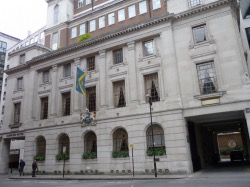
Saddler’s Hall in Gutter Lane where the Worshipful Company of Weavers is based out of.

In 1490, the Weaver’s Guild obtained a Grant of Arms, in the early 16th century it claimed the status of an incorporated craft, and, in 1577 it obtained ratification of its ordinances from the City of London.

By the late 16th century, the company – its numbers swollen by foreign weavers including Protestants fleeing persecution in Europe – built a hall on land it owned in Basinghall Street. A casualty of the Great Fire of London, the hall was rebuilt by 1669 but by the mid-1850s had fallen into disrepair and was pulled down and replaced by an office block.

After the office building was destroyed during World War II (fortunately some of the company’s treasures which had been stored there had already been moved), the company considered rebuilding the hall but decided its money could be better used, including on charitable works.

For many years, the company’s business was run from various clerk’s offices outside the City of London but since 1994 it has been run from Saddlers’ House.

The company, which ranks 42nd in the order of precedence for livery companies, has the motto ‘Weave Truth With Trust’.

For more, see www.weavers.org.uk.

Lost London – Blackwell Hall…

A trade hall for the wool and cloth trade, Blackwell Hall, also known as Bakewell Hall, once stood on the east side of Guildhall Yard in Basinghall Street.

The buttressed stone building – whose previous owners included Thomas Bakewell (from where apparently it gets its name) – is understood to have been purchased by the City of London Corporation during the reign of King Richard II and subsequently established as a cloth market.

‘Factors’ were introduced to act as agents and handle the sale of goods on behalf of the clothiers but shifts in trade – in particular the expansion of northern mills which led to them handling their sales directly –  saw the importance of the London-based factors wane.

The structure was rebuilt a couple of times over its lifespan – there are records of a rebuilding in 1588 and again after the Great Fire of 1666 – before it was finally demolished in 1820 to make way for the Bankrupcy Court.

Remains of the foundations were discovered during excavations in Guildhall Yard in 1988.