What’s in a name?….Giltspur Street

This City of London street runs north-south from the junction of Newgate Street, Holborn Viaduct and Old Bailey to West Smithfield. Its name comes from those who once travelled along it.
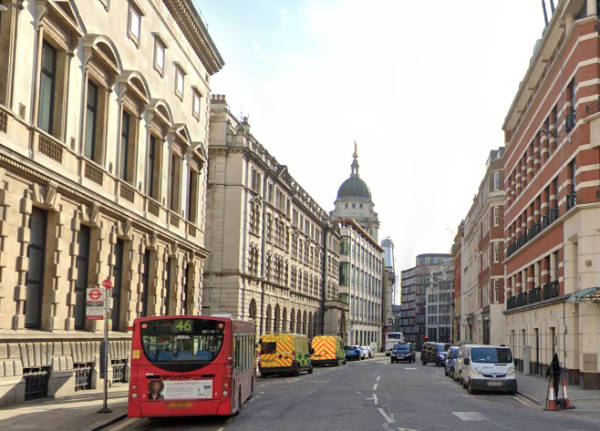
Looking south down Giltspur Street, with the dome of the Old Bailey visible, in 2018. PICTURE: Courtesy of Google Maps

An alternative name for the street during earlier ages was Knightrider Street which kind of gives the game away – yes, the name comes from the armoured knights who would ride along the street in their way to compete in tournaments held at Smithfield. It’s suggested that gilt spurs may have later been made here to capitalise on the passing trade.

The street is said to have been the location where King Richard II met with the leaders of the Peasant’s Revolt who had camped at Smithfield. And where, when the meeting deteriorated, the then-Lord Mayor of London William Walworth, ending up stabbing the peasant leader Wat Tyler who he later captured and had beheaded.

St Bartholomew’s Hospital can be found on the east side of the street. On the west side, at the junction with Cock Lane is located Pye Corner with its famous statue of a golden boy (said to be the place where the Great Fire of London was finally stopped).

There’s also a former watch house on the west side which features a monument to the essayist late 18th century and 19th century Charles Lamb – the monument says he attended a Bluecoat school here for seven years. The church of St Sepulchre-without-Newgate stands at the southern end with the Viaduct Tavern on the opposite side of the road.

The street did formerly give its name to the small prison known as the Giltspur Street Compter which stood here from 1791 to 1853. A prison for debtors, it stood at the street’s south end (the location is now marked with a City of London blue plaque).

Lost London – South Sea House…

This former Threadneedle Street institution in the City of London was the headquarters of the South Sea Company.

Incorporated in 1711, the company was assigned a monopoly on British trade with Spanish America but when that failed to result in riches, it embarked upon a speculative scheme which ended in the economic collapse known as the ‘South Sea Bubble’ and saw many investors ruined.

Among those employed at the company as a clerk was essayist Charles Lamb who adopted his nom-de-plume, Elia, based on one of his fellow clerks.

The building, located on the corner with Bishopsgate was designed around a quadrangle. The back of it apparently burned down in 1826 and was subsequently rebuilt.

The building was partly remodelled in the 1850s and was eventually demolished at the end of the 19th century.

PICTURE: A 1750s engraving of Old South Sea House

10 sites from Mary Shelley’s London…7. Charles and Mary Lamb’s house…

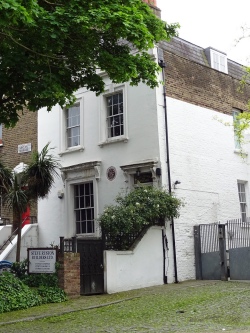
Renowned sibling writers Charles and Mary Lamb lived in a property at 64 Duncan Terrace in Islington from 1823-27 and, their visitors there apparently included Mary Shelley.

Shelley had returned to London in 1823 after the death of her husband Percy Bysshe Shelley who had drowned along with two other men off the coast of Italy in July the previous year.

Back in London, Shelley lived in various properties as far afield as Kentish Town – many of which are no longer extant. But one home she was known to have visited after her return (which is still standing) was that of the Lambs.

Charles, part of the literary circle which included Samuel Taylor Coleridge and William Wordsworth, described the property – Colebrook Cottage – as a “white house with six good rooms”. Now Grade II-listed, it dates from the 18th century.

The New River once ran close by  – so close, in fact, that one guest, believed to be the blind poet George Dyer, walked into the river after leaving the house and had to be rescued by Lamb. The river is now covered.

The property features an English Heritage Blue Plaque (although in this case, it’s actually brown), commemorating Lamb’s stay here.

PICTURE: Spudgun67 (licensed under CC BY 2.0).


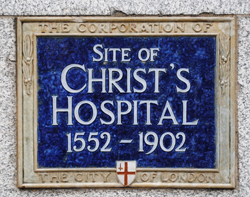
Lost London – Christ’s Hospital…

One of the achievements of the short-lived reign of King Edward VI, son of King Henry VIII, was the establishment of this hospital for orphans in 1552 in what were once buildings used by the Greyfriars Monastery (for more on the history of Greyfriars, see our earlier post here).

Christs-HospitalLocated in Newgate Street, the hospital soon had a school attached which became known as the Blue Coat School thanks to the distinctive long blue coats the students wore (and still do, the school is now located near Horsham in West Sussex).

Many of the hospital buildings were destroyed in the Great Fire of London of 1666 but most were later rebuilt under the supervision of Sir Christopher Wren, although the actual work was apparently carried out by others.

Students at the school have included antiquarian William Camden, Romantic poet Samuel Taylor Coleridge and writer Charles Lamb.

New buildings for girls were opened in Hertford in 1704 and the school moved out to Sussex in 1902 with the General Post Office built over the top of the demolished buildings.

Where’s London’s oldest…public library?

While the designation of London’s oldest public library depends on your definition, for the purposes of this article we’re awarding the title to the Guildhall Library.

Its origins go back to about 1425 when town clerk John Carpenter and John Coventry founded a library – believed to initially consist of theological books for students, according to the terms of the will of former Lord Mayor, Richard (Dick) Whittington (for more on him, see our previous post here).

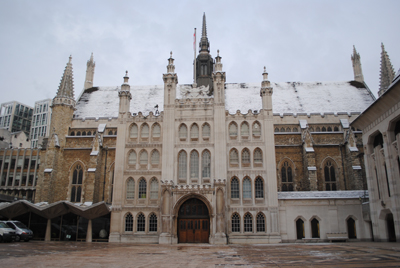
Guildhall2Housed in Guildhall (pictured above), this library apparently came to an end in the mid-1500s when Edward Seymour, the Duke of Somerset and Lord Protector for the young King Edward VI, apparently had the entire collection loaded onto carts and taken to Somerset House. They were not returned and only one of the library’s original texts, a 13th century metrical Latin version of the Bible, is in the library today.

Some 300 years passed until the library was re-established by the City of London Corporation. Reopened in  1828, it was initially reserved for members of the Corporation but the membership was soon expanded to include”literary men”.

By the 1870s, when the collection included some 60,000 books related to London, the library moved into a new purpose-built building, located to the east of Guildhall. Designed by City architect Horace Jones, it opened to the public in 1873.

The library lost some 25,000 books during World War II when some of the library’s storerooms were destroyed and after the war, it was decided to build a new library. It opened in 1974 in the west wing of the Guildhall where it remains (entered via Aldermanbury).

Today, the 200,000 item collection includes books, pamphlets, periodicals including the complete London Gazette from 1665 to the present, trade directories and poll books as well as the archive collections such as those of the livery companies, the Stock Exchange and St Paul’s Cathedral and special collections related to the likes of Samuel Pepys, Sir Thomas More, and the Charles Lamb Society.

The library also holds an ongoing series of exhibitions.

Where: Guildhall Library, Aldermanbury; WHEN: 9.30am to 5pm, Monday to Saturday; COST: Entry is free and no membership of registration is required but ID may be required to access rarer books; WEBSITE: www.cityoflondon.gov.uk/things-to-do/visiting-the-city/archives-and-city-history/guildhall-library/Pages/default.aspx.