10 significant (and historic) London trees…7. D-Day Tree…

PICTURE: Courtesy of Google Maps

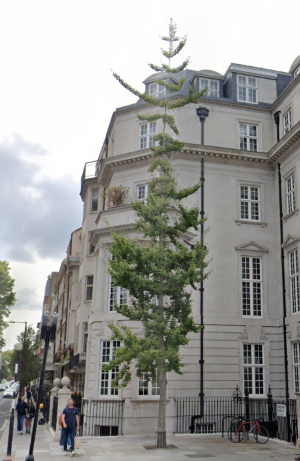
Nations, including the UK, have just marked the 80th anniversary of the D-Day landings in Normandy at a range of locations in France and England. But did you know London has its own “D-Day tree”?

The tree, a Ginkgo biloba or Maidenhair tree, is located outside number 22 in Grosvenor Square in Mayfair (on the corner with Upper Brooks Street). It was planted in 1994 to mark the 50th anniversary of the D-Day landings.

As well as the tree itself, the landings are commemorated with plaques around the base which provide the date of the landings and its code-name, Operation Overlord.

The location apparently relates to 20 Grosvenor Square being, for a time, the headquarters of Dwight D Eisenhower, Supreme Commander of the Allied Expeditionary Force launched on D-Day. There’s a plaque on the building commemorating his tenure.

In fact, the number of Americans working in the square – at locations including the US Embassy – led to it being known colloquially as ‘Eisenhower Platz’).

The tree was planted by the City of Westminster.

Note: There seems to be some conflicting information, not the least on a plaque in Bushy Park about Eisenhower’s connections with Grosvenor Square and Norfolk House in St James’s Square. We’ll be investigating further to clarify.

Treasures of London – Waterloo Station Victory Arch…

PICTURE: Prioryman (licensed under CC BY-SA 3.0)

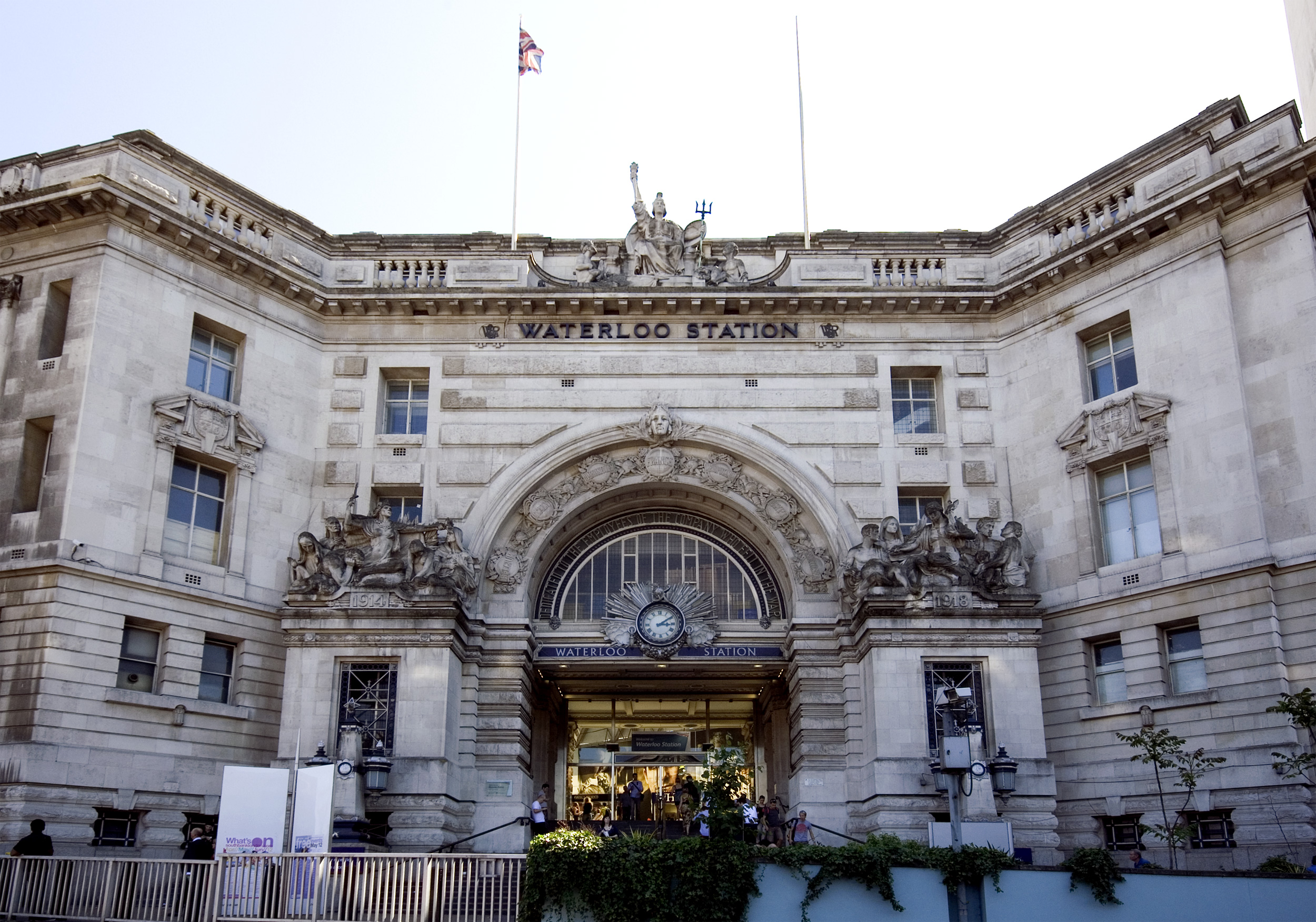
Sitting over the main entrance to Waterloo Station is a Victory Arch which commemorates railway personnel who died in World War I and II.

There are several plaques located at the top of the steps under the arch commemorating those who died in the conflicts and among them, particularly notable this week as the world marks the 80th anniversary of D-Day, is one commemorating those who died in the Normandy landings.

The plaque was installed on the 50th anniversary of the landings – 6th June, 1994.

The arch was built as part of a station rebuild in the first couple of decades of the 20th century and added to the design following World War I. The new station was completed in 1922.

The now Grade II-listed memorial, the work of sculptor Charles Whiffen, features two sculptural groups located on either side – one dedicated to Bellona and dated 1914 and the other dedicated to Peace and dated 1918.

Set around a glazed arch are the names of countries where key battles were fought in the conflict and at the centre is a clock set within in a sunburst. Sitting above the arch is a depiction of Britannia holding aloft the torch of liberty.

As well as the D-Day plaque under the arch, a Roll of Honour commemorates the 585 London and South Western Railway employees who lost their lives in World War I. There is also a plaque commemorating the 626 men of the Southern Railway who died in World War II.

10 (more) curious London memorials…8. The SOE Memorial…

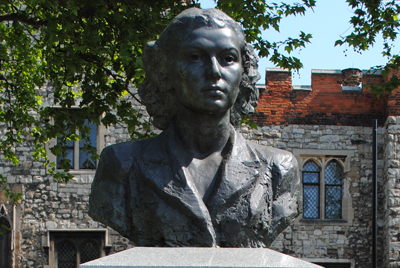
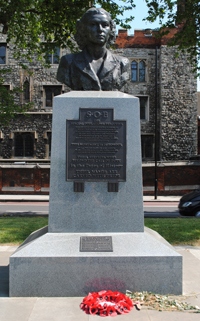
SOE-bigTucked away on Albert Embankment just to the north of Lambeth Bridge, this moving memorial was only unveiled in 2009 and formally honours the under-cover agents who worked for the Allies behind enemy lines during World War II.

The plinth is topped with a larger-than-life bust of Londoner Violette Szabo, sculpted by London artist Karen Newman. Szabo, who here gazes out across the Thames, was tortured and executed after being captured by the Germans while on a mission behind enemy lines following the D-Day landings.

SOEThe daughter of a French mother and English father, Szabo grew up in South London and, when World War II broke out in 1939, volunteered to work as an undercover operative in France as member of the British Special Operations Executive (SOE).

She had successfully completed one mission and had returned to France for a second when she was discovered and sent to a prison camp where she was unsuccessfully tortured for information.

Posthumously awarded the George Cross and the Croix de Guerre, a plaque on the memorial says she was among the 117 SOE agents who did not survive their missions to France. As many as 407 SOE agents were sent on “sabotage missions” to occupied France to fight with the French resistance.

Surprisingly, this SOE Memorial was apparently the first public memorial to honour the work of the unit. Formed on the orders of PM Sir Winston Churchill, it consisted of agents from various countries who were devoted to the Allied cause. Its feats included a raid which destroyed a factory in the Telemark region of Norway where the Germans were trying to produce heavy water which is used in the creation of atomic bombs – an operation which receives a special mention on the memorial.

The memorial was officially unveiled by the Duke of Wellington on 4th October, 2009. One of the plaques on it states that the monument “is in honour of all the courageous S.O.E. Agents: those who did survive and those who did not survive their perilous missions”. “Their services were beyond the call of duty. In the pages of history their names are carved with pride.” Enough said.

For more on the history of women serving in the SOE, see Squadron Leader Beryl E Escott’s book The Heroines of SOE: F Section: Britain’s Secret Women in France.

10 small (and fascinating) museums in London…9. HMS Belfast

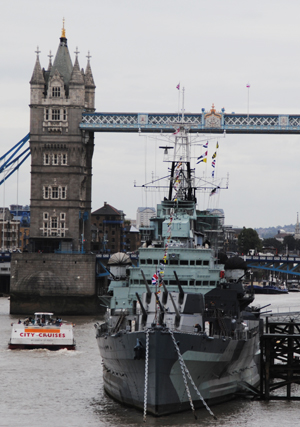
OK, so it’s not exactly small but HMS Belfast – an offshoot of the Imperial War Museum moored permanently on the Thames near Tower Bridge – does make a fascinating museum in which to spend a few hours.
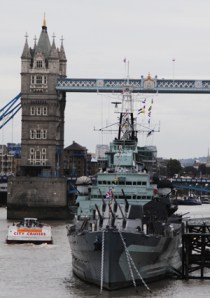
Commissioned into the Royal Navy on 5th August, 1939 (just in time for the start of World War II), the HMS Belfast is a large light cruiser built, along with the HMS Edinburgh, as an improvement on the then existing ‘Southampton’ class vessels. It is now the only surviving example of the many big gun armoured warships which were built for the Royal Navy in first half of the twentieth century.

Assigned to the Home Fleet on the outbreak of war, the ship operated out of Scapa Flow in the Orkney Isles in far north Scotland and was charged with patrolling the northern waters as part of efforts to impose a maritime blockade on Germany. Striking a mine in November of that year, however, it was put of out action until two years later when it rejoined the Home Fleet and then began escorting Arctic convoys to the Soviet Union – a mission which saw it take part in the Battle of North Cape off the Norwegian coast in late 1943 (this battle saw the sinking of the German battle cruiser Scharnhorst).

The HMS Belfast later saw action on D-Day, the Allied invasion of Normandy in 6th June, 1944, when it was employed to bombard German positions onshore before, heading to Japan where, after the end of the war, it was used to evacuate survivors of prisoners-of-war and internment camps in China.

The HMS Belfast saw action in the Korean War and then spent further time in the Far East before – under threat of being disposed of and broken up – it was acquired as a museum and moored in London. The first visitors were admitted on Trafalgar Day, 1971, and, as of last year, nearly 10 million people have taken up the chance to look at the ship.

These days there’s a well-defined route through the vessel, complete with audio guide (it’s included in the admission price), which takes visitors on an informative journey describing what life was like for those who served onboard the Belfast – including everything from the Arctic messdecks where ratings slept in hammocks to the NAAFI store where they could buy supplies, sick bay, the ‘modern’ laundry room, and chapel as well as the engine room, shell rooms and magazines, and , of course, the bridge.

Many of the rooms have been set up – some using life-sized manniquins – to show how they would have looked during a typical day. Particularly worth a look is the new Gun Turret Experience: A Sailor’s Story 1943, an immersive film, light and sound show which gives a glimpse into what life was like working inside one of the six inch gun turrets.

It can take a while to get around the whole ship (and parents are asked not to take small children into the boiler room) but it’s well worth taking the time to explore properly. In addition to the features of the ship itself, there are two exhibitions – one looking at the role of the ship in peace and war, and the other, an interactive experience in what life was like on board.

WHERE: HMS Belfast is moored on the Thames between London Bridge and Tower Bridge. Entry is from the south bank of the Thames near Morgans Lane (nearest Tube stations are London Bridge, Tower Hill or Monument); WHEN: 10am-6pm (last admission 5pm) daily until 31st October, then 10am to 5pm (last admission 4pm); COST: £13.50 adults/£10.80 seniors and students/children under 16 free (price includes a voluntary donation); WEBSITE: http://hmsbelfast.iwm.org.uk.