This Week in London – Jousting at Eltham; Thamesmead Festival returns; and, ‘Robot Zoo’ at the Horniman…

A knight prepares to joust at an earlier event at Hampton Court Palace. PICTURE: David Adams

Eltham Palace returns to the medieval age this weekend with a jousting tournament in which knights will compete for glory. The ‘Legendary Joust’ will feature four knights, each representing a character from myth or legend including The Wyvern, The Wildman, Sir Lancelot and Jason of the Argonauts. The event runs from 10am to 5pm on Saturday and Sunday. Admission charge applies. For more, see https://www.english-heritage.org.uk/visit/whats-on/eltham-palace-legendary-joust-2-3-aug-2025/.

The Thamesmead Festival returns to Southmere Park in south-east London over the next two weekends. The free, family-friendly festival boasts four big stages with headline guest Omar and musical performances across genres including Afrobeat, R&B, rock and pop as well as spoken word, comedy, and street dance. There will also be a market featuring local artists and food from around the world. Runs from 12pm to 7:30pm on Saturday and on 8th August. For more, head to https://www.thamesmeadnow.org.uk/whats-on/arts-culture/thamesmead-festival-2025/.

On Now: Robot Zoo. This exhibition at the Horniman Museum in Forest Hill features a range of larger-than-life animals recreated using machine parts and gadgets in a bid to reveal how their real life counterparts see, eat, hunt and hide. The display also features interactive exhibits giving visitors the chance to try jet-propelled squid racing and shoot a chameleon’s ‘tongue-gun’. There’s also two specially commissioned interactive murals by artist Giulia Casarotto. Runs until 2nd November. Admission charge applies. For more, see www.horniman.ac.uk/event/robot-zoo/.

Send all items for inclusion to exploringlondon@gmail.com

This Week in London – Michelangelo’s last decades; expressionists on show; and, Dinosaur rEvolution…

Michelangelo Buonarro (1475–1564) – study for the ‘Last Judgment’ (Black chalk on paper, about 1534–36); the fall of Phaeton (Black chalk, over stylus underdrawing, on paper, about 1533); and, Christ on the Cross between the Virgin and St John (Black chalk and white lead on paper, about 1555–64.) All images © The Trustees of the British Museum

A landmark exhibition exploring the final three decades of the life of Renaissance master Michelangelo has opened at the British Museum. Michelangelo: the last decades focuses on how his art and faith evolved and centres on the two metre high Epifania (about 1550–53), which is being displayed for the first time since conservation work on it began in 2018. Showing alongside it is a painting made from it by Michelangelo’s biographer, Ascanio Condivi, as well as preparatory drawings from the Last Judgment, which chart how Michelangelo invented a fresh vision of how the human form would be refashioned at the end of the world, and works created as part of his correspondence with his friends Tommaso de’ Cavalieri and the poet Vittoria Colonna. The latter include The Punishment of Tityus (about 1532) showing an eagle tearing out the liver of a bound naked man which was gifted to Tommaso as moral guidance for the young man. Other highlights include a group of drawings of Christ’s crucifixion which he made during the last 10 years of his life and through which he explored his feelings about mortality, sacrifice, faith, and the prospect of redemption. Runs until 28th July in the Joseph Hotung Great Court Gallery. Admission charge applies. For more, see www.britishmuseum.org/michelangelo.

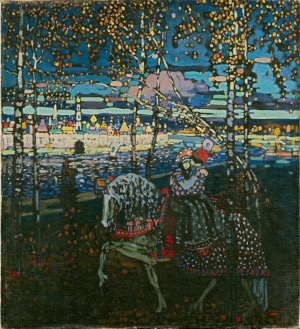
Wassily Kandinsky, ‘Riding Couple’, 1906-1907, Lenbachhaus Munich, Donation of Gabriele Münter, 1957

• A new exhibition has opened celebrating the expressionists’ radical experimentations with form, colour, sound and performance at the Tate Modern. Expressionists: Kandinsky, Münter and the Blue Rider features masterpieces from the Lenbachhaus in Munich and includes some works never previously seen in the UK. Among the artists whose work is on display are everyone from renowned artists like Wassily Kandinsky, Gabriele Münter, Franz Marc and Paul Klee, through to lesser known figures like Wladimir Burliuk and Maria Franck-Marc. Highlights include Marianne Werefkin’s Self-Portrait (c1910), Münter’s Listening (Portrait of Jawlensky) (1909), Erma Bossi’s Circus (1909), Kandinsky’s Impression III (Concert) (1911), Franz-Marc’s Deer in the Snow II (1911), Klee’s Legend of the Swamp (1919), and a selection of photographs from the Masterpieces of Muhammadan Art exhibition staged in Munich in 1910. Runs until 20th October. Admission charge applies. For more, see tate.org.uk.

On Now – Dinosaur rEvolution. This exhibition at the Horniman Museum in Forest Hill highlights discoveries from recent decades which have changed the way we envisage dinosaurs – not all as scaly green reptiles but many with an array of colours, feathers, quills and spikes. At the centre of the display are five large animatronic dinosaur models – including a seven metre-long Tyrannosaurus rex – as well as well as artworks by artist and exhibition curator Luis V Rey. The exhibition also features fossil casts including the horned skull of a Diabloceratops, the claw of a Therizinosaurus, and skeletons of Velociraptor and Compsognathus – a chicken-sized, feathered dinosaur. Runs until 3rd November. Admission charge applies. For more, see www.horniman.ac.uk.

Send all inclusions to exploringlondon@gmail.com.

This Week in London – V&A reopens; institution reopenings; and, ZSL London Zoo looks for volunteers…

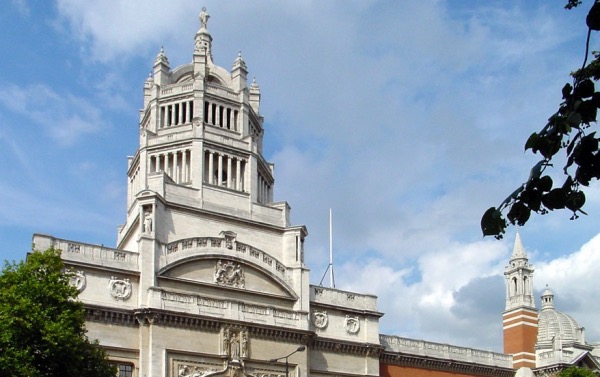
The V&A in South Kensington reopens its doors to visitors today in the first phase of a staged reopening strategy. All of the ground floor galleries are reopening including the Medieval & Renaissance Gallery, the Cast Courts, The Jameel Gallery of Islamic Art and Fashion Gallery, as well as the Europe 1600–1815 galleries on lower ground floor. The first and second floor collection galleries including The William and Judith Bollinger Jewellery Gallery, Theatre & Performance Galleries, and the Photography Centre as well as the museum’s Paintings, Tapestries and Silver Galleries are all scheduled to open on 27th August as well as the exhibition Kimono: Kyoto to Catwalk, which had closed just two weeks into its run.  For more, see www.vam.ac.uk. PICTURE: M.chohan (Public domain). 

Other recent and upcoming reopenings include: the Horniman Museum, the Foundling Museum, the National History Museum, The Queen’s House in Greenwich (Monday, 10th August) and the National Maritime Museum in Greenwich (exhibitions only; galleries coming later).

ZSL London Zoo is calling for volunteers to help assist visitors as they make their way around the zoo via three new one-way trails. The move, which follows a successful fundraising effort fronted by Sir David Attenborough, is aimed especially at people still furloughed and students forced to cancel gap year travel plans. Those interested in volunteering are asked to commit to a minimum of half a day each fortnight. For more, see  www.zsl.org/volunteering.

Send all items for inclusion to exploringlondon@gmail.com.

This Week in London – Princess Beatrice’s bouquet; Technicolour Dickens; and, the Royal Parks’ ‘Summer of Kindness’…

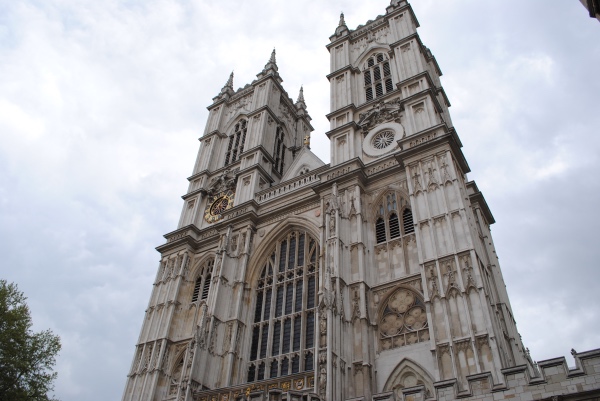
Princess Beatrice, who married Edoardo Mapelli Mozzi in a private ceremony in The Royal Chapel of All Saints at Windsor’s Royal Lodge last week, has sent the bouquet she carried during the wedding to rest on the Grave of the Unknown Warrior in Westminster Abbey. The tradition of royal brides sending their bouquets to rest on the grave was started by Queen Elizabeth, the Queen Mother, when she lay her bridal bouquet on the grave in memory of her brother Fergus who was killed in 1915 at the Battle of Loos during World War I. Brides including Queen Elizabeth II, the Duchess of Cambridge and Princess Beatrice’s sister, Princess Eugenie, have since continued the tradition. The grave commemorates the fallen of World War I and all those who have since died in international conflicts.

The Charles Dickens Museum in Bloomsbury reopens on Saturday, 25th July, with a new exhibition marking the 150th anniversary of the author’s death. Technicolour Dickens: The Living Image of Charles Dickens explores the power of the writer’s image and features paintings by the likes of William Powell Frith, Victorian-era photographs, ink drawings by “Automatons”, and letters from Dickens in which he explains what he really thought of sitting for portraits. The museum has also commissioned artist and photographer Oliver Clyde to create eight colourised portraits based on images taken from its collection. For more see www.dickensmuseum.com. Other reopenings this coming week include the Horniman Museum (Thursday, 30th July).

The Royal Parks are launching a ‘Summer of Kindness’ campaign to keep the parks clean after unprecedented levels of rubbish were left in the parks during the coronavirus lockdown. The Royal Parks, which played a key role in the physical and mental wellbeing of many people during the lockdown, report that some 258.4 tonnes of rubbish – the equivalent in weight of 20 new London buses or 74 elephants – were collected from London’s eight Royal Parks in June alone with staff having to spend more than 11,000 hours to clear up. And, with groups now able to gather, the littering has continued, prompting The Royal Parks to call for visitors to care for the parks by binning litter or taking it home. So, please, #BeKindToYourParks.

Send all items for inclusion to exploringlondon@gmail.com.

LondonLife – #MuseumWeek…

Dr-Johnsons-HouseIt’s #MuseumWeek on Twitter and museums all over London are among the more than 2,000 institutions worldwide already tweeting away. Among those, large and small, taking part in London are the @hornimanmuseum, @ExploreWellcome, @JewishMuseumLDN, @BFHouse@HRP_Palaces, @NMMGreenwichand @drjohnsonshouse (pictured). Each day of the week they’ll be tweeting on a different theme until Sunday (today’s is #souvenirsMW). For the full stream, head to @MuseumWeek.

Where is it? #25

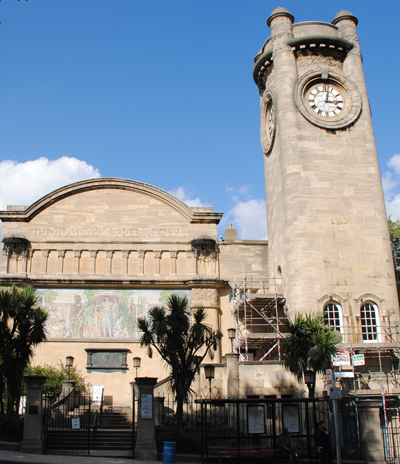
The latest in the series in which we ask you to identify where in London this picture was taken and what it’s of. If you think you can identify this picture, leave a comment below. We’ll reveal the answer early next week. Good luck!

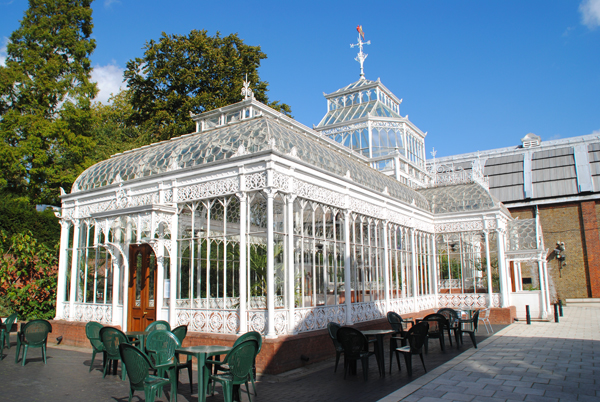
Well done to Charlotte, Sean and Jameson – this is, of course, a picture of the Horniman Conservatory located at the rear of the Horniman Museum located in Forest Hill in London’s south-east.

While the eclectic museum has its own fascinating story (see our earlier post here), so too does the conservatory. It was built in 1894 at the family home of the museum’s founder – wealthy merchant, philanthropist and MP Frederick John Horniman – located at Coombe Cliff in Croydon.

The Grade II listed cast iron and glass building was relocated to its current site by English Heritage in the late 1980s. It can now be hired out for private functions including weddings.

Interestingly, the gardens surrounding the Horniman are currently undergoing a £2.3 million revamp and will be fully reopened later this year. We’ll have more on that at a later date…

10 small (and fascinating) museums in London…10. The Horniman Museum

For the last in our series on small (and fascinating) museums, Exploring London visited the Horniman Museum, an eccentric collection of artifacts based in south-east London.
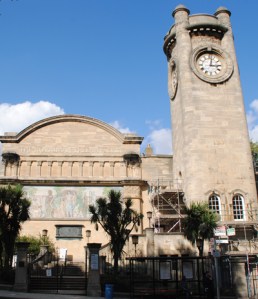
The museum started life as the personal collection of wealthy 19th century tea merchant, philanthropist and MP Frederick John Horniman. Horniman, who started collecting in the 1860s, opened his house in Forest Hill to the public so people could come and view his collection. But as the number of objects in the collection increased, he decided to construct a purpose-built museum and in 1898 commissioned architect Charles Harrison Townsend to design it.

The new art deco museum building – which includes a landmark clocktower – opened in 1901 and, along with 16 acres of gardens, was given to the people of London. While further buildings were added over the ensuing century (including in 1911 when Horniman’s son Emslie donated a new building), some of these later additions were demolished in the late Nineties and a new extension built which was opened in 2002.

These days Horniman’s original collections only make-up around 10 per cent of the 300,000 objects in the museum. The artifacts are grouped in a series of thematic galleries. Among them is a Natural History Gallery containing stuffed specimens and models of animals ranging from the Dodo (extinct since 1680) to the yellow-bellied pangolin (which rolls into a prickly ball when threatened).

Other galleries include the stunning African Worlds Gallery, housing everything from a display of Ethiopian crowns, a series of plaques from Benin depicting scenes from the country’s history, 25 kilogram Bwa plank masks, and macabre Midnight Robber head-dresses from Trinidad as well as the Music Gallery which contains an amazing array of instruments old and new, including a monster 6’6” tall tuba and a Tibetan trumpet made from a femur.

There is also the Centenary Gallery which contains a display of Horniman’s original artifacts and new finds – everything from American Indian head-dresses to a Burmese Buddhist shrine and a fake torture chair which was once claimed to have dated from the Spanish Inquisition but is actually believed to have been assembled in the 19th century.

The site also includes an aquarium (an entry fee applies) and spaces for special exhibitions – these currently include The Art of Harmony, which brings together musical instruments from the Horniman and some on loan from the V&A, and Bali: Dancing for the Gods, which explores Balinese dance culture and dance (this is free with the aquarium ticket or an entry fee applies).

There’s also a shop, cafe and gardens to explore (although the latter are currently undergoing redevelopment, meaning of the gardens are currently not accessible).

This quirky museum – aptly once known as a “cabinet of curiosities” – will reward any visitor. As Horniman himself said in a quote which appears in the museum: “Those who use their eyes obtain the most enjoyment and knowledge. Those who look but do not see go away no wiser than they came.”

This is the last in our series on 10 small (and fascinating) museums. Given the number of museums we haven’t yet mentioned, we’ll be running another such series in the future. Next week we start a new Wednesday series on Royal Parks.

WHERE: Horniman Museum, 100 London Road, Forest Hill (nearest station is that of Forest Hill – both Overground and South-Eastern); WHEN: 10.30am to 5.30pm; COST: Free (with the exception of the aquarium and some special exhibitions – the aquarium is £2.50 an adult/£1.20 a child aged 3 to 16/ £5.50 a family; WEBSITE: www.horniman.ac.uk