10 World War II memorials commemorating Londoners…2. Kennington Park air raid shelter…

More than 100 people died when, on the night of 15th October, 1940, a bomb destroyed an air raid shelter located in Kennington Park in Lambeth.

Subscribe for just £3 a month to access all of Exploring London’s content (and support our work!)

While no official death toll was announced at the time, it’s now believed that 104 people died in the bombing. Forty-eight bodies were recovered and buried in Streatham Cemetery while the remainder still lie under the park.

The majority of those killed were women and children with the youngest just three-months-old. The oldest known victim was 75.

While Lambeth’s civilian dead are commemorated in a memorial at Lambeth Cemetery dedicated in 1952, in early 2000s the Friends of Kennington Park raised funds for a permanent memorial to those killed in the tragedy in the park.

The memorial, which was designed by Richard Kindersley and is located in the South Field close to the Tinworth Fountain Gate, is an upright stab of Caithness stone brought from Scotland standing 2.6 metres tall.

It is inscribed with a quote from poet Maya Angelou – “History despite its wrenching pain cannot be unlived but if faced with courage need not be lived again.”

While another inscription around the edge of the stone commemorates the more than “50 men, women and children” who died during the bombing, a nearby interpretation board puts the toll at more than 100.

A list of known victims can be found in a pamphlet by Rob Pateman published by the The Friends of Kennington Park.

WHERE: Kennington Park, inside the Tinworth Fountain Gate, Kennington Park Road, Lambeth (nearest Tube station is Oval); WHEN: Usually 7.30am until 15 minutes before sunset; COST: Free; WEBSITE: www.lambeth.gov.uk/parks/kennington-park
10 sites from Victoria and Albert’s London – 9. Prince Consort’s Model Lodge, Kennington

The Crystal Palace was the most famous remnant of the 1851 Great Exhibition but there is another less grand monument – and both Prince Albert and Queen Victoria had a connection to it.

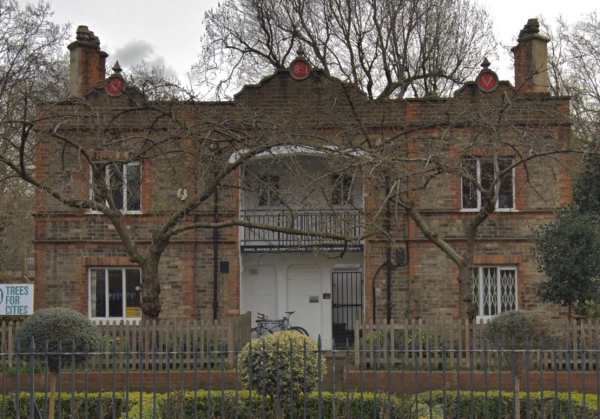
Originally constructed for display at the 1851 Great Exhibition in Hyde Park, the Prince Consort Model Lodge, also known as Prince Albert’s Model Cottage, was designed by architect Henry Roberts for the Society for Improving the Conditions of the Labouring Classes.

Prince Albert was president of the society which turned to him for support when it was initially refused permission to build the model home in the exhibition’s grounds and, as a result, it was eventually agreed it could be build close to them at the Knightsbridge Cavalry Barracks.

The two storey red brick cottage (the bricks were hollow, an innovation aimed at making the homes sound-proof and fire-proof as well as cheaper to build) actually contained homes for four families – each with a living room, a scullery, a parent’s bedroom and two other bedrooms as well as a water closet.

Among the estimated 250,000 people who visited the homes were Queen Victoria – who did so on 12th July, 1851, lavishing praise on her husband’s project – as well as writer Charles Dickens and philanthropist Angela Burdett Coutts.

Following the closure of the exhibition, the home was dismantled and rebuilt on the edge of Kennington Park in 1853 (the park became a public recreation ground the following year and was subsequently the first public park in south London). It can still be seen on the Kennington Park Road side of the park today with improvements including the addition of a porch on the rear.

Interestingly, the cottage is decorated with mosaic tiles featuring intertwined ‘V’s’ and ‘A’s’ – the initials of the royal couple, a motif which is repeated in brickwork on the cottage’s sides. There’s also an inscription on the front which reads ‘Model houses for families • Erected by HRH Prince Albert’.

The model cottage, which has previously served as a home for the park’s superintendent, has been the headquarters of Trees for Cities since 2003. It’s also been featured on a new British stamp this year, among a series marking the 200th anniversary of the birth of the Prince.

And, yes, the design was adopted for homes built in several other locations including Stepney and Kensington in London and Hertfordshire as well as in locations overseas including The Hague, St Petersburg and Brussels.

PICTURE: Google Maps