The disappearance of King Edward V and his brother, Richard, Duke of York, after being last seen in the Tower of London is one of London’s most famous mysteries. And while it’s one we’ve written about before, we thought we’d take a look at the recent announcement that new evidence had been found in the matter.
King Edward V
Moments in London’s history – Five unusual facts about royal coronations past…

Ahead of the coronation of King Charles III, here’s five unusual facts about coronations of bygone eras…
1. Queen Mary I did not use the Coronation Chair during her coronation on 1st October, 1553. An ardent Catholic, the Queen apparently believed the ancient seat had been tainted by her half-brother Edward VI’s Protestantism and so was crowned in a different chair. The chair is said to have been sent to her by the Pope but what became of it remains something of a mystery. The Queen also had a new, special supply of coronation oil for the anointing part of the ceremony made and sent to her by the Bishop of Arras for the same reason – that Edward had “polluted” the previous oil.
2. So many things went wrong at Queen Victoria’s coronation that a group of historians was established to examine the history of coronations and create a more structured ceremony. The mishaps during the five hour ceremony included the Queen having the Coronation Ring painfully forced into the wrong finger, the Bishop of Bath and Wells prematurely announcing that the ceremony had ended, and the elderly Lord John Rolle falling down a flight of steps when making his homage to the Queen (the Queen then graciously went down to him rather than have him attempt the steps again).
3. Two (or possibly three) English monarchs never had coronations. They include King Edward V – one of the “Princes in the Tower” who became king following the death of his father, Edward IV, on 9th April, 1483, but who then disappeared with his brother Richard after last being seen in the Tower of London (King Richard III was subsequently crowned King instead). They also include King Edward VIII who, having became king on 20th January, 1936, abdicated in December that year before his coronation was held (King George VI was subsequently crowned on the date set for Edward’s coronation – 12th May, 1937). And, depending on whether you accept her monarchy, Lady Jane Grey, who reigned for only nine days before she was executed.
4. King Edward VII’s coronation had to be delayed because of an emergency appendectomy operation. The ceremony, which had originally been scheduled for 26th June, 1902, took place some weeks later than planned on 9th August – and was then marred when the Archbishop of Canterbury, Frederick Temple, placed the crown back-to-front on the King’s head.
5. King George IV refused to let his wife Queen Caroline attend his coronation. Such was the acrimonious nature of their relationship that, having already been informed she was not welcome at the event, Caroline found the doors to Westminster Abbey barred to her when she attempted to enter as he was being crowned on 19th July, 1821. After repeated attempts to enter, she was eventuallys forced to leave without having gained entry.
10 historic stairways in London – 9. ‘Two Princes Staircase’, Tower of London…

A truncated staircase – really just a few steps – located near the entrance to the White Tower is famous – or perhaps infamous is a better word – for its connection with the so-called ‘Princes in the Tower’ – the 12-year-old King Edward V and his nine-year-old brother, Richard, Duke of York, who disappeared after entering the Tower of London in the late 15th century.
While the princes are believed to have been held in the Bloody Tower, their connection with the staircase, which is located in a doorway niche halfway up the main outer stairway into the White Tower, dates to 1674.
King Charles II had ordered the demolition of what was left of the royal palace to the south of the White Tower and during those works a wooden chest containing two skeletons was discovered beneath the foundations of a staircase which had led up to St John’s Chapel.
Many have subsequently believed the skeletons to be those of the two princes.
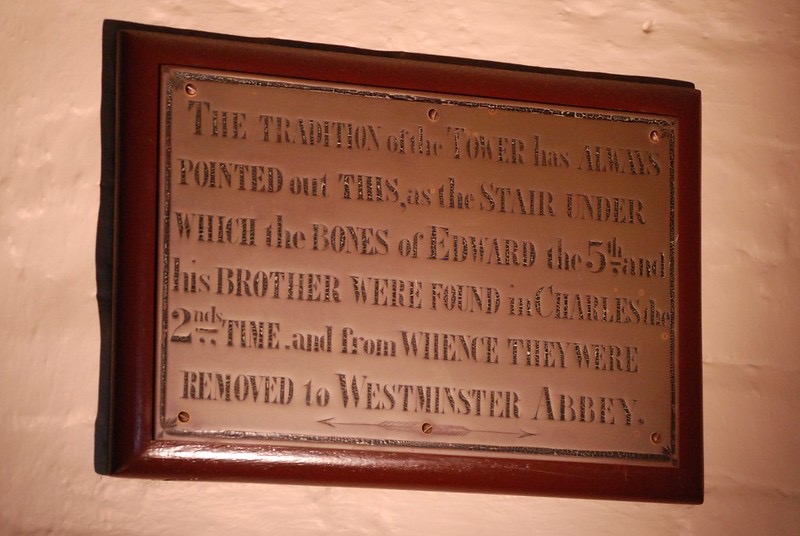
The princes had been taken to the tower in April, 1483, following the death of their father, King Edward IV, on the 9th of that month. Their uncle, Richard, Duke of Gloucester (and the Lord Protector of his nephews), had done so, ostensibly for their protection, while Edward’s coronation was initially scheduled for June.
The last recorded reference to them being in the tower dates from 16th June when they were seen “shooting [arrows] and playing in the garden of the Tower sundry times”.
There has since been much debate over their fate with many believing Richard, who in July of that year was crowned King Richard III, had them murdered to ensure his own ascension to the throne.
The two skeletons found almost 200 years later were put on display for several years following their discovery before King Charles II ordered that they be placed in an urn and reburied in the Henry VII Chapel in Westminster Abbey. In 1933, they were disinterred and forensically examined by LE Tannery and W Wright who concluded they were the skeletons of two boys, aged 10 and 13. They were subsequently reinterred and have remained buried since. They have never been tested for DNA.
Historic Royal Palaces Chief Curator Lucy Worsley and special guests will look at the question of whether the urn should be opened and the bones tested using modern forensic methods in an online event on 16th March at 7pm. Follow this link to register for this event.
WHERE: Tower of London (nearest Tube station Tower Hill); WHEN: 9am to 4.30pm (last admission), Tuesday to Saturday, 10am to 4.30pm (last admission) Sunday to Monday; COST: £29.90 adults; £14.90 children 5 to 15; £24 concessions (family tickets available; discounts for online purchases/memberships); WEBSITE: www.hrp.org.uk/toweroflondon/.
A Moment in London’s History – Sir Walter Raleigh leaves the Tower…
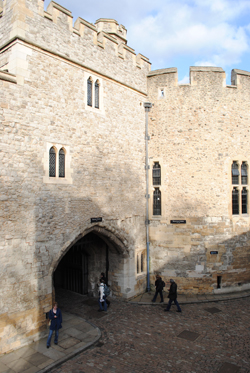 It was in February, 1616 – 400 years ago this year – that the adventurer and courtier Sir Walter Raleigh (Ralegh) was released from the Tower of London where he had spent the last 13 years of his life. Sadly, his freedom was to be short-lived.
Raleigh had been imprisoned in 1603 by King James I – not his biggest fan – after being accused of plotting against the king and subsequently sentenced to death for treason (a sentence which was then commuted to life imprisonment).
The Tower, where he’d been imprisoned a couple of times before – most notably by Queen Elizabeth I for secretly marrying Bessy Throckmorton, one of her maids-of-honour, was to be his home for the next 13 years.
It was in Bloody Tower (in left of picture) that his rather luxurious ‘cell’ was located. Originally known as the Garden Tower, it was renamed for the tradition that the two ‘Princes in the Tower’, King Edward V and his brother Richard, had been murdered here in 1483.
The tower’s top floor was added specifically to provide more room for his family in 1605-06 (and Raleigh’s son Carew was conceived and born while he was imprisoned here). It was also during this time of imprisonment that he wrote his History of the World (published in 1614).
Raleigh was released in 1616 to lead an expedition to the New World – he’d previously been on a couple of expeditions there including one with his half-brother Sir Humphrey Gilbert aimed at finding the Northwest Passage (but which deteriorated into privateering and led to his brief imprisonment following his return to England), and one aimed at finding the legendary ‘golden land’ of El Dorado (which he failed to do). It was again with the purpose of finding gold that he now returned to the Orinoco River region of South America.
Failure, however, was once more the outcome, and on Raleigh’s return to England, the death sentence issued on 1603 was reimposed (for his failure but also for attacking the Spanish in defiance of the king’s instructions to specifically not do so, although the blame was not all his). He would be executed in Old Palace Yard at Westminster on 29th October, 1618.
 Exploring London