What’s in a name?…Nunhead…

This district of London, which lies to the south-east of Peckham in the London Borough of Southwark, is believed to owe its name to a local tavern named, you guessed it, the Nun’s Head on the linear Nunhead Green (there’s still a pub there, called The Old Nun’s Head, in a building dating from 1905).
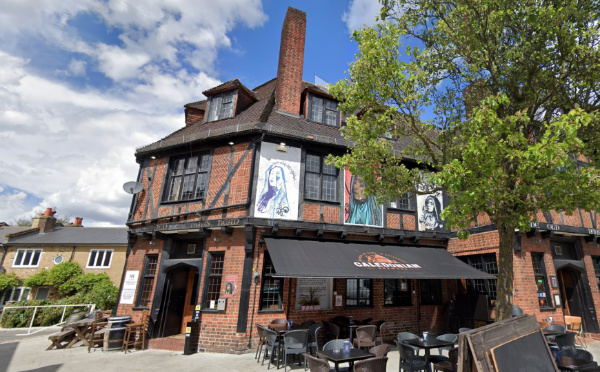
The Old Nun’s Head near Nunhead Green. PICTURE: Google Maps

There may well have been actual nuns here (from which the tavern took its name) – it’s suggested that there was a nunnery here which may have been connected to the Augustinian Priory of St John the Baptist founded in the 12th century at Holywell (in what is now Shoreditch).

A local legend gets more specific. It says that when the nunnery was dissolved during the Dissolution, the Mother Superior was executed for her opposition to King Henry VIII’s policies and her head was placed in a spike on the site near the green where the inn was built.

While the use of the name for the area goes back to at least the 16th century, the area remained something of a rural idyll until the 1840s when the Nunhead Cemetery, one of the “Magnificent Seven” cemeteries of Victorian London, was laid out and the area began to urbanise.

The chapel at Nunhead Cemetery. PICTURE: Owen Barritt (licensed under CC BY-SA 2.0)

A fireworks manufactory – Brocks Fireworks – was built here in 1868 (evidenced by the current pub, The Pyrotechnists Arms). The railway arrived in 1871.

St Antholin’s Church was built in 1877 using funds from the sale of the City of London church, St Antholin’s, Budge Row, which was demolished in 1875. St Antholin’s in Nunhead was destroyed during the Blitz and later rebuilt and renamed St Antony’s (the building is now a Pentecostal church while the Anglican parish has been united with that of St Silas).

There’s also a Dickens connection – he rented a property known as Windsor Lodge for his long-term mistress, actress Ellen Ternan, at 31 Lindon Grove and frequently visited her there (in fact, it has even been claimed that he died at the property and his body was subsequently moved to his home at Gad’s Hill to avoid a scandal).

Nunhead became part of the Metropolitan Borough of Camberwell in 1900. These days, it’s described by Foxtons real estate agency as “a quiet suburb with pretty roads and period appeal”.
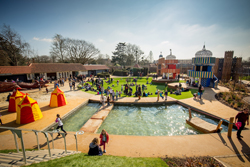
This Week in London – Hampton Court’s Magic Garden; the Stones on show; and, Dutch Flowers at the National Gallery…

The-Magic-Garden
PICTURE: Historic Royal Palaces

 Inspired by myths and legends of the Tudor Court, The Magic Garden has opened at Hampton Court Palace. The garden – located in King Henry VIII’s former tiltyard – has been designed by award-winning landscape architect Robert Myers and has been six years in the making. Features include the famous five lost tiltyard towers which have been recreated with each reflecting a different aspect of the Tudor era – from the King’s and Queen’s Towers which offer the best vantage point over the area, to the Discovery Tower which represents the Tudor fascination with exploration, the Battle Tower which symbolises King Henry VIII’s warlike spirit and the Lost Tower which brings to mind the eventual fate of the towers. There’s also a ‘wild wood’ – evoking the hunting grounds loved by the Tudors, a winding pathway of strange topiary and a ‘jungle’ of tree ferns and fatsias as well as a 25 foot long sleeping dragon who wakes as the clock strikes the hour. The garden, which is open until 30th October, is aimed at children of all ages, particularly those between two and 13 years-of-age. Admission charge applies. For more, see www.hrp.org.uk/hampton-court-palace/.

More than 500 artefacts related to the Rolling Stones have gone on display at the Saatchi Gallery in the first international exhibition on the group. EXHIBITIONISM: The Rolling Stones spans two floors and nine thematic galleries and charts the history of the Stones from the early 1960s to cultural icons as well as considering the band’s influence on popular culture. It features never-before-seen dressing room and backstage paraphernalia, instruments and costumes, original stage designs, audio tracks and video footage, personal diaries and album cover artwork. Works by an array of artists, designers, musicians and writers – everyone from Andy Warhol to Tom Stoppard and Martin Scorsese – are also included. Admission charge applies. Runs at the Kings Road gallery near Sloane Square until 4th September. For more, see www.saatchigallery.com.

The evolution of Dutch flower painting from the turn of the 17th century is the subject of a free exhibition which opened at the National Gallery off Trafalgar Square this week. Dutch Flowers features 22 works, about half of which come from the gallery’s collection while the other half come from private holdings. Artists whose works are featured include Jan Brueghel the Elder, Ambrosias Bosschaert and Roelandt Savoy – all among the first to produce paintings that exclusively depicted flowers. The exhibition – the first display of its kind for more than 20 years – is in Room 1 until 29th August. Admission is free. For more, see www.nationalgallery.org.uk.

Send all items for inclusion to exploringlondon@gmail.com.