Sixteenth century historian John Stow wrote numerous chronicles of English history but is mostly remembered for his landmark survey of London, a monumental work which has lead to him being informally given the title “founding father of London history”.
Stow (sometimes written as Stowe) was born a Londoner in about 1525 in the parish of St Michael, Cornhill. He was the eldest of seven children of Thomas Stow, a tallow chandler, and his wife Elizabeth.
Nothing is known about Stow’s early education - whether he attended a grammar school or was self-taught – but he is known to have developed a deep knowledge of English history, culture and customs as well as of Latin.
He didn’t follow his father’s trade but instead became an apprentice tailor and in 1547 was named a freeman of the Merchant Taylors’ Company. He is said to have worked as a tailor in London for almost 30 years.
In 1560, he started on his best known work, A Survey of London, a detailed topographical survey of the City of London and its suburbs – it was eventually published in 1598 (a second, longer edition followed in 1603). But his first book, on the works of Geoffrey Chaucer, was published in 1561, and he went on to publish numerous editions of English chronicles.
Stow was in contact with many of the era’s leading antiquarians, including the likes of John Dee and William Camden, and he was an active member of the first Society of Antiquaries, established in about 1586.
He also attracted the patronage of some significant figures including the Archbishops of Canterbury Matthew Parker and John Whitgift and Robert Dudley, Earl of Leicester, and was well-known for his collection of manuscripts, the largest group of which is now within the Harley collection at the British Library.
Stow, whose work never made him a wealthy man and who, at times, was the subject of his acquaintances’ charity (although Barrett L Beer in an entry in the Oxford Dictionary of National Biography describes his pleas of poverty as “exaggerated”), married his wife Elizabeth sometime after 1549. They lived initially in Aldgate where his business was also based (and later moved to the Lime Street ward). The couple had three daughters, two of whom – Joan and Julyan – survived him.
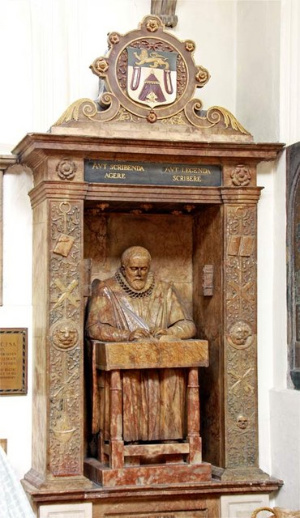
Stow died on 5th April, 1605. He was buried in the church of St Andrew Undershaft and his wife commissioned a marble monument to commemorate him which depicts Stow seated at his desk. A commemorative service, organised by the Merchant Taylors Company, is still held in the church every three years during which the quill he writes with is regularly replaced in a sign of respect.

 Exploring London