Special – Roman London’s first basilica found under an office block – here’s what it reveals about the ancient city

In an article first published on The Conversation, LACEY WALLACE of the University of Lincoln, looks at the recent discovery….

Archaeologists from the Museum of London have discovered a well-preserved part of the ancient city of London’s first Roman basilica underneath the basement of an office block. The basilica was constructed for use as a public building in the 70s or early 80s AD.
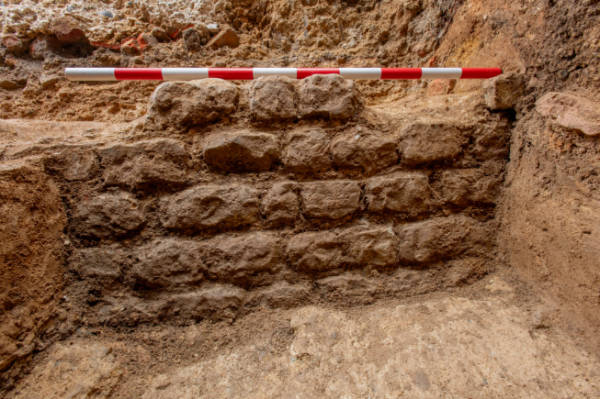
A section of the wall from the Roman basilica. PICTURE: MOLA

In a Roman town, a basilica was a multi-functional civic building. Often paid for by leading local inhabitants, it provided a large indoor space for public gatherings. These ranged from political speeches to judicial proceedings.

Along with the connected forum – an arrangement of buildings that surrounded an open courtyard space – the building formed the centre of administrative and civic life in the ancient Roman city of Londinium.

Other walls of London’s basilica and forum have been known by archaeologists since the early 1880s. But they were only recognised as remains of the social and civic centre of Londinium in 1923.

The story until now

Peter Marsden, the author of The Roman Forum Site in London (1987), compiled disconnected evidence for the different phases of London’s forum basilica complex.

Referring to the current area of excavations (on Gracechurch Street), he noted that: “More than half of the archaeological deposits still remain, and should be carefully excavated when the opportunity arises, since only then will the history of the site be elucidated.”

Occasional opportunities have arisen to reveal small parts of the forum basilica. For example, during construction of a shaft to install a lift at 85 Gracechurch Street, some important remains from the first century were found. But the excavated area was too small to contribute greatly to our knowledge.

In contrast, the recent work is part of a major redevelopment. It has opened targeted excavation areas where walls of the basilica were expected to be found, exposing substantial parts of the building.

Archaeologists have found one-metre-wide foundations and walls of the interior, some of which probably extend for more than 10 metres in length. The walls are constructed of flint, tile and Kentish ragstone (a type of limestone quarried in Kent), and some stand at four metres high.

What was the basilica for?

Londinium was constructed on an unoccupied site beginning in about AD47 or 48. It began to gain the trappings of a Roman-style town, including a basilica building, in the lead-up to its destruction in the Boudican Revolt in AD60 or 61.

The city did not have a monumental forum and basilica complex until later, however, when a major programme of public and private construction was undertaken in the Flavian period (AD69–96).

London’s Flavian basilica took the plan of a long rectangle (44m x 22.7m) divided into three aisles. There is good evidence from the deeper central aisle (nave) wall foundations that the nave roof was raised to two storeys, to allow for windows to provide internal light.

A reconstruction drawing of the first London forum. PICTURE: PeterMarsden/MOLA

Shallow foundations crossing the nave are evidence of a raised dais or platform at the eastern end. The speaker or judge would sit there, elevated above the crowds, increasing both his visibility and status. This platform, or “tribunal”, is the area that has recently been revealed.

The basilica would have risen above the north side of the buildings that formed the forum courtyard. It would have dominated the high ground of this monumental space at the highly visible crossroads leading straight up from the Roman Thames bridge.

It would have been the largest building in the area and firmly announced that the people of Londinium were constructing a high-status Roman city.

Rebuilding following the British Queen Boudica’s revolt had been swift. The post-Revolt fort that was built only 100 metres or so down the street had likely been decommissioned and the people were ready to embark on a new phase and a major expansion of the urban centre.

The designs of late first century forum basilica complexes varied across the provinces. But generally they combined religious, civic, judicial and mercantile space.
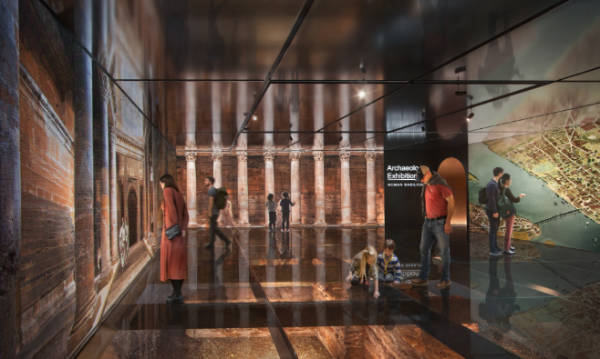
An artist’s impression of the proposed exhibition space that will showcase the newly discovered walls. PICTURE: Woods Bagot/MOLA

In places like Pompeii, the forum had developed over time. But, when the town was buried by the ash of Vesuvius in AD79 (approximately the same time the forum basilica of London was built), the focus of the elongated monumental space was the Temple of Jupiter, symbol of the Roman state.

Although a classical temple was constructed to the west of the exterior of Londinium’s Flavian forum, it was clearly separate. No forum in Britannia was dominated by a temple, setting the core of urban space in this province apart from most examples in the rest of the empire.

The Flavian forum basilica at Londinium is one of the earliest examples to demonstrate this characteristic, along with that at Verulamium (St Albans). There, an inscription links the circa AD79–81 construction to the governor Agricola, who is well known among historians from the celebratory biography written by his son-in-law, Tacitus.

The Flavian basilica and forum only stood for about 20 or 30 years, however. With increased prosperity in the early second century, they were demolished and replaced by a new structure which was five times larger, leaving the remains of the first basilica underneath the surface of the later courtyard space.

Museum of London Archaeology will now analyse and publish the results of its find, applying modern methods to advance our understanding of the development of the first forum basilica. We can expect refined dating evidence and an improved understanding of the architecture from the post-excavation analyses. An exhibition space to make the remains visible for the public is also planned.

The Conversation

Lacey Wallace is a senior lecturer in Roman history & material culture at the University of Lincoln. This article is republished from The Conversation under a Creative Commons license. Read the original article.
LondonLife – Largest Roman mosaic found in 50 years…

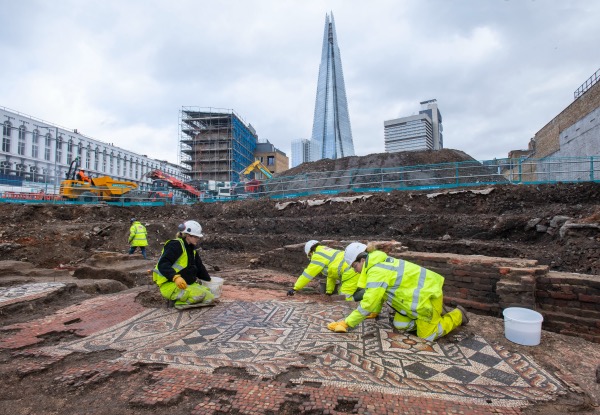
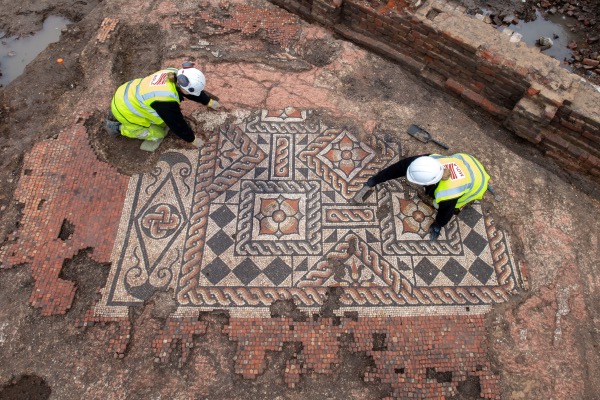
MOLA archaeologists at work on the mosaic unearthed in Southwark. PICTURE: © MOLA/Andy Chopping

The largest Roman mosaic to be unearthed in London in 50 years has been found near The Shard in Southwark.

The well-preserved mosaic, parts of which are thought to be 1,800-years-old, features two highly decorated panels.

The largest of the two shows large, colourful flowers surrounded by bands of intertwining strands – a motif known as a guilloche – while the design also features lotus flowers and several different geometric elements, including a pattern known as Solomon’s knot which is made of two interlaced loops.

The smaller panel features a simpler design, with two Solomon’s knots, two stylised flowers and striking geometric motifs in red, white and black. Its design is the “almost exact parallel” of a mosaic found in the German city of Trier which suggests a travelling group of artists may have been responsible for both.

The mosaic is believed to be floor of a dining room or ‘triclinium’ of a Roman ‘mansio’, an “upmarket ‘motel'” which offered accommodation, stabling, and dining facilities to people of high rank. The room would have contained couches on which people would have reclined to eat and would have featured brightly painted walls. Fragments of colourful wall plaster have been found on the site as well as traces of an earlier mosaic underneath the one they discovered.

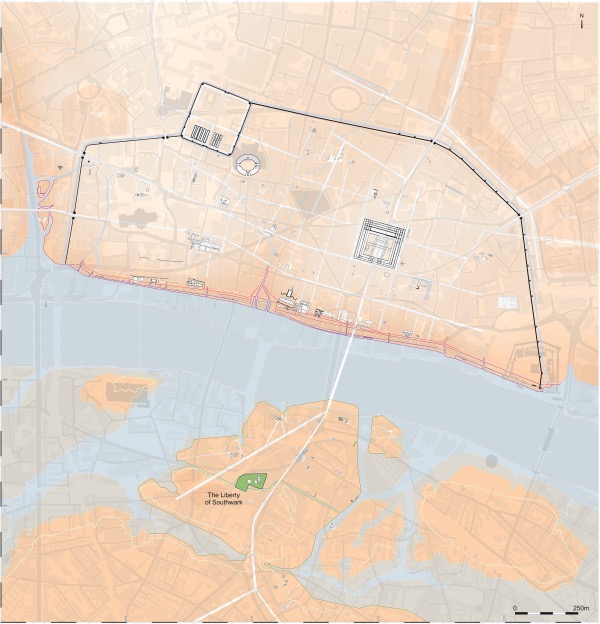
Location of The Liberty of Southwark site in Roman London (detail). PICTURE: © MOLA reproduced with permission of Ordnance Survey.

The discovery was made by archaeologists from Museum of London Archaeology (MOLA) during an excavation ahead of building work on a new mixed use development to be constructed on the site, which was previously used as a car park.

MOLA site supervisor, Antonietta Lerz, described the discovery in a statement as a “once-in-a-lifetime find in London”.

“It has been a privilege to work on such a large site where the Roman archaeology is largely undisturbed by later activity-when the first flashes of colour started to emerge through the soil everyone on site was very excited!” 

The archaeologists have identified another large Roman building neighbouring the mansio which they believe is likely to have been the private residence of a wealthy individual or family.

Plans for the future display of the mosaic are currently under discussion.

MOLA archaeologists at work on the mosaic unearthed in Southwark. PICTURE: © MOLA/Andy Chopping

LondonLife – Roman “pen” souvenir among thousands of finds on Bloomberg site…

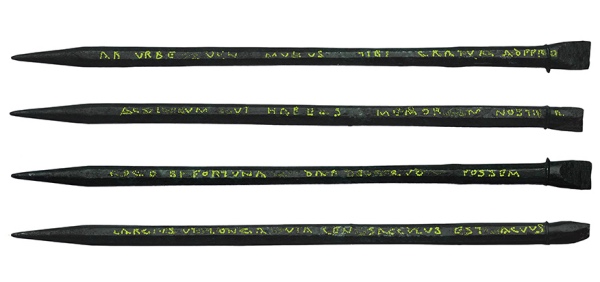
An iron stylus bearing an inscription – described as the sort of cheap souvenir you might bring back for a friend after visiting a foreign city – is among thousands of Roman-era artefacts discovered during excavations for Bloomberg’s new European headquarters in Cannon Street. The stylus, which is about the length of a modern pen, dates from about AD70 and was used to write on wax-filled wooden writing tablets. It is inscribed in Latin text which, translated by classicist and epigrapher Dr Roger Tomlin, reads: “I have come from the city. I bring you a welcome gift with a sharp point that you may remember me. I ask, if fortune allowed, that I might be able [to give] as generously as the way is long [and] as my purse is empty”. It is believed the “city” referred to is Rome. The stylus is one of some 14,000 items Museum of London Archaeology archaeologists unearthed on the dig – including 200 styli (although only one bears an inscription) – which took place on what was the bank of the (now lost) Thames tributary, the Walbrook, between 2010 and 2014. It is among items on show in an exhibition now on at the Ashmolean Museum in Oxford called Last Supper in Pompeii. Head here for more details. Other finds from the excavations can be seen at the recently opened London Mithraeum Bloomberg SPACE. PICTURE: © MOLA

LondonLife – Georgian ice house (re)discovered…

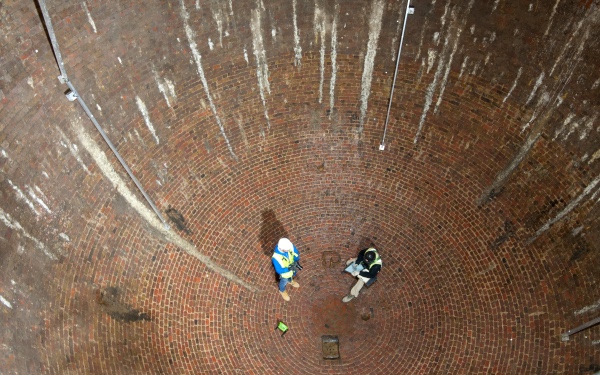
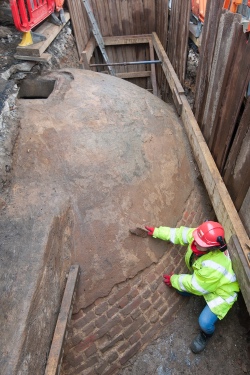
An 18th century ice house has been (re)discovered beneath the streets of Marylebone during a residential development project known as Regent’s Crescent. The subterranean red brick ice house – which measures 7.5 metres wide and 9.5 metres deep and was built in the 1780s – was used by pioneering ice-merchant William Leftwich during the 1820s to bring high quality ice to wealthy households and service the trend to serve frozen treats to guests as well as supply increasing demand from food retailers and medical institutions. Leftwich, seeing a niche for clean, quality ice (ice sourced from local canals and lakes during winter was often dirty), shipped ice collected in Norway’s frozen lakes and then transported it into London via Regent’s Canal. Now listed as a scheduled monument by Historic England, the egg-shaped ice house was rediscovered by MOLA archaeologists who were working on the site on behalf of property developer Great Marlborough Estates. It will now be incorporated into the gardens of Regent’s Crescent which have been newly designed by Kim Wilkie as part of the £500 million development project. The Grade I-listed crescent was originally designed by John Nash (of Buckingham Palace and Brighton Pavilion fame) and built in 1819. The houses were destroyed during the Blitz and replica properties were built in the 1960s. But the ice house, an entrance tunnel and ante-chamber all survived the bombing and remain in what MOLA has called “excellent condition”. It is anticipated that the ice house chamber will be open to public viewing via a special corridor during archaeological and architectural festivals.

PICTURES: Top – Buildings archaeologists from MOLA record the interior of the ice house/A MOLA archaeologist brushes the near perfect exterior of the ice house exposed during excavation in 2015 (Images© MOLA).