This Week in London – Mudlarking finds celebrated; MI5 reveals its secrets; and, fixing the broken planet at the Natural History Museum…

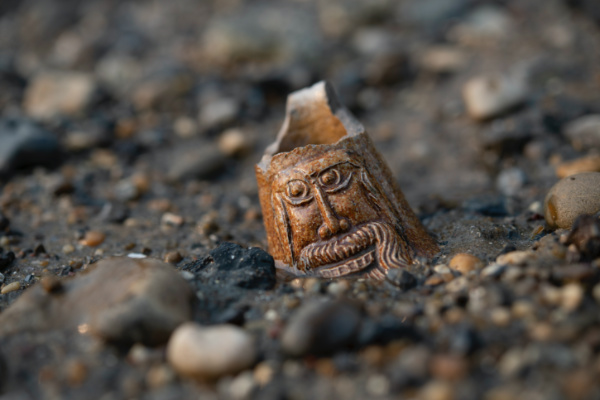
The neck from a stoneware bottle with a bearded face known as a Bartmann bottle 1500s – 1600s. The bearded face decorating the neck lies half-buried on the foreshore. PICTURE:
© Alessio Checconi /London Museum.
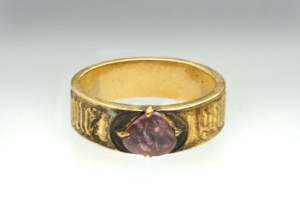
Gold finger ring, late medieval, mid 15th century, with pink ‘spinel’ stone. The engraved band includes an inscription ‘pour amor say donne’- For Love I am Given. © London Museum

The first major exhibition on mudlarking opens at the Museum of London Docklands tomorrow. Secrets of the Thames: Mudlarking London’s lost treasures features some of the fascinating finds made along the Thames foreshore – from a Tudor head-dress and a medieval gold ring to an an elaborately decorated Viking era dagger and a pair of 18th century false teeth. While mudlarking was historically an activity of the poor, often children, during the 19th century, it has evolved into a popular hobby for some (albeir permits are required) and in recent years led to some spectacular finds. Others among the more than 350 objects on show include a 16th century ivory sundial, the nationally significant Iron Age Battersea Shield, a pair of medieval spectacles, 16th century wig curlers, and a Roman badge decorated with a phallus. The exhibition also features the installation, The Moon by artist Luke Jerram, which highlights the role the moon and tides play in creating the unique conditions for mudlarks to explore the river’s banks. Admission charge applies. Runs until 1st March next year. For more, see www.londonmuseum.org.uk/whats-on/secrets-thames/.

The hidden world of MI5 is being revealed in a new exhibition opening at the National Archives in Kew on Saturday. MI5: Official Secrets features original case files, photographs and papers alongside equipment used by spies and spy-catchers during the organisation’s 115 year history. Among the items on show are first-hand account of Kim Philby’s confession in 1963, papers related to the past activities of Cambridge spy Anthony Blunt, M15’s first camera – a pocket-sized ‘Ensignette’ made by Houghton Ltd from 1910, evidence that led to German spy Josef Jakobs being the last person executed at the Tower of London, and, advanced radio equipment found buried in the garden of Soviet spies Helen and Peter Kroger in the 1960s. The exhibition also features video insights from former MI5 directors general, intelligence experts including Professor Christopher Andrew – author of MI5’s official history, and Baroness May, former Prime Minister and one of Britain’s longest serving Home Secretaries. The exhibition is free to visit and runs until 28th September. For more, see https://www.nationalarchives.gov.uk/mi5-official-secrets/.

The first new permanent gallery at the Natural History Museum – Fixing Our Broken Planet – opens today. The new gallery brings together pioneering research from the museum’s scientists with advice from environmentalists and young changemakers on how to better care for the planet and its future and aims to be a “definitive destination for those looking to explore the threats to our natural world whilst discovering where solutions can be found”. Visitors will come face-to-face with more than 250 specimens including a Sumatran rhinoceros, parasitic worms and whale’s earwax; each telling an important story about our fragile relationship with the natural world and will also see research showing how fungi is used to fertilise crops, how bacteria can be harnessed to extract copper from mine waste, how bison are helping to engineer forests in the UK to store more carbon and how vital DNA analysis on mosquitos is being used to fight mosquito-borne diseases, such as malaria. The new display is located in the restored original 1881 Waterhouse building. The gallery is free to visit. For more, see www.nhm.ac.uk.

• Send all items to exploringlondon@gmail.com

London Explained – Mudlarks…

Modern mudlarks at Queenhithe on the River Thames. PICTURE: Geoff Henson (licensed under CC BY-ND 2.0)

Spotted along the Thames foreshore when the tide is low, the term ‘mudlark’ is used to describe someone who scavenges for lost or discarded objects in the mud along the Thames river banks.

In the 18th and 19th century, mudlarks were among London’s poorest who eked out a living by selling items – lumps of coal, pieces of rope, precious metals – found on the river’s banks. They were often the young or the elderly and the working conditions, which included navigating through the raw sewage and other noxious waste which ended up on the foreshore, were horrendous.

Victorian journalist Henry Mayhew, who writes in his seminal and expansive series of reports – London Labour and the London Poor – described how mudlarks were so-named because of their need at times to wade up to their waists in mud to retrieve items.

By the 20th century, the practice appears to have somewhat died out. But in more recent years, the term mudlark has been applied to hobbyists, including those using metal detectors, to search along the Thames foreshore during the hours when the tides allow. Since the mid-1970s, The Society of Thames Mudlarks has provided some organisational structure for those involved but membership in this body is limited.

A permit from the Port of London Authority is required for modern mudlarking. As the authority’s website states: “Anyone searching the tidal Thames foreshore from Teddington to the Thames Barrier – in any way for any reason – must hold a current and relevant foreshore permit from the Port of London Authority. This includes all searching, metal detecting, ‘beachcombing’, scraping and digging”.

Finds of potential archaeological interest must be reported to the Museum of London (and human remains, of course, to police). Mudlarks are also encourage to report finds to the Portable Antiquities Scheme.

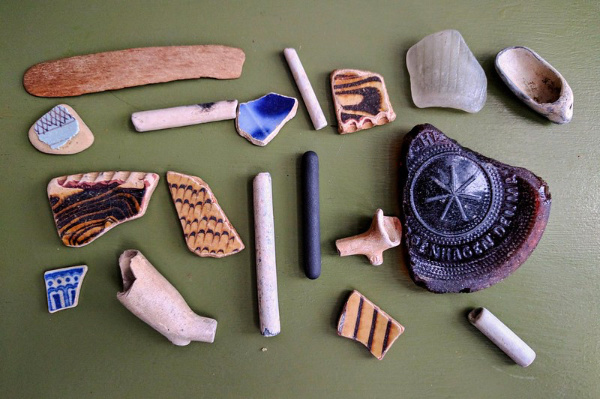
Mudlark finds. PICTURE: Neil Cummings (licensed under CC BY-SA 2.0)

Objects found include everything from clay pipes, bits of pottery, buttons, bones and pins through to more precious items such as coins, rings and even daggers and swords.

Lara Maiklem, author of the 2019 book Mudlarking: Lost and Found on the River Thames, is among the most well-known of the modern mudlarks. As detailed in his book, her finds have included everything from a Roman amphora stopper to medieval roof tiles, a bearded man from a late 16th century Bellarmine jug and an 18th century shoe pattern.

This Week in London – Video games explored; NHM celebrates ‘James and the Giant Peach’; and Thames Mudlarks’ finds on show…

Video games – their design and use both in terms of gaming but also in pushing boundaries – are the subject of a new exhibition opening at the V&A this Saturday. Videogames: Design/Play/Disrupt will provide rare glimpses into the creative process behind games like The Last of Us, Journey and Kentucky Route Zero through original prototypes, early character designs and notebooks as well as cultural inspirational material ranging from a Magritte painting to a viral cat video. The display also features large scale, interactive and immersive multimedia installations featuring games like Minecraft and League of Legends, and explore how major technological advancements have transformed the way games are designed, discussed and played. Runs in Room 39 and North Court until 24th February. Admission charge applies. For more, see vam.ac.uk/videogames. PICTURE: V&A.

The Natural History Museum is celebrating Roald Dahl Day (13th September) with a James and the Giant Peach weekend. The South Kensington museum will this weekend offer a range of James and the Giant Peach-inspired family-friendly events and activities including the chance to see insects up close in the Darwin Centre and the Wildlife Garden as well as specimens in the Attenborough Studio. There’s also the chance to take in a ‘Whizzbanging Words’ session with a team from the Roald Dahl Museum and Story Centre, and music from the three-piece band, Roald Dahl’s Giant Bugs. Runs from 11am to 4.50pm on Saturday and Sunday. Admission is free (but some events are ticketed – check website for details). For more, see www.nhm.ac.uk/events/james-and-the-giant-weekend.html

An exhibition revealing some of the historical artefacts found by some of London’s most prolific Mudlarks along the banks of the River Thames opens on Tuesday as part of Totally Thames. Hannah Smiles has been taking the pictures over the past year and they capture everything from Tudor-era pins to World War II shells, medieval pottery, human teeth and even messages in bottles. The photographs and artefacts themselves both form part of the display. A series of talks by Mudlarks accompanies the free display. It can be viewed at the Art Hub Studios, 5-9 Creekside, in Deptford until 16th September. For more information, head to www.totallythames.org.

Send all items for inclusion to exploringlondon@gmail.com.