This Holborn pub apparently has a history dating back to 1549.
It is believed to have been established to cater to farm labourers working in nearby Lincoln’s Inn Fields.
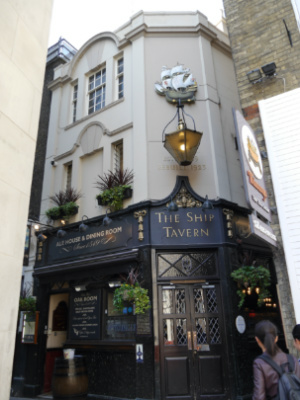
Its name, however, is said to be related to its proximity to the now-underground River Fleet which runs through Holborn and linked the area with the River Thames. It’s said that the pub’s clientele soon included dock workers and that it may have even had connections to smuggling and pirates. It was apparently these connections that gave the pub the name it still has today.
These days tucked down a narrow alleyway at 12 Gate Street in a building dating from 1923 (apparently considerably bigger than the original), the pub, which features wood panelled walls and leaded windows, has a storied history.
Having been established during the reign of King Edward VI, the pub is known to have provided a space for banned Catholic worship (complete with spotters to warn if officials were seen in the area and hiding places for the priests should the officials decide to raid the premises).
Indeed, the pub would have also served those who attended executions of Catholics such as Robert Morton and Hugh More who were executed in 1588 in the nearby Lincoln’s Inn Fields (other executions there included that of Anthony Babington, executed in 1586 after being convicted of plotting against Queen Elizabeth I, and Lord Russell, executed in 1683 for his involvement in the Rye House Plot).
Other clientele, meanwhile, may have come from the nearby thoroughfare of Whetstone Park which was once notorious for gambling houses and other illicit behaviours.
The Ship also has Freemason connections, being officially consecrated as a Masonic Lodge in 1736 by the then-Grand Master, the Earl of Antrim.
Famous figures said to have been associated with this pub include Richard “Trusty Dick” Penderell, who aided Charles I’s escape after the Battle of Worcester in September, 1651, the antiquarian John Bagford, the French diplomat and spy Chevalier d’Eon who lived both as a man and, later in life, as a woman, and John Smeaton, the builder of a lighthouse once located at Eddystone in Cornwell. It’s even been suggested Shakespeare visited.
There’s also said to be a number supernatural clients at the pub with mysterious figures seen sitting at tables and glasses being moved around (it’s been suggested some of these relate to the persecution of Catholics on the site).
For more, visit theshiptavern.co.uk.
 Exploring London