10 World War II memorials commemorating Londoners…2. Kennington Park air raid shelter…

More than 100 people died when, on the night of 15th October, 1940, a bomb destroyed an air raid shelter located in Kennington Park in Lambeth.

Subscribe for just £3 a month to access all of Exploring London’s content (and support our work!)

While no official death toll was announced at the time, it’s now believed that 104 people died in the bombing. Forty-eight bodies were recovered and buried in Streatham Cemetery while the remainder still lie under the park.

The majority of those killed were women and children with the youngest just three-months-old. The oldest known victim was 75.

While Lambeth’s civilian dead are commemorated in a memorial at Lambeth Cemetery dedicated in 1952, in early 2000s the Friends of Kennington Park raised funds for a permanent memorial to those killed in the tragedy in the park.

The memorial, which was designed by Richard Kindersley and is located in the South Field close to the Tinworth Fountain Gate, is an upright stab of Caithness stone brought from Scotland standing 2.6 metres tall.

It is inscribed with a quote from poet Maya Angelou – “History despite its wrenching pain cannot be unlived but if faced with courage need not be lived again.”

While another inscription around the edge of the stone commemorates the more than “50 men, women and children” who died during the bombing, a nearby interpretation board puts the toll at more than 100.

A list of known victims can be found in a pamphlet by Rob Pateman published by the The Friends of Kennington Park.

WHERE: Kennington Park, inside the Tinworth Fountain Gate, Kennington Park Road, Lambeth (nearest Tube station is Oval); WHEN: Usually 7.30am until 15 minutes before sunset; COST: Free; WEBSITE: www.lambeth.gov.uk/parks/kennington-park
10 (more) curious London memorials…4. ‘People of London’ Memorial…

People-of-London

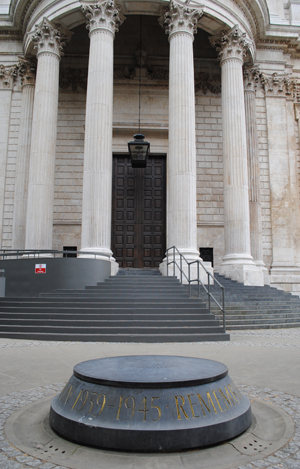
Amid all the grand war-related memorials of London, this rather humble memorial sitting outside the north transept of St Paul’s Cathedral in St Paul’s Churchyard can easily be overlooked. 

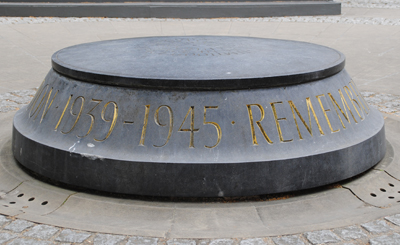
Known as the Memorial to the Londoners killed in World War II Bombardments or simply as the ‘People of London’ memorial as it’s called on the sculptor’s website, it commemorates the 30,000 Londoners who were killed during the Blitz  (not to be confused with the National Firefighters’ Memorial, known informally to many as the Blitz Memorial, which sits opposite the cathedral’s south transept and commemorates firefighters who died during the Blitz).

People-of-London---smallThe round memorial was carved from a three tonne block of Irish limestone and is set into paving (it was initially very shiny).

The gilded inscription which runs around the outside reads “Remember before God the people of London 1939-1945” while on top, written in a spiral, is an inscription written by Sir Edward Marsh – “In war resolution, in defeat defiance, in victory magnanimity, in peace goodwill”, the text of which was used by Sir Winston Churchill in the frontispiece to his history, The Second World War.

Unveiled by the Queen Mother on 11th May, 1999, the memorial is the work of Richard Kindersley, whose other memorials include the Commonwealth Memorial on Constitution Hill.

Kindersley writes on his website, that the “position of the memorial adjacent to St Paul’s is most appropriate, as most people will remember the dramatic photograph of the Cathedral dome of the taken during a devastating attack in 1941.”

It was paid for by public funds raised following an appeal in the Evening Standard newspaper, launched in connection with the 50th anniversary of VE Day.