This series of three inter-connected docks in London’s east were once the largest enclosed docks in the world (they’re still the largest enclosed docks in the UK).
Royal Victoria Dock
10 historic vessels in London’s Thames…3. SS Robin…
The world’s only complete surviving Victorian steamship, the SS Robin is moored in east London, close to where it was built.
One of a pair of steam coasters (the other being Rook) built initially by Mackenzie, MacAlpine & Co at Orchard House Yard on Bow Creek (and then completed by London shipowner Robert Thomson) in 1890, the SS Robin was fitted out at East India Dock before being towed to Dundee to be fitted with her engine, boiler and auxiliary machinery at Gourlay Brothers & Co.
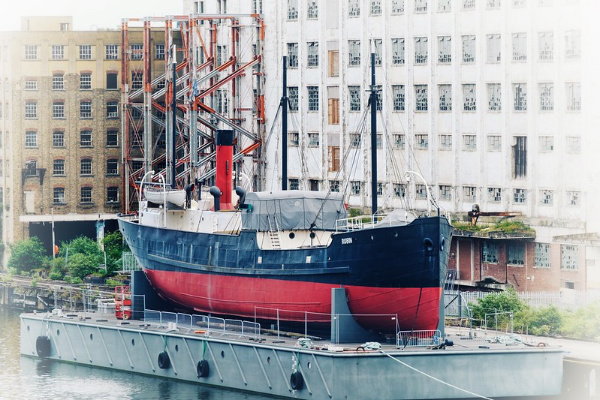
The SS Robin commenced her sailing career at Liverpool on 20th December, 1890, and spent the next decade carrying cargos – including grain, coal, and iron ore – between British ports as well as some in northern France. Early on – in 1892 – she was sold to Alexander Forrester Blackater of Glasgow and re-registered there.
In 1900, the Robin was sold to what would be the first of three Spanish owners and renamed the Maria. The ship would then spend the next 74 years working along the Spanish coast, carrying a range of cargos including iron and coal.
In 1974, only days after discharging her final cargo and about to be sold to Spanish ship breakers, the Maritime Trust purchased the ship.
Following a two restoration project at the Doust & Co shipyard in Rochester, Kent, and, once again named the Robin, she was subsequently moored in St Katharine Docks. The ship was moved to a new mooring at West India Quay in 1991 but fell into disrepair.
In 2000, David and Nishani Kampfner bought Robin for £1 with the idea of creating an educational centre and gallery. Two years later, in 2002, SS Robin Trust was created and volunteers subsequently began the work of restoring the coastal steamer.
From 2004 until 2007, the vessel was home to a gallery and workshops run by Kampfner to encourage creative thinking in children.
But the need for further refurbishment saw this come to an end and, financed by a £1.9 million loan from Crossrail and a £1 million grant from The Heritage Lottery Fund, in June, 2008, the Robin undertook her first sea journey in 35 years, travelling to Lowestoft for the much needed restoration works.
Once at Lowestoft, however, it was discovered the ship was too fragile to go to sea again and so a pontoon was created onto which the ship was lifted in 2010. Towed to Tilbury, the Robin underwent further refurbishment there until, in July, 2011, she returned to London.
Moored initially at the Royal Albert Dock, she is now located at Royal Victoria Dock (and can be seen from nearby viewing points). There are now plans to relocate her to Trinity Buoy Wharf and for further development as a museum ship.
For more information, head to http://ssrobin.com.
This Week in London – Dunkirk Little Ships at Royal Docks a highlight of ‘Museums at Night’; the Magna Carta in stitches; and Peter Kennard’s works on show…
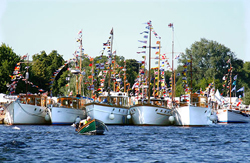 • More than 20 Dunkirk Little Ships will gather at London’s Royal Docks this weekend ahead of their Return to Dunkirk journey marking the 75th anniversary of the Dunkirk evacuations. The event, which is part of the UK’s annual festival of late openings Museums at Night, will see the ships parade around Royal Victoria Dock on Saturday night with the Silver Queen offering twilight trips and the chance to step on board some of the other ships (the Little Ships will continue with their own festival on Sunday commencing with a church service by the quayside at 11am). Other events being offered in London as part of Museums at Night include ‘Dickens After Dark’ in which the Charles Dickens Museum will open its doors to visitors for night of Victorian entertainment on Friday night and a night of music featuring the Royal College of Music at Fulham Palace (also on Friday night). Among the other London properties taking part are the Handel House Museum, Benjamin Franklin House, the Wellcome Collection, Museum of the Order of St John, and the National Archives in Kew. For a full list of events, check out http://museumsatnight.org.uk
• Meanwhile, Dulwich Picture Gallery in south London is holding its first weekend culture festival, MayFest: Men of Mystery, as part of Museums at Night. On Friday and Saturday nights, there will be tours of the gallery’s new exhibition featuring the work of artist Eric Ravilious followed by outdoor cinema screenings of Alfred Hitchcock’s Rear Window and The 39 Steps as well as free swing dance lessons, street foods and a pop-up vintage shop which will help people get the vintage look. Visitors are being encouraged to dress up in styles of the 1930s and 1940s with a prizes awarded to those with the “best vintage style”. The gallery will also be inviting visitors to take part in a mass installation drop-in workshop held in the gallery’s grounds over the weekend and Saturday morning will see special events for children. For more, see www.dulwichpicturegallery.org.uk/whats-on/.
• A major new work by acclaimed artist Cornelia Parker goes on display in the entrance hall of the British Library in King’s Cross tomorrow to mark the 800th anniversary of the Magna Carta. The almost 13 metre long Magna Carta (An Embroidery) replicates the entire Wikipedia entry on the Magna Carta as it was on the 799th anniversary of the document and was created by many people ranging from prisoners and lawyers to artists and barons. It accompanies the library’s exhibition Magna Carta: Law, Liberty, Legacy. Entry to see the artwork is free. For more, see www.bl.uk/cornelia-parker.
• The works of Peter Kennard, described as “Britain’s most important political artist”, are on display in a new exhibition which opens at the Imperial War Museum in London today. Peter Kennard: Unofficial War Artist is the first major retrospective exhibition of his work and features more than 200 artworks and other items drawn from his 50 year career including an art installation, Boardroom, created especially for the display. Works on show include his iconic transposition of Constable’s painting Haywain which he showed carrying cruise missiles about to be deployed in Greenham Common, the Decoration paintings created in 2004 in response to the Iraq War of 2003, his seminal STOP paintings which reference events of the late 1960s such as the ‘Prague Spring’ and anti-Vietnam war protests and his 1997 installation Reading Room. The free exhibition runs at the Lambeth institution until 30th May next year. For more, see www.iwm.org.uk/london.
Send all items for inclusion to exploringlondon@gmail.com.
Where is it?…#58
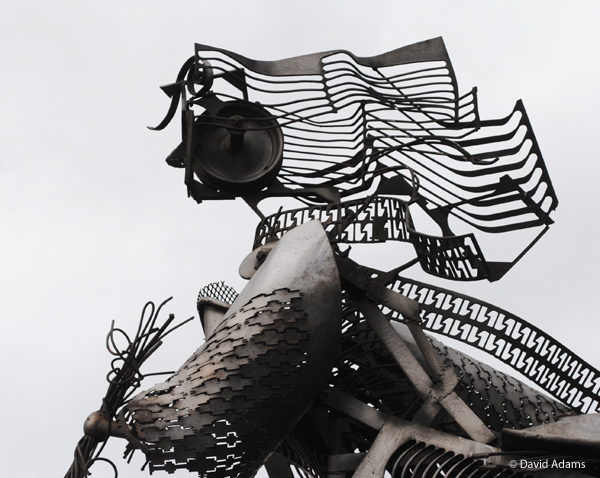
Can you identify where in London this picture was taken? If you think you can, leave a comment below. We’ll reveal the answer early next week. Good luck!
A bit of a harder one this week (so we thought we’d leave a bit longer before giving you the answer!). This is a sculptural figure – aptly named Figurehead for Docklands – which stands at the north-east corner of Poplar Dock in East London. Designed in 1997 by Anna Bisset, it’s made of cast iron and welded steel and was inspired by the idea of ship’s figureheads. Initially put on show at Tidal Basin, Royal Victoria Dock, over the summer of 1995 as part of an outdoor exhibition organised by the University of East London and the London Docklands Development Corporation, it was subsequently purchased by the LLDC and put on permanent display in its current location. For more of Anna Bisset’s work, visit www.annabisset.co.uk.
We’ll post our next Where is it? over the weekend…
 Exploring London