This Week in London – ‘After Impressionism’; a new woodland for Richmond Park; and, a new exhibition at the Heath Robinson…

Paintings and sculptures by artists including Cézanne, Van Gogh, Rodin, Picasso, Matisse, Klimt, Kandinsky and Mondrian opens at The National Gallery on Saturday. After Impressionism: Inventing Modern Art features more than 100 paintings and sculptures from museums and private collections around the world spanning the period between 1886 and 1914. Highlights include André Derain’s La Danse, Edgar Degas’s Dancers in the Foyer, Paul Cézanne’s Grandes Baigneuses, Edvard Munch’s The Death Bed, Paul Gauguin’s Vision of the Sermon, Camille Claudel’s Imploration / l’Implorante, and Lovis Corinth’s Nana, Female Nude. Admission charge applies. Runs until 13th August. For more, see www.nationalgallery.org.uk/exhibitions/after-impressionism-inventing-modern-art.

Sir David Attenborough has planted an English oak tree to officially open the Platinum Jubilee Woodland, a new woodland in Richmond Park. The woodland has been created as part of The Queen’s Green Canopy initiative to celebrate and honour the late Queen Elizabeth II’s lifetime of service. Some 70 young trees have been planted in the woodland, including oak, Dutch elm-disease-resistant elm, small-leaved lime, and sweet chestnut trees, planted around a focal point which will later incorporate a seating area. Sir David’s tree is one of the last to be planted as part of The Queen’s Green Canopy initiative which concludes on 31st March. The project invited people from across the nation to plant trees in honour of Queen Elizabeth II to mark the Platinum Jubilee and benefit future generations. For more on the park, see www.royalparks.org.uk/parks/richmond-park.

Illustrative works by William Heath Robinson, Charles Robinson and Thomas Health Robinson, many of which have not be exhibited before, are on show in a new exhibition at the Heath Robinson Museum in Pinner. The works, which come from the collection of Martin and Joanne Verden, include original drawings for Railway Ribaldry and William Heath Robinson’s How to… series of books. Admission charge applies. Runs until 21st May. For more, see www.heathrobinsonmuseum.org.

Send all items for inclusion to exploringlondon@gmail.com.
This Week in London – Kew celebrates 10 years of The Shirley Sherwood Gallery with botanical art, and BBC great honoured with Blue Plaque…

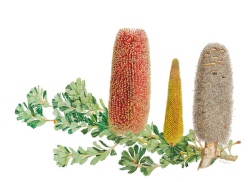
A unique collection of contemporary botanical art from The Florilegium Society at the Royal Botanic Gardens in Sydney, Australia, has opened at The Shirley Sherwood Gallery in Kew Gardens. Among several exhibitions marking the gallery’s 10th anniversary, this display features life-sized works by 64 Australian and international artists of the society (the name florilegium means ‘a gathering of flowers’). Meanwhile, a showcase of botanical works by Australian and New Zealand painters selected by Dr Shirley Sherwood from among her collection has also gone on show. Down Under II: Works from the Shirley Sherwood Collection follows an earlier exhibition in 1998. And finally, with the Temperate House set to reopen next month after a five year restoration, the gallery is also hosting Plans and plants – the making of the Temperate House which takes a look at the history of this Victorian-era landmark through plans, drawings and photographs taken from Kew’s archives. All three displays can be seen until 16th September. Admission included with Gardens entry.  For more, see www.kew.org. PICTURE: Banksia praemorsa by Margaret Pieroni. The Florilegium Society at the Royal Botanic Gardens, Sydney.

Sir Hugh Carlton Greene, director-general of the BBC during the 1960s, has been honoured with an English Heritage Blue Plaque at his former home in Holland Park. Greene (1910-1987) lived in the two-storey semi-detached home at 25 Addison Avenue between 1956 and 1967, a period which mostly coincided with his time as director-general. A former journalist and younger brother to novelist Graham Greene, he had joined the BBC in 1940 and was appointed director-general in 1960, remaining in the post for more than nine years before resigning in 1969. He presided over the BBC during a period in which the broadcaster was forced to reinvent itself following the arrival of ITV. The plaque was unveiled by veteran broadcaster, naturalist and former colleague, Sir David Attenborough. For more on Blue Plaques, see www.english-heritage.org.uk/visit/blue-plaques/.

Send all items for inclusion to exploringlondon@gmail.com.