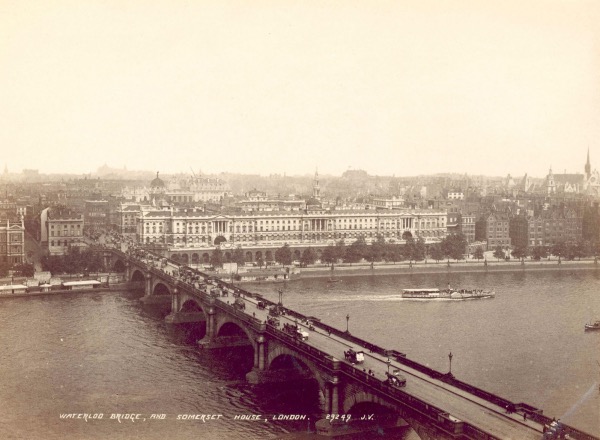
Lost London – Old Waterloo Bridge…

Waterloo Bridge between 1865-1875. PICTURE: Valentine, J, Universitaire Bibliotheken Leiden/licensed under CC BY 4.0)

Built between 1813 and 1817, the first Waterloo Bridge was designed by Scottish civil engineer John Rennie and featured nine elliptical arches, pairs of Doric columns at the piers and a flat roadway.

Originally known as The Strand Bridge, the name was changed by an Act of Parliament in 1816 and commemorated the victory over Napoleon Boneparte at the Battle of Waterloo in 1815.

It was opened by the Prince Regent, accompanied by the Duke of Wellington, on 18th June, 1817 – the second anniversary of the battle.

The bridge originally featured toll booths – the toll was removed in 1877.

In the early 20th century, piers from the bridge settled into the riverbed and created a dip, possibly due to the increasing traffic using it. A temporary steel bridge was placed alongside it and, despite opposition, it was eventually demolished in 1936.

The current bridge, designed by Sir Giles Gilbert Scott, was built over the years 1937 to 1942 (although it wasn’t fully completed until 1945).

Old Waterloo Bridge was famously depicted in a series of works by Claude Monet painted between 1900 and 1904 while he stayed at the Savoy Hotel and by John Constable who created a famous painting of its opening (it’s actually his largest work). The bridge also lends its name to the 1940 American film, Waterloo Bridge, which was adapted from a 1930 play.

Interestingly, granite blocks from the original bridge were sent to Australia and New Zealand while timbers from the bridge were used for shelves and wall panels in the library at Anglesey Abbey in Cambridgeshire (where the famous Constable painting hangs). Some of the original blocks were also incorporated into the foundations and approaches of the new bridge.

The keystone from the original bridge, recovered when it was demolished, is located at the Institution of Civil Engineers in Great George Street.
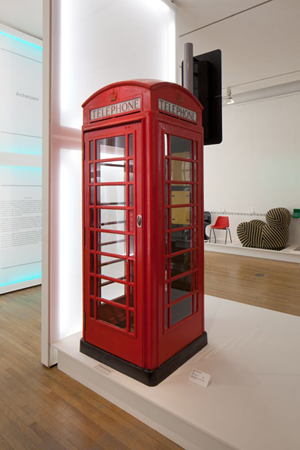
Treasures of London – K2 telephone kiosk at the Design Museum…

This version of the iconic British ‘institution’ – the red phone box – was designed by architect Sir Giles Gilbert Scott in 1924 (you may know him as the designer of the Battersea Power Station).

K2-KioskFormally known as the K2 telephone kiosk, Scott’s design was selected after a competition organised by the Royal Fine Art Commission (there’s a wooden prototype of Scott’s K2 located under the entrance to the Royal Academy of Arts in Piccadilly – the location where it was originally positioned).

The design featured a classical-looking dome (said to have been influenced by the work of architect Sir John Soane) which featured the royal crest of King George V (done in perforation, so it also provided ventilation). The phone box was made in cast iron and painted red (Scott had apparently suggested silver). From 1926 onwards, around 1,700 of the K2s – which weighed more than a ton – were deployed around London (very few were ever erected outside the city).

The surviving K2s – there are said to be slightly more than 200 – are now listed buildings.

The telephone box is a part of the Design Museum’s permanent collection which is currently held in two locations but from 2015 will be housed in a new purpose-built museum in High Street Kensington.

The box, which will be displayed on the museum’s top floor which will be dedicated to the display of 20th century artefacts, is currently featured in a special exhibition, Design Museum Collection: Extraordinary Stories About Ordinary Things, which runs at the museum’s current premises until January, 2015.

To further explore the Design Museum’s collection, you can download a free Design Museum Collection App for iPad app via iTunes.

WHERE: Design Museum, 28 Shad Thames (nearest Tube stations are London Bridge and Tower Bridge); WHEN: 10am to 5.45pm daily (last admission 5.15pm); COST: £11.85 adults/£10.70 concessions/£7.50 students (children under 12 are free); WEBSITE: www.designmuseum.org

Where’s London’s oldest…red telephone box?

An iconic symbol of Britishness, these days the red telephone boxes found throughout the city may well have more use as a prop in tourist’s photos than for actually making phone calls. But where’s the oldest?

Nestled under the gateway into the Royal Academy of the Arts in Piccadilly sits a rather non-descript looking red telephone box.

Created in 1924, it is actually a prototype of the red phone boxes that later became ubiquitous across the country.

The phone box prototype was designed by Sir Giles Gilbert Scott, one of three architects who were asked to create designs for the boxes after the Post Office’s initial designs were apparently rejected.

Scott’s successful design is the only one of the three to survive and while it’s made of wood, the later boxes were made of cast iron and painted red for visibility.