The Welsh-born “merchant adventurer” Sir Hugh Myddelton (also spelt Myddleton or Middleton) is best remembered in London for the construction of the New River, a water engineering project which still provides some of city’s water.
 Born about 1560, the sixth son (and one of 16 children) of Richard Myddelton, governor of Denbigh Castle in Wales, Hugh Myddelton travelled to London to seek his fortune and there became apprenticed to a goldsmith before himself becoming a member of the Goldsmith’s Company in 1592 (he later became warden of the company).
Operating out of premises in Bassishaw (now Basinghall Street), he gained a reputation among the wealthy and nobility for his work and was appointed Royal Jeweller to King James I (he had apparently also supplied jewellery to Queen Elizabeth I).
Myddelton became a wealthy merchant and banker, and, in 1603, he also succeeded his father as MP for Denbigh Borough, a post he held repeatedly until 1628.
Sir Hugh became one of the driving forces behind the New River project which aimed to address the strain on London’s water sources by bringing clean water from the River Lea in Hertfordshire via a 39 mile-long canal to New River Head in London.
After an aborted earlier attempt to build a canal from Hertfordshire to London (which had run into financial difficulties), Sir Hugh was granted authority to carry out the works for the New River in 1609 and employed mathematicians like Edward Pond and Edward Wright to direct the course with the man behind the earlier attempt, Edmund Colthurst, overseeing the works.
By 1611 it became clear to Myddelton that he wouldn’t have the necessary funds to complete the works so he obtained the financial aid of the king (in return the king was to get half of all profits).
The project was eventually completed in 1613 and a ceremony was held at the New River Head in Islington where the canal then terminated (just south of where Sadler’s Wells Theatre now stands).
Myddelton, who continued to diversify in business and made considerable sums from his ownership of lead and silver mines in Wales as well as from a land reclamation project on the Isle of Wight, became the first governor of the New River Company when it was created by royal charter in 1619 and remained a key figure in it until his death. He was created a baronet in 1622.
Myddelton, who married twice, had 15 or more children to his second wife – only about half of whom survived him. He died on 7th December, 1631, and was buried in the now demolished St Matthew Friday Street where he had been a church warden (some of his children were buried there as well). One of his brothers, Sir Thomas Myddelton, was a Lord Mayor of London.
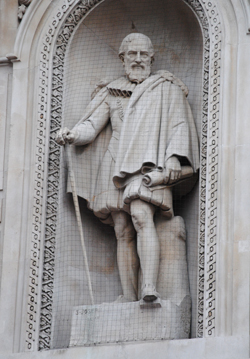
Among memorials to Sir Hugh in London is a statue of him on Islington Green which was unveiled in 1872 by William Gladstone, later PM. There is also a statue of him on the Royal Exchange (pictured) and a number of Islington streets have been named for him.
For more on London’s historic water sources, see London’s Lost Rivers: A Walker’s Guide .
.

 Exploring London