We finish our series on Christopher Wren by providing a quick recap…
1. The Old Court House, Hampton Court Palace Green…
9. St James’s Street, Piccadilly…
We’ll start a new series in the New Year!
We finish our series on Christopher Wren by providing a quick recap…
1. The Old Court House, Hampton Court Palace Green…
9. St James’s Street, Piccadilly…
We’ll start a new series in the New Year!
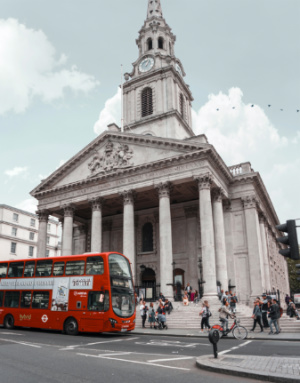
Not one of the many churches rebuilt by Wren after the Great Fire of 1666, St Martin-in-the-Fields, located just to the east of what is now Trafalgar Square, is special to the great architect for very personal reasons.
For it was in this church that his first wife Faith (nee Coghill) and his first son Gilbert were both buried, having died within a few years of each other, along with his second wife Jane (nee Fitzwilliam).
Wren married Faith Coghill, a childhood neighbour and daughter of Sir Thomas Coghill of Bletchingdon, at the age of 37 on 7th December, 1669, at the Temple Church (it’s been suggested it was his appointment that year as Surveyor of the King’s Works that may have provided him with the financial security he desired before marrying).
Their first child – Gilbert – was born in October, 1762. But he died at the age of just 18-months-old. A second child, Christopher (Wren the Younger), was born in February, 1675 (he would go on to live a full life and follow in his father’s footsteps as an architect).
Faith died of smallpox on 3rd September that same year. She was buried beneath the chancel of St Martin-in-the-Fields beside Gilbert.
On 24th February, 1677, Wren married again, this time to Jane Fitzwilliam, daughter of William FitzWilliam, 2nd Baron FitzWilliam, and Jane Perry, in a private ceremony believed to have been undertaken in the Chapel Royal at Whitehall. The couple had two children together – Jane in November that year and William in June, 1679.
Tragically, Jane also died after only a few years of marriage of tuberculosis on 4th October, 1680. She was buried alongside Wren’s first wife and child in St Martin-in-the-Fields.
Wren was not to marry again – and for his long 90 years of life, he was only in the end married for nine.
The medieval church of St Martins-in-the-Fields was altered several times during its lifetime – including being enlarged and beautified – but it’s this earlier church that Wren would have known. The current church was rebuilt to the designs of James Gibbs in the early 1720s and was completed in 1726 after Wren’s death in 1723.
Interestingly, the first wife of Wren’s son Christopher – Mary – was also buried in the church in 1712 and a monument to her can still be seen in the crypt.
As the fame of author Charles Dickens grew, so too did his philanthropy and today we’re highlighting a couple of the London institutions he was known to support (and yes, we’ve changed the title for this series as most of the entries comprised more than one site!)…
1. Urania Cottage. A home for the redemption of “fallen women” or prostitutes, Urania Cottage was founded by an initially reluctant Dickens in Shepherd’s Bush in the city’s west in the late 1840s following an approach by Angela Burdett Coutts, heiress to the Coutts banking fortune. The home was founded as an alternative to existing institutions for such women – known for their “harsh and punishing” routines – and instead looked to provide an environment where they could learn skills, such as reading and writing, to help them successfully reintegrate into society (this would be overseas as all the women who spent time at the house were apparently required to emigrate following their time there). After founding the home in Lime Grove, Dickens became heavily involved in establishing the day-to-day running of the home – including interviewing prospective residents and personally searching prisons and workhouses for suitable candidates. It’s estimated that 100 women graduated from the home between 1847 and 1859. (For more, see Jenny Hartley’s Charles Dickens and the House of Fallen Women
2. Great Ormond Street Hospital. Dickens played an important role in helping to publicise the work of this hospital – then known as the Hospital for Sick Children in Great Ormond Street, it opened in a converted 17th century townhouse in Great Ormond Street in 1852 and, initially with just 10 beds, was the first hospital in Britain to offer inpatient care only to children. The hospital was apparently initially regarded with suspicion by many and had few patients but Dickens, a close friend of Dr Charles West, the principal founder of the hospital, was able to write a powerful article about the hospital in his publication Household Words and so help to popularise its ground-breaking work. Dickens was a regular at the hospital’s annual fundraising dinner, was appointed an honorary governor and helped save the church from financial collapse in 1858 when he gave a public reading at St Martin-in-the-Fields’ church hall to raise funds. For more on the history of Great Ormond Street, see www.gosh.nhs.uk/about-us/our-history/.
3. Battersea Dogs & Cats Home. Clearly concerned with the well-being of all creatures great and small, Dickens was an influential supporter of the dogs home – then housed in a disused barn in Hollingsworth Street, Holloway – writing an article in the 1860s in his magazine All The Year Round about how dogs were cared for at the then fledgling organisation. In honor of the bicentenary of his birth, the home has been naming some of the animals in its care after some of the characters created by the Victorian author – these include a Staffordshire bull terrier called Copperfield and a bull mastiff cross called Dodger. For more on the home, see www.battersea.org.uk.
We’d be interested to hear from you if there are any other organisations you’re aware of which Dickens supported…
 Exploring London