This strangely named church has its origins at least as far back as the 12th century when it was under the jurisdiction of the Prior and Convent of Canterbury.
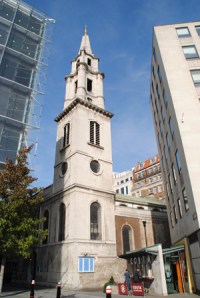 The name St Vedast is in itself unusual – St Vedast (known as St Vaast elsewhere) is said to have been the Bishop of Arras in northern France during the late fifth and early sixth centuries. How his name came to be associated with a church in London remains a matter of speculation but one plausible explanation is that the church was founded in the twelfth century by a small group of French merchants who had emigrated from Arras.
The ‘alias Foster’ part of the name is perhaps easier to explain although it has led to considerable confusion over the years. While some have in the past suggested the name refers to a different obscure saint – that is, the church is dedicated to St Vedast and St Foster – Foster is actually just an corrupted Anglicised version of Vedast.
But back to the church’s history. The medieval building was apparently replaced at the beginning of the sixteenth century and in the early 1600s this was enlarged and “beautified”. It escaped total destruction during the Great Fire of London but was badly enough damaged to require restoration and this was carried out, albeit not very well, so that in the late 1600s, Sir Christopher Wren was asked to rebuild it.
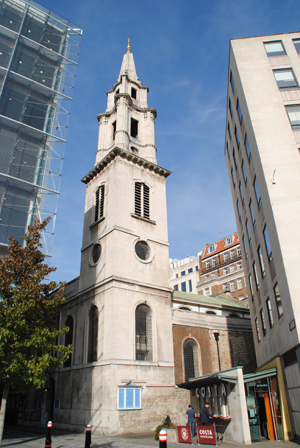
Given the demands of Wren’s time elsewhere, it’s not known if he personally designed the resulting church (the spire is possibly the work of Nicholas Hawksmoor), but the church was rebuilt and stood until 194o when the body of the building was ruined in the Blitz. The spire, however, survived and the restoration of the remainder of the church was completed in 1962.
It was also after World War II that the city parishes were reorganised and St Vedast-alias-Foster was united with three other former parishes – St Alban Wood Street, St Anne & St Agnes, St Lawrence Jewry, St Mary Aldermanbury, St Michael-le-Querne, St Matthew Friday Street, St Peter Chepe, St Olave Silver Street, St Michael Wood Street, St Mary Staining, St Mary Magdalene Milk Street, St John Zachary, and St Michael Bassishaw, of which only the buildings of St Lawrence Jewry and St Anne and St Agnes remain along with the tower of St Alban Wood Street).
Although the bulk of the building of St Vedast-alias-Foster is modern, the church does retain its seventeenth century Great West Doors and the font also comes from that century, having been designed by Wren and carved by Grinling Gibbons for the church of St Anne and St Agnes. The reredos which stands behind the altar, meanwhile, is inscribed with the Ten Commandments, the Lord’s Prayer and The Creed, and originally stood in St Christopher-le-Stock Parish Church in Threadneedle Street. Other features to come from other churches include the seventeenth century pulpit (All Hallows, Bread Street) and swordrest (St Anne and St Agnes).
The church’s Fountain Courtyard features part of a Roman floor found under St Matthew Friday Street and a stone (actually baked brick) upon which is inscribed cuneiform writing. The latter, which comes from a Zigurrat in modern Iraq built in the 9th century BC, was presented to Canon Mortlock, rector of the church, marking his work with novelist Agatha Christie and her husband, archaeologist Sir Max Mallowan and was found during his 1950-65 dig on the site. The lump of stone bears the name of Shalmaneser who reigned from 858 to 834 BC.
Famous figures associated with the church include John Browne, sergeant painter to King Henry VIII, Sir Thomas More, Lord Chancellor of King Henry VIII who was born in nearby Milk Street, and Thomas Rotherham, rector of the church from from 1463-48 and later Archbishop of York and Lord Chancellor of King Edward IV.
WHERE: 4 Foster Lane (nearest Tube station is St Paul’s). WHEN: 8am to 5.30pm weekdays/11am to 4pm Saturday (Mass is held between 12.15 and 12.45 weekdays and a sung Eucharist at 11am on Sundays) ; COST: Free but a donation of at least £1 per head is asked; WEBSITE: www.vedast.org.uk.

 Exploring London