10 historic vessels in London’s Thames…10. The ‘Knocker White’…

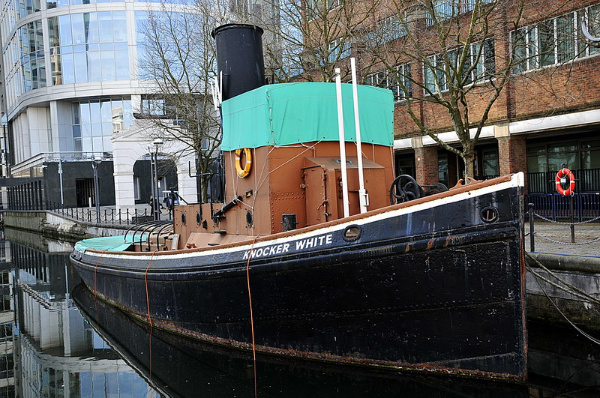
The ‘Knocker White’ in 2013. PICTURE: martin_vmorris (licensed under CC BY-SA 2.0)

A Dutch-built tugboat, the Knocker White (originally called the steam tug Cairnrock) was built in 1924 by T Van Duijvendijk’s yard at Lekkerkek near Rotterdam, Netherlands for Harrisons (London) Lighterage Ltd.

Following the installation of a steam engine and boiler at Great Yarmouth, the steel-hulled Cairnrock – which was designed for general towage work and featured a drop-down funnel for travelling under bridges – was initially used to Tow the Harrisons’ floating steam-powered coal elevator Wotan around the lower reaches of the Thames. 

In 1960, the 77 foot long tug was sold and passed through the hands of a couple of different owners and ended up, by 1962, in the hands of WE White and Sons. It was during this time that its name was changed (after a White family nickname), marine diesel engines installed and the steam engines and boilers removed.

The Knocker White continued in service, operating out of the WE White & Sons base at Hope Wharf in Rotherhithe, working on the Thames and the Solent until 1982.

In November of that year, it was sold for scrap to Todd (Breakers) Ltd of Dartford but, after being drawn to the attention of the Museum of London, was acquired by them in March 1985 as a classic example of an early tall-funnelled Thames steam tug.

In November, 2016, the Knocker White – along with the Varlet – was acquired by Trinity Buoy Wharf with the aim of restoring the vessel and putting on public display. It can be seen moored at the wharf today.
Treasures of London – Lighthouse at Trinity Buoy Wharf…

trinity-buoy-wharf-lighthouse

September is the month of ‘Totally Thames’, London’s celebration of its mighty river, so we thought it only fitting that we look at one of the city’s riverside treasures.

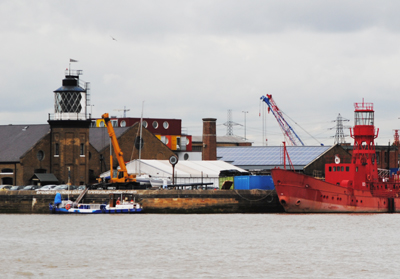
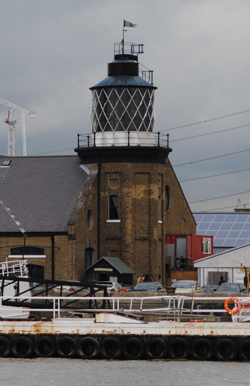
Located to the east of the City at Trinity Buoy Wharf on the north bank of the Thames can be found London’s only lighthouse (pictured left). No longer operational, it was built between 1864-66 for what became known as the Corporation of Trinity House, an association of shipmen and mariners.

trinity-wharf-lighthouseGranted its charter by King Henry VIII in 1514, in 1573 it was given the authority to erect and maintain beacons, mark and signs to help sea navigation. It’s since been the provider of buoys, lighthouses and lightships and, while headquartered at Trinity House in the City of London, established Trinity Bouy Wharf, located at the confluence of the Bow and Thames Rivers, as its Thames-side workshop in 1803.

The wharf was originally used to make and store wooden buoys and sea marks and as a mooring site for the Trinity House yacht which laid and collected buoys.

The lighthouse is the second on the site – the first was built in 1854 by the then chief engineer of Trinity House James Walker. The second, existing, lighthouse was built James Douglass – Walker’s successor – and as an “experimental lighthouse” was used for testing equipment and training lighthouse keepers.

The wharf, meanwhile, continued to be used until 1988 when it was purchased by the London Docklands Development Corporation and the site is now leased to Urban Space Management who have developed it as a centre for art and cultural activities. The area around the wharf also now features two prototype “cities” made out of shipping containers.