10 atmospheric ruins in London – 6. Tudor and medieval remains at Eltham Palace…

Once a medieval royal palace, Eltham Palace in London’s east was transformed into a 1930s house which incorporates the medieval great hall.

Tudor ruins in the garden of Eltham Palace (with the home behind). PICTURE: Peter Gasston (licensed under CC BY-NC-ND 2.0)

But there are also some other remains of the former medieval palace on the site – including the footings of the palace’s west range incorporating royal apartments used in the Tudor era.

These included separate apartments for the king and queen as well as a gallery where the king could walk in inclement weather.

The ruins feature diamond-patterned brickwork (pictured), part of the west range which was built during the reign of Queen Elizabeth I in the 1580s.

There are also the remains of a tower of yellow brick, which possibly dates from the 14th century when, prior to the site being a royal palace, it was rebuilt as a manor house by Anthony Bek, Bishop of Durham (it was Bek who gave the manor to the future Edward II in 1305).

These days the ruins lie within the home’s magnificent gardens, recreated to show how they might hav. Alongside the remains of the west range (and the medieval great hall which dates from the reign of King Edward IV and is largely intact), are the remains of a late 15th century bridge over a medieval moat, at the south end of which are the remains of a gatehouse.

There’s also an oak pedestrian bridge, supported by medieval brick and foundations which once formed part of the main southern entrance to the palace.

WHERE: Eltham Palace, Court Yard, Eltham, Greenwich (nearest train station is Mottingham); WHEN: 10am to 4pm Wednesday to Sunday; COST (advance online tickets): £14.50 adults/£8.60 children/£12.70 concessions/£37.60 family (can include a donation/English Heritage members free); WEBSITE: www.english-heritage.org.uk/visit/places/eltham-palace-and-gardens/.
Famous Londoners – William Baldwin…

An English author who originally hailed from the west of England (possibly Wales), William Baldwin wrote and published a number of works in the mid-1500s while living in London and has been credited, thanks to his satirical work, Beware the Cat, as being the author of the first English novel.

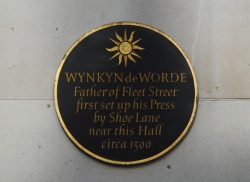
Baldwin is believed to have studied at Oxford prior to coming to London where, from 1547, he worked with the printer Edward Whitchurch – who had apparently set up shop at Wynkyn de Worde’s former printworks at the Sign of the Sun (now at the Stationer’s Hall, just off Ludgate Hill – pictured) – as a corrector.

Whitchurch also published Baldwin’s works including the popular Treatise of Moral Philosophy (1547) and Canticles or Balades of Salomon (1549), which was dedicated to a young King Edward VI and was a translation of the Biblical book, Song of Songs.

His other works included being the editor and key contributor to the hugely popular and influential Mirror for Magistrates (1554) which was something of a cautionary tale for public officials, and the Marvelous History Entitled Beware the Cat, Concerning Diverse Wonderful and Incredible Matters (aka Beware the Cat).

The latter book, which is an attack on Catholicism, tells the story of a priest who uses alchemy to talk to cats and finds that, despite his low opinion of them, they actually live according to strict rules (reflecting on the arbitrary nature of the “rules” which govern everyday life).

While Baldwin is believed to have finished the work during the last months of the reign of King Edward VI (he died on 6th July, 1553), the subsequent accession of Queen Mary I and her tougher line on the press freedoms led Baldwin to postpone publication until 1561 by which time Queen Elizabeth I was on the throne.

Around the same time as he completed this work, Baldwin is said to have assisted the Royal Master of Revels, George Ferrers, in preparing Christmas festivities at the Royal Court – this was an occasional role he would perform beside his work with Whitchurch.

Baldwin’s last known work was The Funerals of King Edward the Sixth (1560). In 1563, he is believed to have been ordained a deacon and stepped away from the printing trade. He served in various clerical roles (there is an account of him preaching at Paul’s Cross) before dying some time prior to 1st November, 1563.

(With thanks to John N King’s 2004 article in the Oxford Dictionary of National Biography).