This Week in London – Photographers honoured with Blue Plaques; David Hockney meets Piero dell Francesca; and ‘Taylor on Strings’ at Wembley Park…

Two pioneering photographers are being commemorated with English Heritage Blue Plaques today. Christina Broom (1862-1939) is believed to have been Britain’s first female press photographer while John Thomson (1837-1921) was a ground-breaking photo-journalist working at the advent of the medium. Broom’s plaque – the first to be located in Fulham – is being placed on 92 Munster Road, a terraced house of 1896, where she lived and worked for 26 years. Thomson’s plaque, meanwhile, will be located at what is now 15 Effra Road in Brixton where he and his family were living when one of his best-known and influential works, Street Life in London (1877-8), was published. For more, see www.english-heritage.org.uk/visit/blue-plaques/.
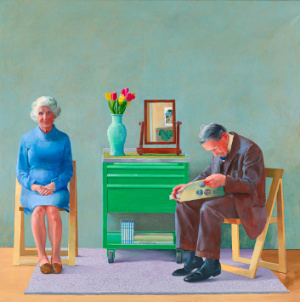
My Parents’ (1977), David Hockney/© David Hockney. Photo: Tate, London

Two of David Hockney’s key works – My Parents (1977) and Looking at Pictures on a Screen (1977) – which feature reproductions of 15th-century Italian painter Piero della Francesca’s The Baptism of Christ (probably about 1437–45) have gone on display alongside the Renaissance work at The National Gallery. Hockney and Piero: A Longer Look explores Hockney’s “lifelong association” with the National Gallery and its collections, particularly in the works of Piero della Francesca (1415/20–1492). Hockney once confessed that he would love to have The Baptism of Christ so he could look at it for an hour each day. My Parents features a reproduction of Piero’s work shown reflected in a mirror on a trolley behind the sitters while Looking at Pictures on a Screen depicts Hockney’s friend Henry Geldzahler, the Belgian-born American curator of 20th-century art at The Metropolitan Museum of Art in New York, peering at a folding screen in the artist’s studio on which are stuck four posters of National Gallery pictures including The Baptism of Christ. The display in Room 46 is free. Runs until 27th October. For more, see www.nationalgallery.org.uk.
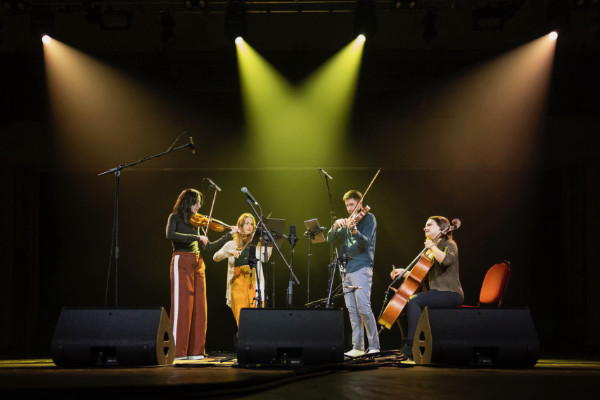
The City String Ensemble. PICTURE: Catherine Frawley

Experience a prelude of Taylor Swift at Wembley Park with with City String Ensemble playing more than a dozen interpretations of Taylor Swift songs. The free open air concert comes ahead of Swift’s return to Wembley Stadium later this month. ‘Taylor on Strings’ will be held at the Sound Shell from 6:30pm on 13th August. Tickets are free but must be booked with 30 released at 10am each day in the lead-up to the concert. For more, head to wembleypark.com/taylor-on-strings.

Send all items for inclusion to exploringlondon@gmail.com
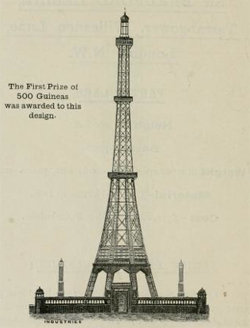
8 structures from the London that never was – 2. Watkin’s Tower…

Designed as London’s response to the Eiffel Tower, Watkin’s Tower was the brainchild of railway entrepreneur and MP Sir Edward Watkin.

Watkin's-TowerFollowing the opening of the Eiffel Tower in 1889, Watkin wanted to go one better in London and build a tower than surpassed its 1,063 feet (324 metres) height.

He apparently first approached Gustave Eiffel himself to design the tower which was to be located as the centrepiece for a pleasure park development at Wembley Park in London’s north (which, incidentally, would be reached by one of Sir Edward’s railway lines – he opened Wembley Park station to service it). But Eiffel declined the offer and Watkin subsequently launched an architectural design competition.

Among the 68 designs received from as far afield as the US and Australia were a cone-shaped tower with a railway spiralling up its exterior, a Gothic-style tower (also with a railway), a tower topped with a 1/12 scale replica of the Great Pyramid, one modelled on the spire of Bow Church in Cheapside and one topped by a giant globe (you can see the catalogue of all entries here).

The winning entry was submitted by Stewart, MacLaren and Dunn who proposed a steel eight legged tower soaring 1,200 feet (366 metres) into the sky. To be lit with electric lighting at night, it came with two observation decks with restaurants, theatres and exhibition space as well as winter gardens, Turkish baths, shops, promenades and a 90 room hotel as well as an astronomical observatory. The top of the tower would be reached by a series of elevators.

The first stage of the project – formally known as London Tower or the Wembley Park Tower – had still not been completed when Wembley Park opened in May, 1894 – standing 154 feet (47 metres tall), it was finally finished in September the following year.

It was to never rise higher. The project become mired in problems – Watkin retired through ill health (and died in 1901), the structure started to subside and the construction company went into liquidation. Dubbed Watkin’s Folly and the London Stump, what there was of the tower was eventually demolished between 1904-1907.

While the dream of the tower never came to be, the site nonetheless became a popular vehicle for recreation and the site was later used for the 1924 British Empire Exhibition with Wembley Stadium built over the spot where the tower had once stood.